

The decision to start a business has been getting more common, not less. More than 5.9 million new businesses were formed in the United States in 2025, an 8% jump over 2024, and every single month outpaced its 2024 counterpart. That is not the shape of a wavering market. That is the shape of a country where the calculus of being one's own boss has shifted in a durable way, and the startup trends driving 2026 sit on top of that base.
What the trends look like at a high level: AI is the dominant theme, sustainability and wellness are pulling capital, side-hustle operators are formalizing into LLCs at a pace nobody predicted three years ago, and remote-first models are still expanding the geography of where new businesses are getting started. The opportunity in 2026 is real, but the gap between an opportunity and a registered business is the work that most aspiring founders underestimate.

Key Takeaways
-
New business formation remains historically strong heading into 2026, with millions of new applications and a sharp rise in entrepreneurial intent across Gen Z and Millennials.
-
AI-native, sustainability-focused, health and wellness, e-learning, and remote-first models are the standout startup trends for 2026, combining lower overhead with strong, durable demand.
-
The cost to start a business is often lower than aspiring founders assume, especially for digital-first ideas, making entity formation, licensing, and foundational systems realistic early investments.
-
Choosing the right structure—often an LLC for most first-time founders, or a C corporation for venture-backed growth—directly affects liability, taxation, fundraising options, and how easily the business can scale.
-
Formalizing a side hustle into a registered entity, appointing a registered agent, and securing an EIN and business bank account are key steps that turn a promising trend into a legally ready, scalable business in 2026.
Why 2026 Is a Pivotal Year for New Business Formation
The data behind the entrepreneurship surge is straightforward: more people are starting businesses, more often, and earlier in their careers. According to QuickBooks research, roughly one in three U.S. adults plan to start a new business or side hustle within the next 12 months, a 94% jump from the year prior. The drivers are familiar to anyone watching the labor market. A tighter, less predictable job environment is pushing more workers toward self-employment. Business Formation Statistics from the Census Bureau show new business applications continuing at a historically elevated pace, with February 2026 alone reaching 496,443 applications, adjusted for seasonal variation. The cost-to-launch curve has dropped sharply for digital-first ideas thanks to AI tooling. Entrepreneurship is not just rising in volume. It is rising across demographics that did not historically self-identify as founders.
The friction point shows up at the cost question. Roughly 47% of aspiring founders cite startup costs as the biggest barrier to launching, and Americans estimate they need about $28,000 to start a business. However, QuickBooks data put the median actual cost closer to $12,000. The gap between perception and reality is wide enough that some founders never even start. For those who do, the early dollars increasingly go to systems and tools rather than rent and inventory.
Generational Shifts in Entrepreneurship
Gen Z leads in entrepreneurial intent, with about 43% planning to start a business in the near term, while Millennials feel the most urgency at roughly 74%. Younger founders are more likely to launch digital-first or AI-native ventures, which tend to have lower overhead and faster paths to revenue. That shift is also diversifying what gets formed: more service businesses, more solo-operator content businesses, more software studios. The composite small business owner of 2026 looks meaningfully different from the composite small business owner of 2016.
The Side Hustle-to-Business Pipeline
About 47% of Americans earned money from a side hustle in the past year, but only one in five formalized that work as a registered entity. Owners stepping from "earning on the side" into "running a business" often find that the paperwork, registered agent designation, and ongoing compliance feel like a tax on the upside before any real revenue has come in. For the wider story behind that generational shift, the InCorp guide on the LLC generation of modern entrepreneurs walks through how solo founders are choosing structure earlier than before.
Top Startup Trends Shaping 2026
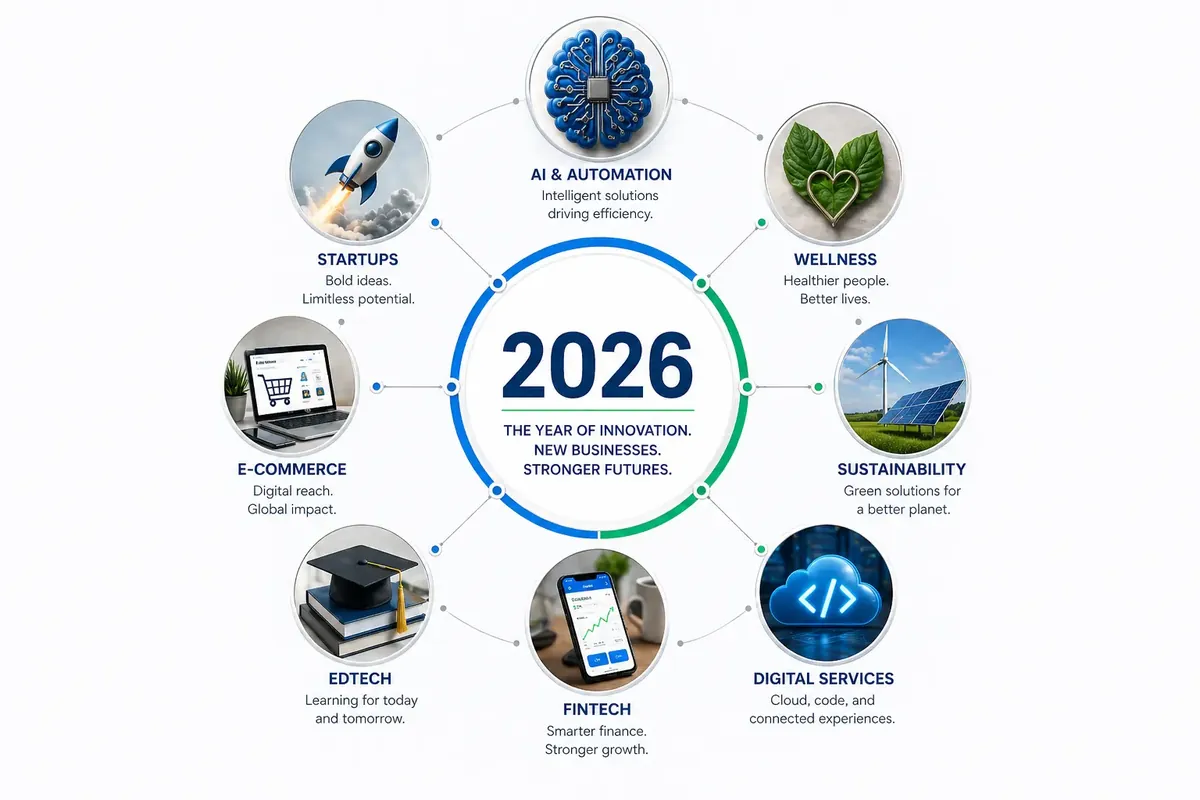
The 2026 startup trends fall into a handful of categories that are attracting capital, founder attention, and customer demand—these new business ideas for 2026 range from AI-native ventures to sustainability-focused services. The list below is not exhaustive, but it covers where the most interesting entrepreneurship activity has been concentrated.
AI-Powered and AI-Native Businesses
Artificial intelligence is the dominant theme of the 2026 startup year. More than 60% of aspiring entrepreneurs say they plan to use AI to help launch their ventures, and AI-focused startups are pulling roughly 40% of total venture capital with seed-stage valuations at record highs. Startup funding in artificial intelligence has concentrated across multiple sub-categories: AI consulting, AI-enhanced SaaS, workflow automation, content tooling, and customer-service layers all sit inside this group. Even non-tech businesses are leaning on artificial intelligence for operations, finance, and customer support.
Sustainability and Green Business
Founders treating environmental impact as a business driver, rather than a cost center, are running some of the more capital-efficient ventures of 2026. Renewable energy projects saw roughly a 35% annual increase in startup funding, and circular-economy business models are gaining real traction. Sustainable packaging, clean energy consulting, carbon offset services, and eco-friendly consumer goods are among the most common categories new entrepreneurs are taking on.
Health, Wellness, and Elderly Care
Personalized health and wellness services are one of the fastest-expanding sectors for new businesses. U.S. digital health firms raised over $10 billion in the past year, with about 37% of that funding directed at AI-focused health ventures. The category includes telehealth platforms, wellness coaching, senior care services, and mental health support businesses, with the demographics of an aging U.S. population pushing demand even higher.
E-Learning and Digital Services
Demand for online education and digital services has held up as remote work and digital-first delivery have become the default rather than the exception. Online courses, digital marketing agencies, virtual assistant services, and subscription content businesses are the most common formats. The low overhead and high scalability of these models make them an accessible entry point for first-time founders.
Remote-First and Distributed Business Models
Roughly 22% of the U.S. workforce now works remotely, which is enough volume to support a whole ecosystem of tools and services for distributed teams. Remote-first businesses also benefit from lower overhead and access to a broader talent pool. One operational caveat: forming an LLC in one state while serving customers or employing people across multiple states often triggers a foreign qualification requirement, which means maintaining a registered agent in every state where the business is qualified to operate.
How to Turn a Trend into a Registered Business
Spotting a trend is the easier half. The harder half is converting the idea into a registered company with a name, a legal structure, and the right paperwork on file. Five steps cover the typical path from idea to entity.
Validate the Business Idea
Before any formation paperwork goes out, the underlying idea needs a real-world stress test. Talk to potential customers, double-check pricing against what competitors charge, and put together a basic business plan that captures who the business serves, what it sells, and how it makes money. Local and state licensing requirements should also get a look at this stage, since some businesses (food, professional services, regulated trades) cannot legally start operating without specific approvals. For more on the licensing categories most often missed at this step, the InCorp guide on business licensing walks through the state-specific requirements.
Choose a Business Name
The chosen name has to be distinguishable from existing registered entities in the state of formation. Most state Secretary of State offices run a free name-availability search, and a formation service can run the same check across multiple states if the business is planning to operate in more than one. The name decision also affects the domain, trademark, and brand work that comes next, so it is worth confirming availability before any of that gets ordered.
File Formation Documents
LLC formation begins with filing articles of organization with the state. Corporations file articles of incorporation. Either set of documents goes to the same Secretary of State office and triggers the creation of the entity. The exact information required varies by state, but it generally includes the entity name, principal business address, registered agent details, and the names of the initial members or directors.
Appoint a Registered Agent
Every LLC and corporation has to designate a registered agent in the state of formation. The agent receives service of process, state notices, and tax correspondence on the entity's behalf, and the appointment is a precondition for the state accepting the filing. Many founders use a third-party service rather than naming themselves, since the agent's name and address become part of the public record, and physical availability during business hours is required.
Obtain an EIN and Open a Business Bank Account
A federal Employer Identification Number from the IRS is what unlocks tax filings, payroll, and most business bank accounts. Opening a separate business account is also what preserves the LLC or corporation's liability protection, since commingled finances are the most common way a new small business owner accidentally pierces their own corporate shield. For the federal tax classification options that come with the structure, the IRS guidance on LLCs covers the default treatment and the elections available to LLCs.
Choosing the Right Entity Structure for Your Startup
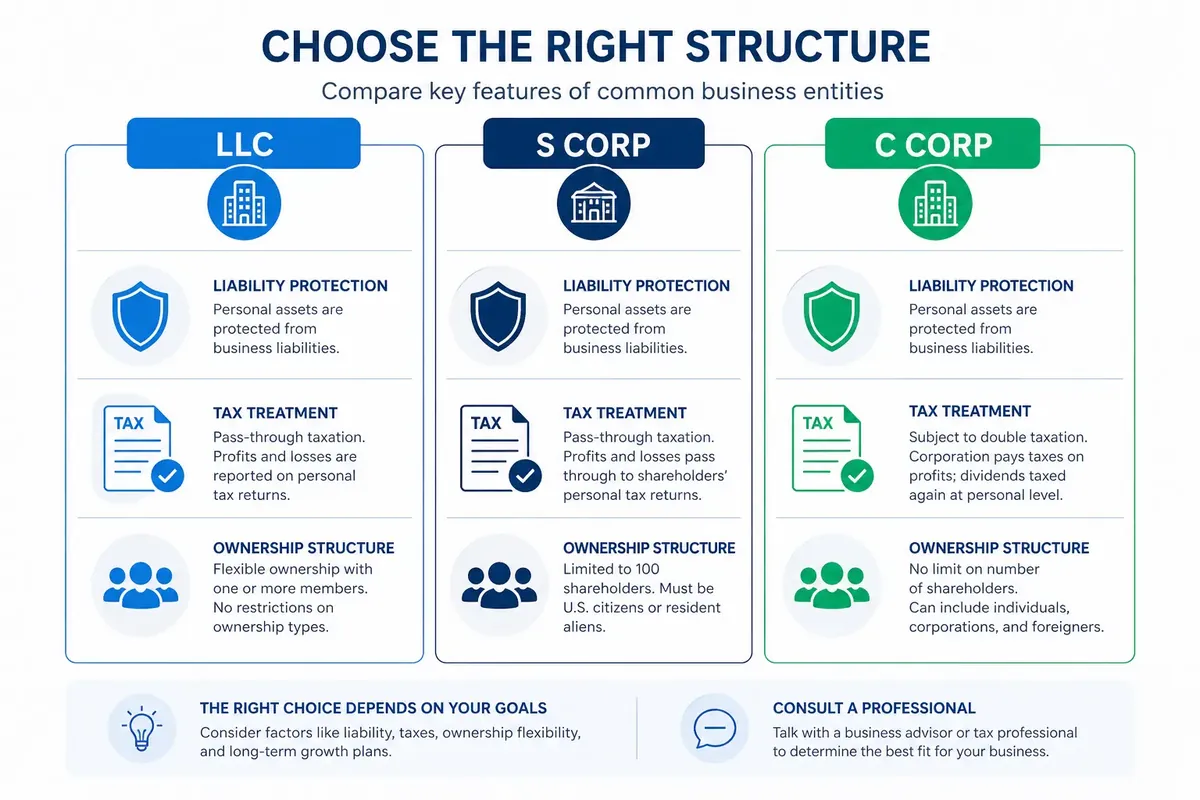
The entity structure a founder picks affects liability, taxation, fundraising, and how the business will scale later. The three options most new founders compare are the LLC, the C corporation, and the S corporation.
Limited Liability Company (LLC)
LLC formation is the most popular entity choice for new businesses by a wide margin: roughly 85% of all new business entity formations in the United States are LLCs. The structure provides personal liability protection, defaults to pass-through taxation (income flows through to the owners' personal returns), and keeps the management overhead low compared to a corporation. Single-member LLCs are an especially natural fit for solo founders and side-hustle operators stepping into formal business mode. For more on the trade-offs behind that choice, the InCorp guide on the benefits of forming an LLC walks through the comparison in plain language.
Corporation (C Corp and S Corp)
C corporations are the most common structure for startups planning to raise venture capital, since they allow multiple classes of stock and accommodate the equity instruments investors expect. S corporations offer pass-through taxation similar to an LLC, but cap the number of shareholders at 100 and limit the entity to one class of stock. Both structures carry more formalities than an LLC, with a board of directors, bylaws, and annual meetings. For founders weighing C-corp vs. S-corp vs. LLC, the SBA guide to choosing a business structure lays out the trade-offs across each option.
Comparing Entity Types
The right entity structure usually comes down to four questions: how much personal liability the founder wants to absorb, how the business should be taxed, how many owners or investors there will be, and whether the plan involves raising outside capital. Founders unsure where to land can run their specifics through the InCorp entity-comparison tool for a side-by-side breakdown of the options.
Launch Your 2026 Startup with InCorp
The startup landscape in 2026 is being shaped by record levels of new business applications, AI-driven innovation, and a growing pipeline of side-hustle operators ready to formalize. Spotting the right trend matters. So does the legal foundation that turns a trend into a registered company prepared to take on customers, hire, and grow.
The InCorp LLC formation service handles entity registration, registered agent designation, and ongoing compliance tracking through the EntityWatch® system in all 50 states, preventing formation work from becoming the bottleneck on day one. From single-member LLCs to C corporations and everything in between, InCorp helps a new small business owner get the structure right before the operations get busy.
FAQs
Is 2026 a good year to start a business?
Data points to yes. More than 5.9 million new businesses were formed in 2025, and one in three U.S. adults plan to start a new business or side hustle in the next 12 months. AI tools, lower digital startup costs, and demand in health, wellness, and sustainability are the main drivers. Prospective founders should still evaluate their market, finances, and business plan before launching.
What is the most popular business structure for startups?
The LLC is the most common entity type, representing about 85% of new business entity formations in the United States. LLCs offer personal liability protection, pass-through taxation, and flexible management. Startups planning to raise venture capital often choose a C corporation instead, since the structure allows multiple classes of stock and aligns with what most institutional investors expect.
How much does it cost to start a business in 2026?
Costs vary widely by business type. Americans estimate they need about $28,000 to start, though QuickBooks data put the median actual cost at around $12,000. State filing fees for LLC formation range from roughly $35 to $500, with additional costs for registered agent services, business licensing, and early operating expenses.
What industries are growing fastest for startups in 2026?
The fastest-growing categories include AI-powered services, sustainability and clean energy, health and wellness, e-learning and digital services, and elderly care. AI startups are pulling the largest share of venture capital, while service-based and digital-first models offer the lowest barriers to entry for first-time founders.
Do I need to form an LLC to start a business?
No, an LLC is not legally required. Operating as a sole proprietorship is legal, but it leaves personal assets exposed to business liabilities. Forming an LLC or corporation separates personal and business assets, offers tax flexibility, and adds credibility with customers, vendors, and banks.
How are AI tools changing the way 2026 founders handle formation and early operations?
In 2026, AI and no-code tools let first-time founders validate ideas, build basic products, and automate early marketing with far less capital than in prior cycles. Many entrepreneurs now use AI to research markets, draft business plans, and even compare entity-type pros and cons before they meet with an attorney or CPA, but final decisions about structure, tax treatment, and multi-state compliance should still be confirmed with qualified professionals because rules and best choices vary by situation.
Why are so many 2026 startups forming LLCs instead of staying informal side hustles?
With more people earning income from digital services, content, and remote-first work, the line between “side hustle” and “business” is much thinner than it was a decade ago. Many of those founders are choosing LLCs earlier because they want personal liability protection, cleaner separation of business finances, and the ability to work with larger clients, while still keeping management and tax treatment relatively simple compared to a corporation.
How do 2026 trends like sustainability and wellness affect a founder’s compliance checklist?
Startups in sustainability, wellness, and elder care often face an extra layer of licensing, consumer-protection, or health-related rules on top of the usual formation and tax requirements. Founders in these sectors need to look beyond entity choice and ensure their marketing, data handling, and day-to-day operations align with industry-specific regulations, which can differ significantly by state and by type of service offered.
What should remote-first 2026 startups know about operating in multiple states?
Remote-first models let founders hire and serve customers from almost anywhere, but they can also create multi-state obligations faster than expected. When a startup formed in one state has employees, contractors, or regular business activities in other states, it may need to register as a foreign entity and appoint a registered agent in each of those states, so founders should monitor where work is actually being done and get advice on when registration is required.
How do capital-light, AI-native businesses think about structure differently from traditional startups?
AI-native and other capital-light startups often start with small teams, low overhead, and a focus on rapid iteration, which can make simple structures like single-member or small multi-member LLCs attractive in the early stages. As those companies grow, add co-founders, or seek outside investment, they have to revisit the initial structure and decide whether staying in an LLC, electing S-Corp treatment, or converting to a C corporation better fits their funding, equity, and long-term scaling plans.
Disclaimer: This content is intended for general educational and informational purposes only and does not constitute legal, tax, or accounting advice. Every effort is made to keep the information current and accurate; however, laws, regulations, and guidance can change, and no representation or warranty is given that the content is complete, up to date, or suitable for any particular situation. You should not rely on this material as a substitute for advice from a qualified professional who can consider your specific facts and objectives before you make decisions or take action.