

A software company discovered that a competitor had copied significant portions of their proprietary code. When they attempted to file an infringement lawsuit, they learned that without Copyright Registration, they couldn't pursue statutory damages or attorney's fees. The delay in registering cost them both legal leverage and months of additional expense preparing their case.
Copyright Registration is the formal process of recording creative works with the U.S. Copyright Office, providing intellectual property protection and legal advantages. While the U.S. Copyright Office hasn't yet published a full 2025-2026 annual registration count, recent data from the Office confirm that its public dataset now includes approximately 22 million copyright records through June 27, 2025, reflecting decades of registrations and the continued scale of filings.
Understanding the registration process and eligible work types helps businesses protect their creative assets effectively. What is a copyright explains foundational concepts for business owners.

Key Takeaways
-
Copyright protection exists automatically when creative works are fixed in a tangible form, but formal registration with the U.S. Copyright Office dramatically strengthens enforcement options.
-
A registration certificate creates a public record and prima facie evidence of ownership, giving businesses stronger leverage in infringement disputes and negotiations.
-
Timely registration (before infringement or within three months of first publication) preserves eligibility for statutory damages and attorney’s fees, which are often critical to making enforcement economically viable.
-
A wide range of business assets can be registered, including literary works, visual art, software code, music, and digital content, allowing companies to protect core creative and technical IP.
-
Electronic filing through the Copyright Office’s online system is typically the most efficient, cost‑effective way for businesses to submit applications, deposits, and fees for registration.
What Is Copyright Registration?
Copyright registration is the formal process of recording creative works with the U.S. Copyright Office to create official government records. Registration provides legal evidence of copyright law claims, making works part of public searchable databases. Authors Alliance explains that registration offers significant advantages despite automatic copyright protection.
The copyright certificate issued upon successful registration serves as prima facie evidence of copyright validity in legal proceedings. Courts presume facts stated in certificates are accurate when registrations occur within five years of publication. This evidentiary presumption strengthens legal rights for creators during infringement disputes.
The copyright filing process creates permanent records accessible through the Copyright Office search systems. Public recordation establishes ownership claims and publication dates, deterring potential infringers who can verify existing registrations before using works.
Types of Works Eligible for Copyright Registration
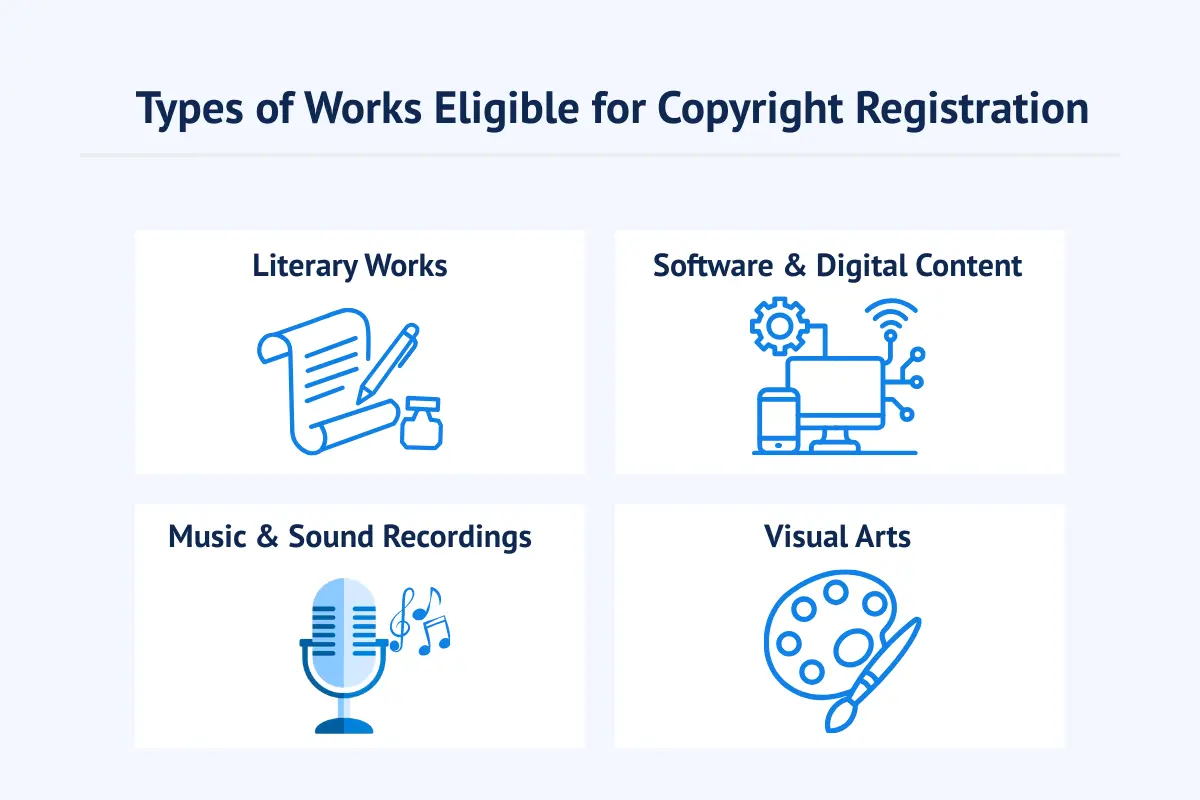
Copyright law protects original works of authorship fixed in tangible expression mediums. Registration eligibility spans multiple creative categories, each with distinct characteristics and business applications. Creative work protection requirements focus on originality rather than artistic merit.
Works must demonstrate minimal creativity and exist in fixed forms to qualify for registration. Ideas, facts, and functional elements receive no protection. Protecting business content requires understanding which creative expressions qualify for copyright coverage.
Literary Works
Literary works include written content expressed through words, numbers, or symbols. Business-relevant examples include website copy, marketing materials, training manuals, software documentation, and business correspondence. Content creators benefit from understanding the protections for literary works.
Both published and unpublished literary works qualify for registration. Businesses can register draft materials, internal documents, and finalized publications. Registration timing flexibility allows protecting works at various development stages.
Digital content copyright extends to electronic documents, blog posts, social media content, and online articles. Form and format don't affect eligibility as long as works contain sufficient original expression.
Visual Arts
Visual arts encompass two-dimensional and three-dimensional works, including photographs, illustrations, graphics, sculptures, and architectural designs. Business applications include company logos, marketing graphics, product packaging designs, and branded visual elements.
Creative work protection for the visual arts covers artistic expression rather than functional aspects. Logos receive copyright protection for artistic elements while trademark law protects brand identity functions. Businesses often pursue both protections for branded visuals.
Digital illustrations, infographics, and website design elements qualify as visual arts. Original arrangement and creative expression determine protectability, not production methods or media types.
Music and Sound Recordings
Musical works include compositions expressed through notes, lyrics, and arrangements. Sound recordings capture specific performances or productions of musical works. Copyright treats compositions and recordings as separate works requiring individual registrations.
Businesses that use original music in marketing, training videos, or customer experiences can register both the underlying compositions and the recorded performances. Copyright application requirements differ slightly between musical works and sound recordings.
Background music created for business purposes, jingles, and branded audio elements all qualify for registration. Protection extends to original musical expressions, regardless of whether they serve commercial or artistic purposes.
Software and Digital Content
Computer programs, applications, websites, and databases qualify for digital content copyright protection. Copyright covers original code expression, user interfaces, and creative database organization. Functional aspects and underlying processes are not subject to copyright protection.
Software registration protects source code, object code, and screen displays demonstrating original creative expression. Businesses can register proprietary applications, custom tools, and specialized software solutions they develop.
Copyright application requirements for software include depositing representative portions of code. Certified copies and proper documentation ensure accurate registration. Complete source code disclosure is not mandatory. Registration focuses on demonstrating original programming expression.
Related protections, such as patents for intellectual property, cover functional innovations, while copyright protects creative expression.
The Copyright Registration Process
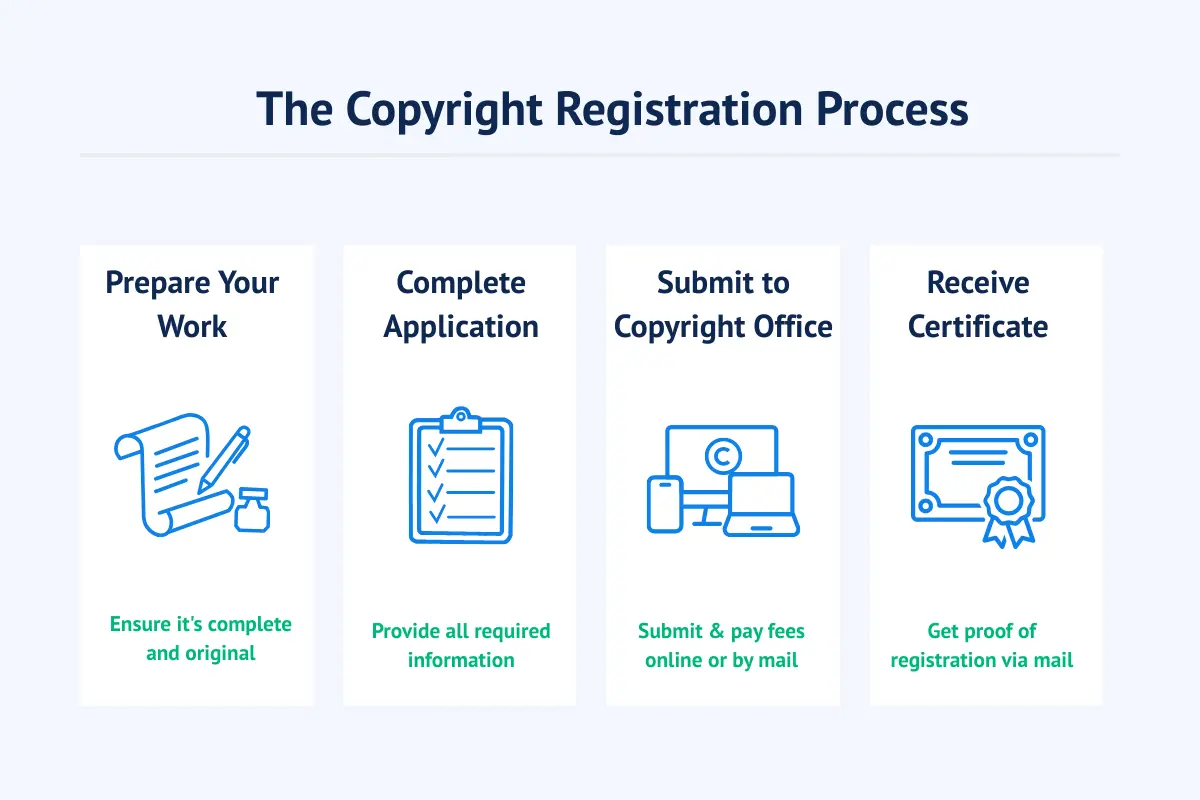
The copyright filing process involves submitting applications, providing required information, paying fees, and depositing work copies. Electronic submissions through the Copyright Office's online system offer faster processing than paper applications. How to register a copyright for a business requires understanding procedural steps.
Registration timelines vary depending on the submission method and the Copyright Office's workload. Filing copyright registration online through the eCO (Electronic Copyright Office) system provides the most efficient registration path. Digital submissions reduce processing times and filing costs.
Application Submission
The copyright registration process for LLCs and other businesses typically uses online submission systems. The eCO platform accepts applications for most work types, including literary works, visual arts, music, and software. Standard applications accommodate single works, while specialized group registration options exist for collections.
Paper applications remain available but are processed more slowly and cost more than electronic filings. Most businesses benefit from the efficiency of online submission. The Copyright Office provides detailed tutorials for completing electronic applications.
Required Documentation
Copyright application requirements include applicant information, work titles, authorship details, and creation/publication dates. Applications must identify authors, copyright claimants, and work-for-hire status when applicable. Accurate information prevents processing delays.
Deposit copies accompany applications as evidence that the works are registered. Electronic works are typically uploaded as digital files. Published physical works may require mailing hard copies to the Copyright Office for deposit.
Work samples must adequately represent works being registered. Complete copies are preferred, though partial deposits suffice in certain circumstances. Deposit requirements vary by work type and publication status.
Fees and Processing Times
Standard electronic registration fees start at $65 for single works. Paper applications cost $125. Group registration options offer reduced per-work costs when registering multiple related works simultaneously. Fee schedules are subject to change.
Processing times range from several months to over a year, depending on the application type and the Copyright Office's capacity. The electronic submissions process is faster than paper filings. Expedited handling is available for additional fees when businesses need urgent registration.
How Long Does Registration Take?
Electronic registration applications typically take 3-10 months to process under normal circumstances. Paper submissions may take 8-15 months or longer. Copyright filing process timelines fluctuate based on Copyright Office staffing and application volumes.
Processing delays occasionally occur during high-volume periods or staffing changes. Applicants can check the status through the Copyright Office online systems. Registration effective dates are based on application receipt dates, regardless of when certificates are issued.
Expedited processing significantly reduces timelines for urgent situations such as pending litigation. Special handling fees apply, but we provide registration certificates within weeks rather than months. Most businesses use standard processing for routine registrations.
Is Registration Mandatory to Have Copyright Protection?
Copyright protection exists automatically when works are created and fixed in tangible form. Registration is not required for copyright protection for digital content or other works to enjoy basic legal protection. However, registration provides significant legal advantages, making it practically necessary for enforcement.
Forbes states that copyright enforcement requires registration before filing an infringement lawsuit in federal court. Domestic works need registration to access courts, creating a practical requirement despite automatic protection.
Benefits of copyright registration for companies include eligibility for statutory damages and attorney's fees. Without timely registration, copyright owners can recover only actual damages and infringer profits, which are difficult and expensive to establish. Statutory damages provide predictable remedies, making the enforcement of copyright infringement economically viable.
Registration within three months of publication, or before infringement begins, enables full access to remedies. Later registrations still allow lawsuits but limit available damages. Strategic registration timing maximizes protecting creative works legally as a business.
How InCorp Can Support Your Copyright Registration Needs
InCorp's copyright services help businesses streamline the copyright filing process by organizing documentation, preparing accurate applications, and tracking the status of submissions. Professional support reduces errors that cause processing delays or rejections.
How to register a copyright for a business becomes more efficient with experienced assistance. InCorp helps identify appropriate application types, gather the required information, and prepare deposit materials that meet Copyright Office standards. Systematic approaches ensure completeness before submission.
Filing coordination across multiple works or ongoing content creation benefits from professional management. Businesses that generate regular creative output can establish registration schedules to ensure timely protection. Contact InCorp to explore copyright registration support for your business.
FAQ's
Is copyright registration required to have copyright protection?
No. Copyright protection exists automatically when a work is created and fixed in a tangible form. Registration, however, provides additional legal benefits, such as eligibility to sue for infringement and potential statutory damages. Registration is practically necessary for enforcement, even though it is not required for basic protection.
How long does the copyright registration process take?
Processing times vary based on the submission type and the Copyright Office's workload. Online filings typically take 3-10 months, while paper submissions may take 8-15 months or longer. Expedited processing is available for additional fees when faster registration is needed.
Can InCorp help with copyright registration?
Yes. InCorp provides professional support to help businesses organize documentation, submit accurate applications, and track deadlines efficiently, streamlining the registration process. Professional assistance reduces errors and ensures proper application preparation.
How does copyright registration help if my business needs to sue for infringement?
When a work is registered, the registration certificate serves as prima facie evidence of copyright ownership and the facts stated in the certificate if registration occurs within five years of publication. Registration is also a legal prerequisite to filing most copyright infringement lawsuits in federal court and can unlock statutory damages and attorney's fees, which are often far greater than provable actual damages alone.
Why is registration especially important for small businesses and marketing content?
For many small businesses, original creative works—such as website copy, visual art, marketing content, and computer programs—are among their most valuable assets. Registering these key works turns them into legally recognized property that is easier to license, enforce against unauthorized use, and leverage in negotiations with partners, investors, or infringers.
What role does the public record play in protecting my creative works?
Once a work is registered, the Copyright Office maintains an official public record that lists the title, author, claimant, and other core details, making it clear who owns the rights. This public record helps potential licensees find the correct copyright owner and strengthens your position if ownership is challenged after infringement occurs.
How does copyright registration interact with trade secrets and other IP like patents or trademarks?
Copyright registration protects original expressive elements in works such as literary works, software code, visual art, and sound recordings, but it does not protect ideas, methods, or confidential business information. Trade secrets, patents, and trademarks cover different aspects of intellectual property, so businesses often combine copyright registration with patent and trademark strategies to protect both creative expression and functional innovations.
What should I do if I receive a cease and desist letter alleging my business used copyrighted materials without permission?
A cease and desist letter usually claims that your business has engaged in unauthorized use of copyrighted materials and may threaten legal action if you do not stop. Because fair use and other defenses are fact‑specific, small business owners should review the letter with an attorney experienced in copyright issues to assess risk, explore settlement options, and avoid escalating statutory damages and attorney's fees exposure if the other party's registered works are infringed.
Disclaimer: This content is intended for general educational and informational purposes only and does not constitute legal, tax, or accounting advice. Every effort is made to keep the information current and accurate; however, laws, regulations, and guidance can change, and no representation or warranty is given that the content is complete, up to date, or suitable for any particular situation. You should not rely on this material as a substitute for advice from a qualified professional who can consider your specific facts and objectives before you make decisions or take action.