

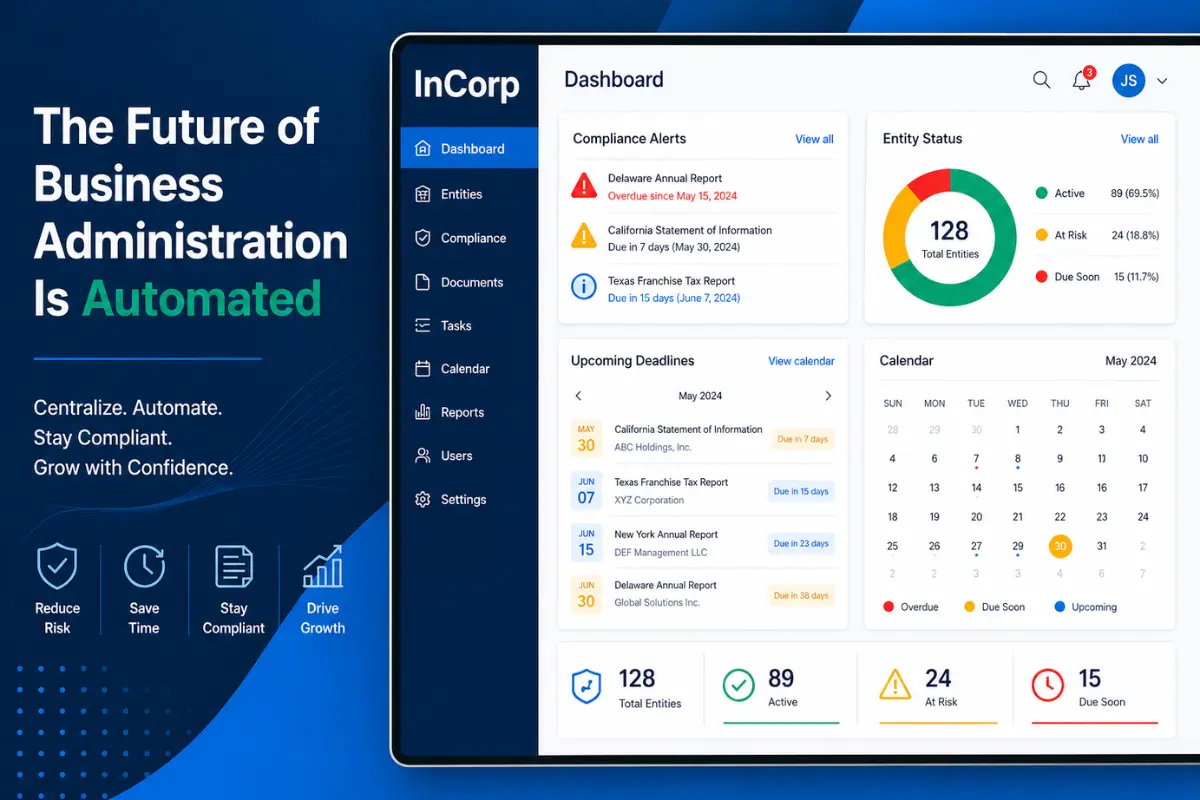
As businesses continue modernizing their operations in 2026, digital entity management platforms are replacing spreadsheets, paper records, and manual compliance tracking, signaling a broader shift toward automated business governance.
Few conversations about business modernization begin with corporate recordkeeping. But they probably should. For decades, the administrative infrastructure holding most businesses together was treated as overhead rather than strategy.
That assumption is shifting, and the companies moving fastest are recognizing that how they manage governance, compliance, and corporate structure is becoming a core part of how modern organizations maintain stability as they grow more complex.
The Hidden Administrative Burden of Running a Business
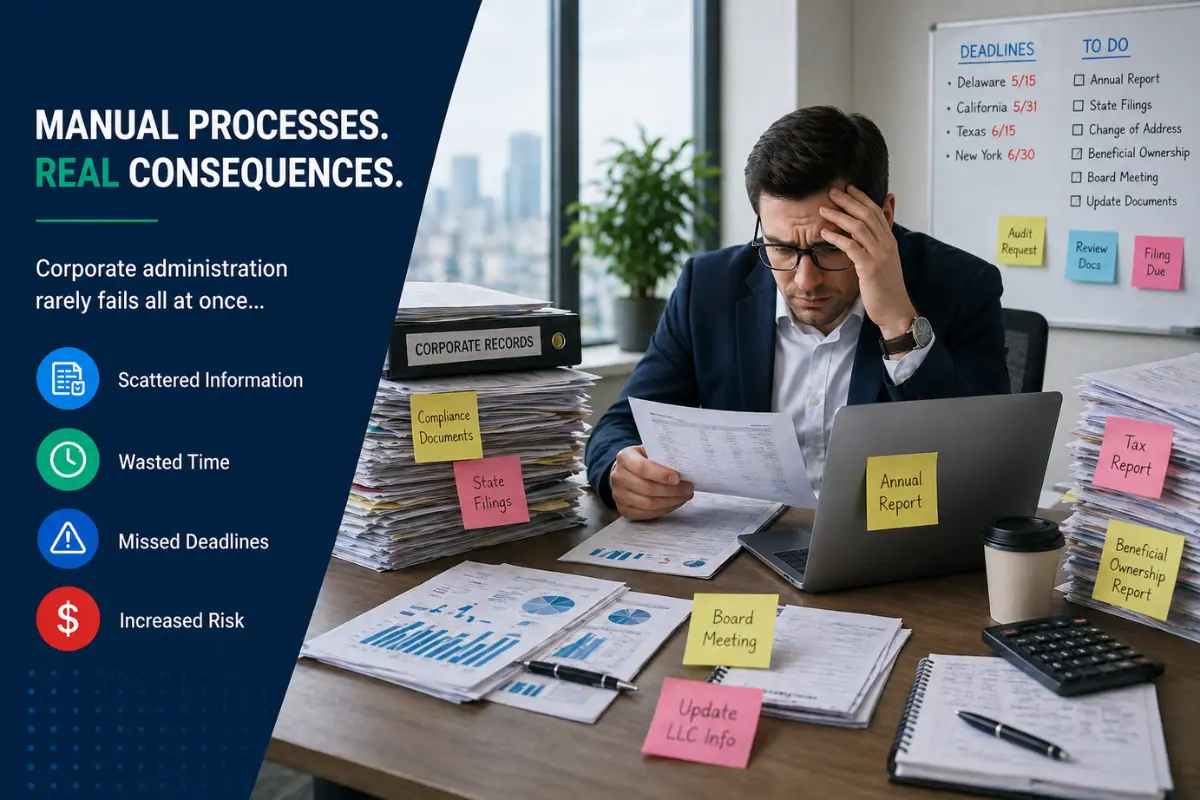
Corporate administration rarely fails all at once. Rather, it tends to wear down through routine work that pulls focus, fragments information, and makes even essential records harder to track with confidence.
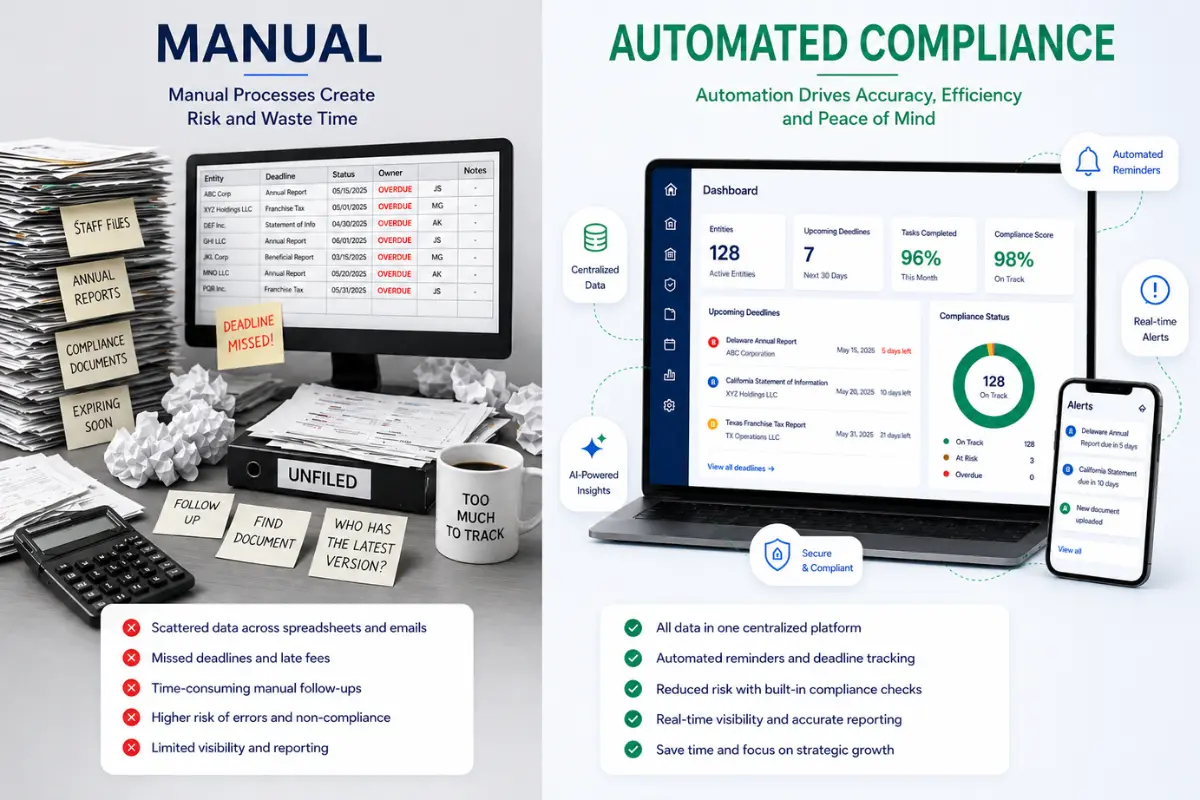
Much of that pressure still plays out across spreadsheets, email threads, and paper-based files that were never designed to function as governance infrastructure, creating gaps where information can be missed or recorded inconsistently.
That strain is reflected in recent U.S. Chamber of Commerce findings, where 47% of small businesses say they spend too much time on regulatory compliance, and 73% report that recordkeeping alone demands a significant share of their time each year.
The burden extends beyond time into day-to-day execution. Adobe found that 48% of workers struggle to locate documents quickly, while nearly half describe their filing systems as confusing or ineffective.
Tom Sullivan of the U.S. Chamber noted that these requirements are “complex, time-consuming, and often prevent small business owners from focusing on running and growing their businesses.”
Why Traditional Entity Management Methods Are Breaking Down
The pressure those systems face has grown considerably as businesses expand. A company managing a single entity in one state can track compliance obligations manually with reasonable confidence. But that changes quickly with each new subsidiary, acquisition, or geographic expansion.
The pressure those systems face has grown considerably as businesses expand. A company managing a single entity in one state can track compliance obligations manually with reasonable confidence. But that changes quickly with each new subsidiary, acquisition, or geographic expansion.
The Association of Corporate Counsel estimates this deterioration occurs at a rate of roughly 25% per year. Yet nearly half of all companies still rely on spreadsheets for auditing and controls.
Regulatory requirements have also multiplied across states and countries, making it harder for any manual system to keep up. Thomson Reuters research shows compliance officers consistently rank ongoing regulatory change as their single biggest challenge, and that pressure only intensifies as a business operates across more jurisdictions.
When records are scattered across disconnected systems, the gaps that were once manageable can become serious liabilities.
The Rise of Digital Entity Management Platforms
“As companies expand across multiple states, the complexity of maintaining compliance increases exponentially, not linearly. What we’re seeing in 2026 is a shift from reactive compliance toward proactive governance infrastructure. Businesses that centralize their entity management and automate routine filings are not only reducing risk but also gaining operational clarity that supports faster, more confident decision-making. Entity management is no longer just an administrative function—it’s the foundational layer that makes truly scalable growth possible.” says Yuliya Pearson, Director of Product at InCorp Services Inc., a nationwide provider of registered agent, business formation, and corporate compliance services that help companies maintain good standing across all 50 states.
In response to those pressures, organizations are increasingly treating entity management as core governance infrastructure rather than a background administrative task.
Digital entity management platforms now provide a centralized environment for storing corporate records, tracking compliance obligations across jurisdictions, and maintaining visibility into ownership structures as organizations expand.
Where documents once lived across email threads and filing cabinets, these systems consolidate them into a single secure repository with role-based access for internal teams and outside advisors.
Henrique Canarim, vice president and assistant corporate secretary at Leidos, described the broader significance of this shift, noting that entity management “should be seen as a strategic enabler, not just a compliance requirement,” and that a well-structured entity framework helps position companies to pursue opportunities more efficiently as they grow.
Governance technology providers, including companies like InCorp Services, have built platforms around this same premise, supporting the transition away from reactive recordkeeping toward systems designed to help organizations maintain consistent visibility and audit readiness across their corporate structures.
Automation and AI in Business Administration
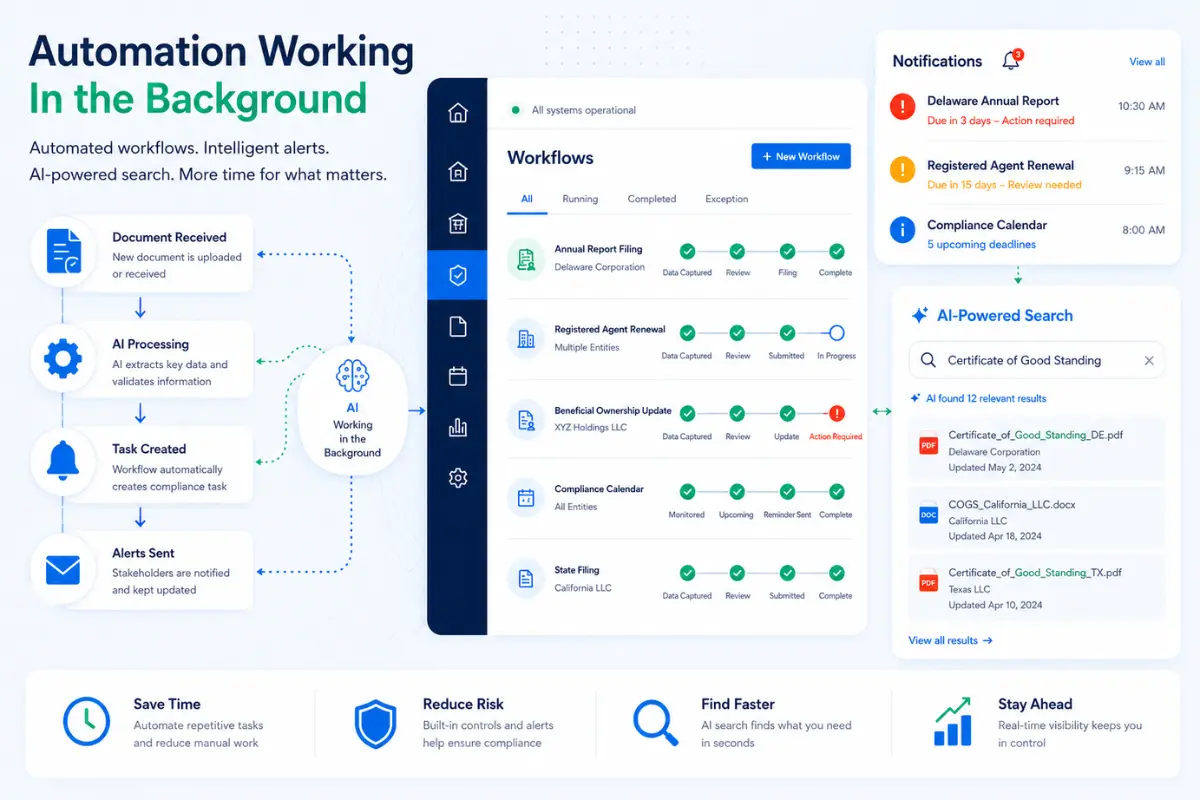
Building that kind of infrastructure requires more than centralized storage. And the platforms gaining traction today are also changing how compliance work actually gets done, moving it away from manual tracking and toward automated processes that run in the background.
Filing deadlines trigger automatic reminders before windows close, and documents that once required manual searching can now be located in seconds through indexed, searchable repositories.
AI-assisted tools are beginning to change that calculation, helping teams surface relevant documents faster and flag compliance gaps before they become problems. The effect is less about replacing human judgment and more about making sure routine work no longer crowds it out.
Why 2026 Marks a Turning Point for Administrative Tech
Adoption of these tools is accelerating for reasons that go beyond any single operational need. The broader push toward digital transformation has fundamentally changed what organizations expect from their governance infrastructure, and cloud-based tools have followed naturally from that.
A Tata Consultancy survey found that 59% of chief information officers now consider cloud technologies essential for innovation, a figure that reflects how far cloud adoption has traveled across the enterprise.
Organizations that once guarded sensitive records behind physical systems have moved that same information into secure cloud platforms, where records stay accessible, consistent, and easier to manage across the business. Distributed teams have sharpened that need considerably.
When the people responsible for governance and recordkeeping are spread across cities or time zones, a centralized digital system stops being a convenience and starts being a necessity. And regulatory scrutiny has added another layer to all of this.
Across industries, the margin for informal processes has narrowed, and organizations are finding that the systems they once relied on no longer meet the level of oversight being asked of them.
That pressure has pushed digital administrative infrastructure past the point of being evaluated as an upgrade over older systems. For a growing number of organizations, it has simply become the expectation.
What This Means for the Future of Business Operations
Organizations that have made this transition are already seeing a change in how their teams work. When compliance tracking runs automatically, and records are always current, the people managing governance spend less time maintaining systems and more time making decisions. That reallocation matters more than it might appear.
For years, administrative work has quietly consumed capacity that organizations needed elsewhere, and the cost of that rarely showed up in any single line item. It accumulated in missed opportunities, delayed decisions, and teams stretched too thin to think strategically.
Governance is becoming more data-driven and more transparent, and compliance is moving from something organizations react to toward something they stay ahead of. Entity management technology is following the same path that accounting software traveled decades ago, moving from a specialized tool to a standard part of how businesses operate.
Disclaimer: This content is intended for general educational and informational purposes only and does not constitute legal, tax, or accounting advice. Every effort is made to keep the information current and accurate; however, laws, regulations, and guidance can change, and no representation or warranty is given that the content is complete, up to date, or suitable for any particular situation. You should not rely on this material as a substitute for advice from a qualified professional who can consider your specific facts and objectives before you make decisions or take action.