
A Complete Guide to Business Formation Services for Startups


A first-time entrepreneur spent weeks researching state filing requirements, attempting to complete LLC formation paperwork independently. After submitting incorrect forms twice and receiving rejection notices, she realized navigating Business Formation Services would have saved time, prevented errors, and ensured proper compliance from the start. Her experience reflects common challenges facing entrepreneurs unfamiliar with legal formation processes.
Business Formation Services help startups legally establish companies by handling state filings, documentation, and compliance tasks. In 2025, about 5.6 million new business applications were filed in the U.S., with LLCs accounting for a large share of the growth, reflecting strong entrepreneurial activity and ongoing demand for business formation support. Monthly business formation statistics from the U.S. Census Bureau's Business Formation Statistics (BFS) show tens of thousands of new registrations in 2025, with 497,046 applications filed in December 2025 alone. Note that BFS figures distinguish between business applications and actual formations, and data may be subject to revisions.
The growth in business formations parallels the increased availability of affordable professional services, making the establishment of legal entities accessible to entrepreneurs across economic backgrounds. Technology-enabled platforms have democratized formation assistance previously available only through expensive attorney services. This accessibility contributes to entrepreneurial success by reducing barriers to establishing a proper legal structure.
Understanding what professional business formation services offer helps entrepreneurs make informed decisions about legal setup support. Services range from basic state filing assistance to comprehensive packages including ongoing compliance monitoring, registered agent services, and additional business tools. This guide covers core services, optional add-ons, benefits, costs, and selection considerations to enable strategic provider evaluation.

Key Takeaways
-
Business formation services help entrepreneurs navigate state filing requirements, prepare formation documents, and establish LLCs or corporations correctly, reducing the risk of rejections and delays.
-
Modern, technology-enabled platforms make professional formation support more affordable and accessible, offering digital tools, templates, and guided workflows for startups with limited legal experience.
-
Many providers go beyond initial filings to offer registered agent services, EIN assistance, compliance monitoring, annual report filing, certificates of good standing, foreign qualification, and other ongoing support.
-
Using professional formation services can save time, minimize filing errors, and support long-term compliance, allowing founders to focus on operations, growth, and revenue instead of administrative tasks.
-
Choosing the right provider requires comparing pricing, service tiers, state coverage, support quality, and available add-ons so startups can match features and costs to their specific needs and risk tolerance.
What Are Business Formation Services?
Business Formation Services are companies or platforms that help entrepreneurs form an LLC, incorporate a business, or establish other entity types through administrative support and document preparation. These services handle business entity formation tasks that would otherwise require entrepreneurs to navigate complex state requirements on their own.
Online business formation company platforms streamline the company registration process by providing digital tools, templates, and filing assistance. Services range from basic document preparation to comprehensive packages including ongoing compliance support and additional business tools. Modern platforms offer user-friendly interfaces that guide entrepreneurs through the formation steps systematically.
Business registration service providers differ from attorneys in that most handle administrative filing tasks rather than providing personalized legal advice. However, many offer attorney consultations as optional add-ons for entrepreneurs needing specific legal guidance on complex situations or unique business structures. These services are not a substitute for legal counsel in complex matters such as ownership disputes, tax strategy, or regulatory compliance beyond basic filings.
Formation services emerged as entrepreneurs sought alternatives to the high costs of attorney fees for routine filings. Technology-enabled platforms to automate document preparation and filing coordination, making professional formation assistance accessible to businesses with limited budgets. This democratization of business formation support has contributed to entrepreneurial growth nationwide.
Different service tiers accommodate varying business needs and budgets. Basic packages handle required state filings, while premium offerings include comprehensive support such as operating agreements, compliance monitoring, and ongoing registered agent services. Understanding tier differences helps entrepreneurs select service levels that match their requirements and financial constraints.
Key Services Typically Offered
Professional business formation services provide core support for establishing legal entities and maintaining compliance. Understanding typical service components helps entrepreneurs evaluate provider options and determine which features address their specific needs.
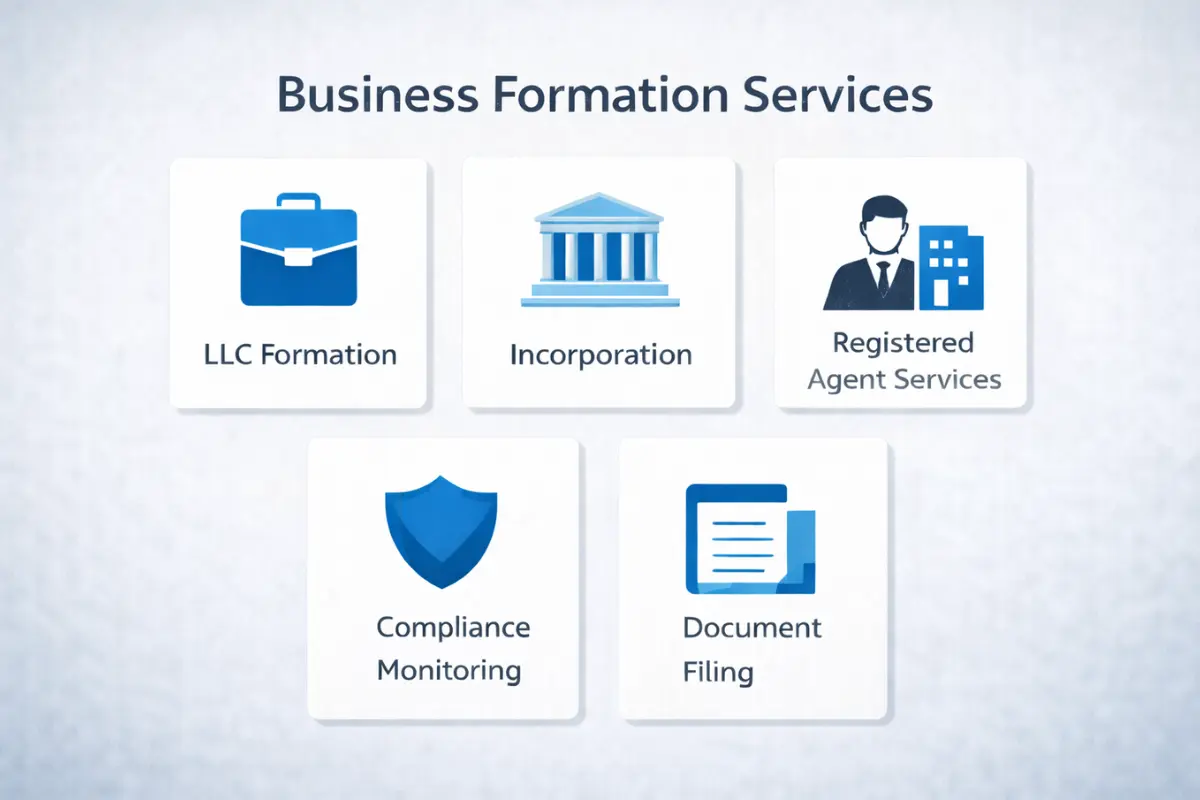
LLC and Corporation Formation
Formation services prepare and file Articles of Organization for LLCs or Articles of Incorporation for corporations with the appropriate state agencies. Forbes explains that LLCs provide liability protection while maintaining operational flexibility. LLC formation through InCorp efficiently handles state-specific requirements.
LLC formation services for startups typically include name availability searches, document preparation, state filing, and certificate delivery. Incorporation services provide similar support for C corporations, S corporations, and nonprofit entities.
Document preparation ensures accurate submission of information that meets state formatting and content requirements. Professional review reduces the risk of rejection and the filing delays common with DIY submissions.
Registered Agent Services
Every LLC and corporation requires a designated registered agent who receives legal documents and state correspondence during business hours. Registered agent services provide reliable document receipt and forwarding while maintaining privacy protection.
Professional registered agents use business addresses on public formation documents rather than personal home addresses. This privacy benefit is particularly valuable for home-based businesses or entrepreneurs who prefer to keep their personal address confidential.
Registered agent services ensure availability during required business hours when many business owners travel, work irregular schedules, or operate remotely. Missing legal notices due to unavailability can result in default judgments or compliance failures.
EIN/Tax ID Assistance
EIN registration assistance helps businesses obtain Employer Identification Numbers from the IRS for tax reporting, employee hiring, and banking purposes. EIN services from InCorp simplify obtaining a federal tax ID.
IRS applications require specific business information, including entity type, formation date, and ownership details. Professional assistance ensures accurate applications, avoiding common errors that delay EIN issuance or require resubmission.
Timely EIN acquisition enables businesses to open bank accounts, establish credit, hire employees, and file tax returns. Formation services coordinate EIN applications with entity establishment, ensuring businesses receive tax IDs promptly after formation approval.
Compliance Monitoring
Compliance monitoring tools track state requirements, including annual reports, franchise tax payments, and license renewals. Business compliance support helps businesses maintain good standing status.
Automated deadline alerts notify business owners of upcoming filing requirements, preventing missed deadlines that trigger penalties or administrative dissolution. Calendar systems track jurisdiction-specific requirements across multiple states for businesses operating nationally.
Monitoring services provide peace of mind that compliance obligations won't be overlooked during busy operational periods. Professional tracking is especially valuable for multi-state operations that face varying state requirements and deadlines.
Annual Reports
Annual or biennial report filings update state records with current business information, including addresses, registered agents, and management details. Missing annual report deadlines can result in late fees, penalties, or loss of good-standing status, which can affect business operations.
Professional filing services prepare reports from current business information and submit them by jurisdiction deadlines. Systematic filing ensures businesses never miss required submissions and maintain continuous good standing.
States vary in annual report requirements, fees, and deadlines. Some require annual submissions while others mandate biennial reporting. Formation services navigate these variations, ensuring proper compliance regardless of jurisdiction.
Certificates of Good Standing
Certificates of Good Standing verify businesses remain properly registered and compliant with state requirements. Banks, lenders, investors, and business partners frequently require current certificates before completing transactions or agreements.
Professional services request and retrieve certificates from state agencies, expediting document acquisition. Knowing how to obtain certificates and typical processing timelines helps businesses plan transactions that require good-standing verification.
Some states issue certificates immediately upon request, while others require several days of processing. Formation services familiar with state-specific procedures efficiently obtain certificates, supporting business timelines.
Trademark Registration
Trademark registration protects brand names, logos, slogans, and other distinctive business identifiers, reducing the risk of infringement. Federal trademark registration through the USPTO provides nationwide protection and legal presumptions supporting enforcement.
Professional services conduct trademark searches to identify potential conflicts before filing applications. Search results help businesses assess the likelihood of registration and modify marks to avoid conflicts with existing registrations.
Application preparation includes proper classification selection, specimen submission, and drafting a description that meets USPTO requirements. Professional assistance increases the likelihood of approval while reducing office action responses and delays.
Copyright Registration
Copyright registration protects original creative works, including written content, software code, visual designs, and multimedia productions. Registration establishes public records of ownership and enables the recovery of statutory damages and attorneys' fees in infringement cases. While copyright protection exists automatically upon creation, registration provides procedural benefits and is required for certain remedies in federal court.
Services help businesses identify copyrightable works, prepare applications, and submit deposits to the U.S. Copyright Office. Proper registration timing proves important as some remedies require registration before or within specified timeframes after infringement.
Copyright protection exists automatically upon creation, but registration provides significant litigation advantages. Professional assistance ensures proper registration covering valuable business assets.
Foreign Qualification
Foreign qualification registers out-of-state LLCs or corporations to conduct business in additional states beyond formation jurisdictions. Businesses must qualify in states where they maintain a physical presence, employ people, or conduct substantial business activities.
Business incorporation services handle foreign qualification applications, including registered agent designation, certificate filing, and fee payment across multiple jurisdictions. Multi-state compliance becomes manageable with professional coordination.
Failure to qualify when required may expose businesses to penalties, contract unenforceability, and inability to sue in state courts, though exact consequences depend on state law and business activity. Professional services assess qualification requirements, helping businesses maintain compliance, and consultation with legal counsel is recommended for multi-state operations.
UCC Search and Filing
UCC searches identify existing liens and security interests in business assets before financing transactions. Lenders require searches to confirm that no prior claims exist against the collateral securing new loans.
UCC-1 filing establishes creditor security interests in business property, protecting lender rights if borrowers default. Professional services prepare accurate filings that meet state requirements and search databases to identify existing liens.
Proper UCC filing and searching are necessary for equipment financing, inventory loans, and other secured transactions. Services familiar with UCC requirements ensure proper documentation protecting all parties' interests.
Apostille and Authentication Services
Apostille services authenticate documents for international use in countries accepting Hague Convention apostilles. Authentication through embassy legalization serves similar purposes for non-Hague countries.
Businesses conducting international operations, opening foreign bank accounts, or registering overseas require authenticated formation documents, good standing certificates, or powers of attorney.
Professional services coordinate state certification, federal authentication, and embassy legalization as required. Understanding complex authentication processes ensures proper document preparation for international acceptance.
Entity Dissolution and Closure
Registering a business online through an online formation service also assists with formal business dissolution when operations cease. Proper dissolution filing prevents ongoing fees, compliance obligations, and potential personal liability for abandoned entities.
Dissolution preparation includes final tax returns, asset distribution, creditor notifications, and state dissolution filings. Systematic closure ensures that all legal obligations are properly concluded, protecting former owners.
States impose continuing obligations on active entities regardless of operational status. Professional dissolution services terminate these obligations, preventing the accumulation of penalties or involuntary administrative dissolution.
Optional Add-On Services
Affordable business formation services offer various optional enhancements beyond basic formation packages. These add-ons provide additional convenience, speed, or support but aren't legally required for entity establishment. Understanding optional services helps entrepreneurs customize formation packages to match specific needs without paying for unnecessary features.
Add-on availability and pricing vary significantly across providers. Some bundles commonly request services into tiered packages, while others offer a completely à la carte selection. Package approaches simplify decision-making for entrepreneurs wanting comprehensive support, while à la carte models provide flexibility for those with specific needs or budget constraints.
Evaluating add-on value requires assessing individual business circumstances. New entrepreneurs unfamiliar with legal requirements may benefit from comprehensive packages including operating agreements, compliance monitoring, and ongoing support. Experienced business owners forming additional entities might need only basic filing services without supplementary assistance.
Expedited Filings and Document Delivery
Expedited filing services leverage state fast-track processing when available, reducing formation approval timelines from weeks to days or hours. Additional state fees apply for expedited review beyond base filing charges. Not all states offer expedited processing, limiting the availability of this option in certain jurisdictions.
Rush document delivery provides faster shipping of formation certificates and official documents after state approval. Digital delivery offers immediate access to approved documents without shipping delays. Electronic delivery is particularly valuable for businesses that need immediate proof of formation for banking or contracting purposes.
Businesses with urgent banking needs, contract deadlines, or immediate operational requirements benefit from expedited services despite higher costs. Standard processing suffices when the timeline is flexible. Cost-benefit analysis should weigh expedited fees against the business impacts of delayed formation, such as lost opportunities or delayed revenue.
Operating Agreement Preparation
Operating agreement preparation services draft customized LLC governance documents defining member rights, management procedures, profit distribution, and operational rules. While not required in all states, operating agreements help prevent disputes and provide operational clarity, making them worth the investment for most LLCs.
Template-based agreements offer affordable options for simple single-member or standard multi-member LLCs. Templates provide basic governance structures suitable for straightforward ownership and management arrangements. Custom drafting accommodates complex ownership structures, special voting rights, and unique profit allocations that exceed the capabilities of templates.
Professional operating agreements address common sources of dispute, including member departures, capital contributions, and decision-making authority. Upfront investment in quality agreements prevents expensive conflicts later. Well-drafted agreements prove especially valuable for multi-member LLCs where ownership dynamics and decision-making processes require clear definition.
Corporate Bylaws Drafting
Corporate bylaws drafting establishes corporation governance rules, including shareholder meetings, director responsibilities, officer appointments, and stock transfers. Bylaws provide operational frameworks similar to LLC operating agreements but adapted for corporate structures and requirements.
Services prepare bylaws consistent with state corporation laws and articles of incorporation. Standard bylaw provisions address typical governance needs, including meeting procedures, voting requirements, and officer duties. Customization accommodates special requirements such as supermajority voting provisions, special share classes, or unique governance arrangements.
Well-drafted bylaws facilitate smooth corporate operations and demonstrate proper corporate formalities important for maintaining liability protection. Courts may pierce the corporate veil when a business fails to observe corporate formalities. Professional preparation ensures legal compliance and practical functionality supporting proper corporate governance.
Business License Research
Business license research identifies federal, state, and local permits or licenses required for specific business activities or locations. License requirements vary significantly across industries, jurisdictions, and business types, creating complexity that entrepreneurs struggle to navigate on their own.
Research services compile comprehensive lists of licenses, including application procedures, fees, and renewal requirements. Systematic identification prevents operating without required licenses, risking fines, business closure orders, or contract unenforceability. Some jurisdictions impose severe penalties, including criminal charges, for operating without a license in regulated industries.
Industry-specific businesses such as restaurants, healthcare providers, contractors, and financial services particularly benefit from professional research. These industries face extensive federal and state licensing beyond basic business permits. Professional research ensures comprehensive compliance rather than piecemeal license acquisition that misses important requirements.
Benefits of Using Professional Business Formation Services
The best business formation service for startups provides advantages beyond simple document filing. Understanding these benefits helps entrepreneurs evaluate whether professional services are worth the cost compared to DIY formation. The value proposition extends across multiple dimensions, including time efficiency, accuracy assurance, ongoing support, and access to expertise.
Professional services are particularly beneficial for first-time entrepreneurs who lack familiarity with state filing requirements and legal terminology. Experienced business owners forming entities in new states also gain value from providers familiar with jurisdiction-specific nuances. The complexity of business formation varies significantly by state, making professional guidance valuable for navigating unfamiliar requirements.
Cost-benefit analysis should consider both immediate formation expenses and potential costs of errors, delays, or missed compliance requirements. While DIY filing saves upfront service fees, mistakes can lead to reformation costs, penalty fees, or operational disruptions that exceed the cost of professional services. Strategic evaluation helps entrepreneurs make informed decisions aligning with their capabilities and risk tolerance.

Time Savings and Convenience
Formation services handle document preparation, state filing, and tracking, reducing the administrative workload for entrepreneurs unfamiliar with state procedures or short on time for bureaucratic tasks.
Convenience proves especially valuable for entrepreneurs juggling full-time jobs while launching businesses or operating in unfamiliar states with complex requirements.
Reduced Risk of Filing Errors
Professional review minimizes common mistakes, including incorrect forms, missing information, improper signatures, and failures to meet state-specific requirements. Avoiding errors prevents delays, rejection fees, and reformation costs.
Formation specialists familiar with state-specific nuances navigate requirements that confuse first-time filers. Expertise ensures compliant filings are accepted on the first submission without requiring corrections.
Error prevention saves both time and money compared to multiple submission attempts or paying reformation fees to correct rejected filings.
Compliance Support and Reminders
Ongoing compliance alerts for annual reports, renewals, and state requirements help businesses maintain good standing. Automated reminders prevent missed deadlines that trigger penalties or administrative dissolution.
Compliance support doesn't replace business owners' legal responsibility, but it provides systematic tracking to prevent oversights during busy operational periods.
Multi-state businesses particularly benefit from centralized compliance monitoring across jurisdictions with varying requirements and deadlines.
Registered Agent and Privacy Protection
Professional registered agent services provide reliable document receipt while protecting personal privacy by using a business address on public records.
Availability assurance during required business hours prevents missed legal notices when business owners travel, work remotely, or maintain irregular schedules.
Privacy protection is valuable for home-based businesses, solo entrepreneurs, or anyone who prefers to keep their personal address confidential on publicly available formation documents.
Centralized Document Management
Online dashboards or portals that store formation documents, annual reports, and compliance records simplify record-keeping and document retrieval for banking, licensing, and investor requirements.
Centralized storage prevents document loss and eliminates the need for states to issue expensive certified copies. Quick access supports business operations that require verification of formation documentation.
Digital management is particularly valuable for businesses operating in multiple states that accumulate numerous formation certificates, qualifications, and compliance filings.
Access to Additional Business Services
Many providers offer related services, including EIN assistance, operating agreement templates, trademark searches, and business license research, thereby simplifying the startup process with one-stop solutions.
Bundled services provide convenience and often cost less than purchasing components separately from multiple providers. Integrated offerings streamline business setup by reducing coordination with multiple vendors.
Additional service availability allows businesses to add support as needs arise without establishing relationships with new providers.
How to Choose the Right Business Formation Service
Selecting appropriate formation services requires evaluating multiple factors, matching provider capabilities with business needs and budget constraints. Systematic comparison ensures informed decisions that balance cost, features, and service quality. The selection process benefits from a clear understanding of business requirements and a realistic assessment of DIY capability versus the value of professional assistance.
Pricing structures vary significantly from basic packages under $100 plus state fees to comprehensive services exceeding $500. Pricing varies by provider, state, and add-ons, and may change over time. Understanding the difference between included features and add-on costs enables accurate price comparisons. Hidden fees or unclear pricing models should raise concerns. Transparent providers clearly itemize state fees, service charges, and optional add-on costs, allowing straightforward comparison across competitors.
State coverage determines whether providers serve all jurisdictions or limit services to specific states. National businesses need providers handling multi-state formations and foreign qualifications efficiently. Regional providers may offer specialized knowledge of local requirements but lack the capability for businesses expanding across state lines. Coverage assessment should consider both current needs and anticipated expansion plans.
Customer reviews and ratings indicate service quality, responsiveness, and reliability. Review patterns reveal common issues or consistent strengths guiding selection decisions. Multiple review sources provide balanced perspectives beyond provider-curated testimonials. Recent reviews prove more relevant than outdated feedback as service quality and provider capabilities evolve over time.
Support options, including phone, email, chat, or a dedicated representative's affect accessibility when questions or issues arise. Response times and support quality vary significantly across providers. Some offer phone support during business hours, while others provide 24/7 chat assistance. Support quality assessment should consider both the availability and the expertise of representatives handling inquiries.
Additional features like compliance monitoring, document management, or an included registered agent service distinguish offerings. Feature comparison helps identify providers that match specific business requirements. Some businesses prioritize comprehensive packages while others prefer basic services supplemented by selected add-ons. Individual business needs should drive feature evaluation rather than maximizing features for their own sake.
Processing speed expectations influence provider selection. Some services guarantee same-day submission to states, while others process orders within several business days. The availability of expedited options matters for businesses with urgent timelines. Understanding standard processing versus expedited options helps set realistic expectations for the formation timeline.
Reputation and longevity indicate provider stability and reliability. Established companies with multi-year track records demonstrate sustained capability and financial stability. Newer providers may offer competitive pricing or innovative features, but carry a higher risk of service disruptions or business closure. Balancing innovation against stability depends on individual risk tolerance and business needs.
Refund policies and satisfaction guarantees protect against service failures or dissatisfaction. Clear policies indicate provider confidence and customer commitment. Understanding refund eligibility and processes before purchase prevents disputes if services fail to meet expectations. Money-back guarantees offer reassurance but require careful examination of the conditions and limitations.
Investopedia's guide to starting a business provides additional context on business formation decisions and planning considerations.
How InCorp Can Help You with Business Formation
InCorp supports entrepreneurs with comprehensive formation assistance, including filing, compliance monitoring, and registered agent services. InCorp's business services provide reliable professional solutions for startup legal requirements across all 50 states and the District of Columbia.
Formation support encompasses document preparation, accuracy review, state filing, and certificate delivery, ensuring proper entity establishment. Experienced specialists navigate state-specific requirements, preventing common errors and delays that frustrate DIY filers. Systematic processes ensure complete applications meeting all state documentation standards for first-submission approval.
Ongoing compliance monitoring tracks deadlines, provides filing reminders, and facilitates annual report submissions, maintaining good standing across jurisdictions. Systematic support prevents missed requirements, which could lead to penalties or dissolution. Automated calendar systems monitor jurisdiction-specific deadlines, ensuring timely filing regardless of varying state requirements.
Registered agent services nationwide ensure reliable receipt of legal documents while protecting the owner's privacy by using a business address. Professional availability during business hours prevents missed notices, which can cause legal complications. Prompt document scanning and forwarding keep business owners informed of important correspondence regardless of location.
Document management systems provide secure online access to formation certificates, annual reports, and compliance filings. Centralized storage simplifies document retrieval for banking, licensing, investor relations, or legal purposes. Digital archives prevent the loss of documents, reducing the need for state agencies to request expensive certified copies.
InCorp's approach emphasizes accuracy, efficiency, and ongoing support beyond initial formation. Businesses benefit from established relationships with state agencies, familiarity with processing procedures, and systematic quality control, which together ensure reliable service delivery. Professional formation assistance through InCorp provides peace of mind, allowing entrepreneurs to focus on business development rather than administrative requirements.
Streamlining Your Business Formation Process
Professional business formation services provide administrative efficiency, error reduction, and compliance support, simplifying legal entity establishment. While not legally required, formation services offer valuable benefits, particularly for first-time entrepreneurs or multi-state operations. The decision between DIY filing and professional assistance depends on individual capabilities, available time, tolerance for complexity, and budget.
Careful provider selection, considering pricing, features, support quality, and review feedback, ensures appropriate service matches business needs. Comparing multiple providers helps identify optimal value by balancing cost and capability. Evaluation should examine both immediate formation needs and long-term compliance support requirements. Some businesses prioritize low upfront costs, while others value comprehensive ongoing assistance, justifying higher initial investment.
Planning formation timing, gathering required information, and understanding state-specific requirements further streamlines processes, whether using professional services or filing independently. Preparation reduces delays and complications regardless of the approach chosen. Common preparation steps include selecting business names, identifying registered agents, determining management structures, and collecting member or shareholder information needed for formation documents.
Understanding state processing timelines helps set realistic expectations for the completion of formation. Standard processing varies from days to weeks, depending on jurisdiction and filing method. Expedited options reduce timelines but increase costs. Aligning formation timing with business launch dates prevents operational delays or premature expense commitments.
Successful business formation represents just the beginning of ongoing compliance obligations. Annual reports, franchise taxes, license renewals, and other requirements continue throughout business operations. Establishing systematic compliance processes during formation lays the foundation for long-term good standing. Whether handling compliance independently or through professional services, an organized approach prevents costly oversights.
FAQ's
What do business formation services actually do?
Business formation services help you set up a separate legal entity (such as an LLC or corporation) by preparing and filing formation documents with the state, arranging registered agent service, and often providing additional tools like EIN assistance or basic operating agreement/bylaws templates. They focus on handling procedural and administrative steps so small business owners do not have to navigate state-specific requirements alone, but they generally do not replace individualized legal or tax advice from a licensed professional.
Are business formation services required to start a business?
No. You can usually form an LLC or corporation by filing directly with your state's business filing office, and many state websites provide do‑it‑yourself instructions and forms. Formation services are optional professional services that can save time and reduce filing errors, which some founders find worthwhile, especially when dealing with unfamiliar state regulations or multi‑owner entities.
How much do business formation services typically cost, beyond state fees?
Pricing varies by provider and package, but many online formation services charge a service fee in roughly the $150–$300 range for standard LLC or corporation setups, in addition to required state filing fees. More comprehensive "entity formation" packages that include extras such as a year of registered agent, EIN assistance, and compliance calendars commonly end up in a few‑hundred‑dollar range total, again plus whatever your state charges to form the entity.
Do business formation services replace the need for a lawyer or tax professional?
Not necessarily. Formation services are designed to handle standardized filings and provide general educational information, but they typically do not give tailored legal or tax advice unless they specifically include attorney consultations. If you have complex ownership, are weighing S‑corp tax status, plan to issue equity, or operate in a heavily regulated industry, consulting a qualified attorney or tax advisor in addition to using a formation service is often important.
Can formation services help after my business is formed, or are they only for startups?
Many providers also support existing businesses by handling annual report filings, registered agent renewals, foreign qualification in additional states, name changes, or even dissolution and reinstatement filings when needed. Ongoing compliance tools such as deadline reminders and document storage portals help small business owners maintain good standing as the company grows, not just at the initial startup stage.
How do business formation services help protect my personal assets?
Business formation services assist you in creating a separate legal entity, such as an LLC or corporation, by correctly filing formation documents and helping you adopt core governance tools like an operating agreement or bylaws. When properly formed and maintained, these structures can provide limited liability protection, reducing the risk that your personal assets are used to satisfy business debts or legal claims, although protection also depends on how you operate and comply with state laws.
Do I still need a separate business bank account if I form an LLC?
Yes. Even with an LLC or corporation, you should open a dedicated business bank account and keep personal and business funds separate. Maintaining clear separation supports limited liability by demonstrating that the company is treated as a distinct legal entity rather than an extension of your personal finances.
Can business formation services help me choose the right business structure (LLC, corporation, or sole proprietorship)?
Most business formation services provide educational resources comparing options like LLCs, corporations, and partnerships, but they typically do not give individualized legal or tax advice unless they explicitly include attorney consultations. For decisions about the best structure for liability protection, taxes, and ownership arrangements, small business owners should use these services for procedural support and consult qualified legal or tax professionals for tailored guidance.
How do formation services support compliance with state and local requirements after formation?
Many providers offer compliance tools such as annual report reminders, registered agent services, and business license research to help you track ongoing obligations under state and local regulations. While these tools improve organization and reduce the risk of missed deadlines, you remain ultimately responsible for meeting filing, tax, and licensing requirements imposed by government agencies.
Can a business formation service help with multi‑owner LLCs and more complex ownership structures?
Yes, many services offer LLC operating agreement templates and related documents that outline ownership percentages, management structure, and decision‑making rules for multi‑member LLCs. However, where there are multiple owners, unusual profit‑sharing, or plans for outside investment, it is often important to have an attorney review or customize these documents to ensure they match your intentions and comply with applicable laws.
Disclaimer: This content is intended for general educational and informational purposes only and does not constitute legal, tax, or accounting advice. Every effort is made to keep the information current and accurate; however, laws, regulations, and guidance can change, and no representation or warranty is given that the content is complete, up to date, or suitable for any particular situation. You should not rely on this material as a substitute for advice from a qualified professional who can consider your specific facts and objectives before you make decisions or take action.
Share This Article:
Stay in the know!
Join our newsletter for special offers.