
LLC or C-Corp: A Foundational Decision for Every Tech Startup


A software developer built a promising SaaS platform as a sole proprietor to avoid the costs of formation. When a venture capital firm expressed interest in a $2 million seed round, they required immediate Delaware C-Corp conversion. The rushed conversion triggered unexpected tax consequences, consumed weeks of legal work, and nearly derailed funding. Attempting to save $1,000 in formation costs created $15,000 in conversion expenses.
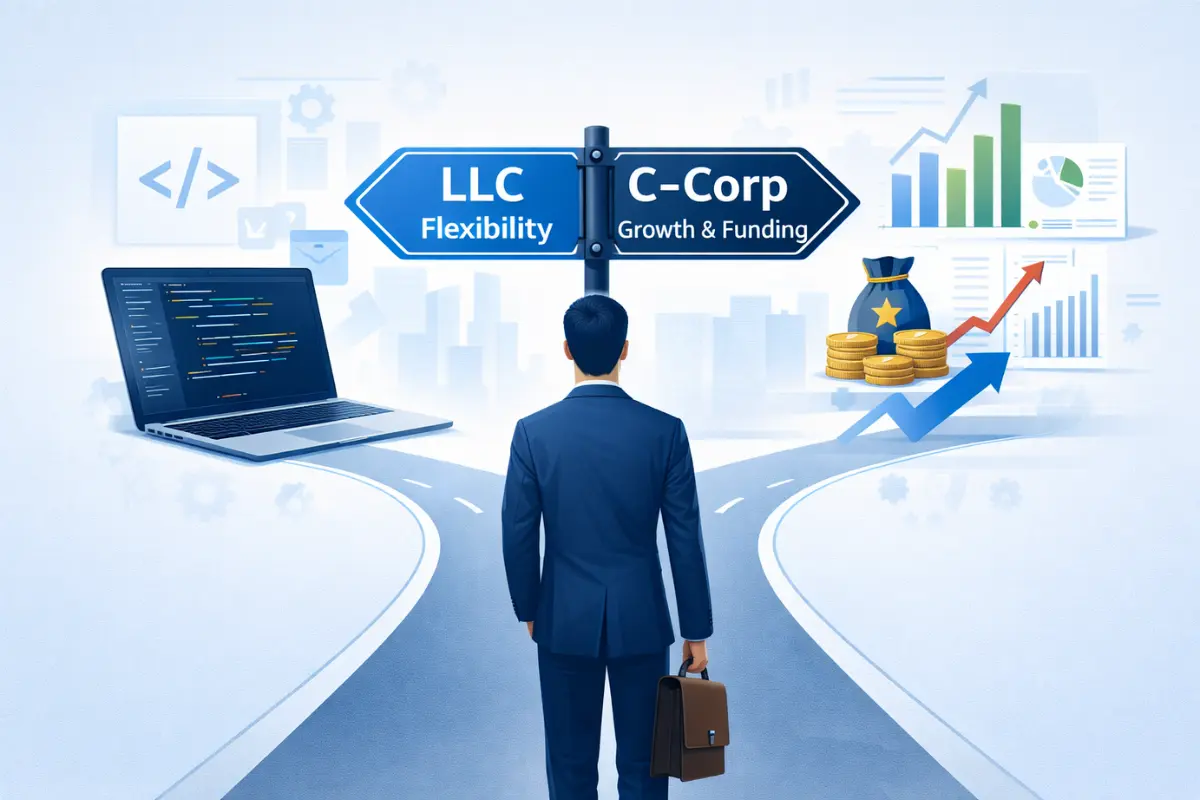
The central dilemma for tech startup founders centers on balancing Limited Liability Company (LLC) simplicity against C-Corporation (C-Corp) scalability. In 2026, the tech landscape demands more than innovative products; entity choice affects startup fundraising capacity, tax strategy, and ability to attract talent. U.S. small businesses account for 99.9% of all companies, with about 36.2 million in 2025, according to HIGH5 SIA.
This guide compares structures to help founders align their tech startup legal structure with exit strategies. Globally, there are 5.4 million active startups as of 2025, with combined unicorn valuations of around $5 trillion, according to BusinessDojo. Understanding the differences between LLC, S-Corp, and C-Corp helps founders make informed decisions.
Key Takeaways
-
Your choice between an LLC and a C‑Corp is a strategy decision, not just paperwork—it affects fundraising options, tax treatment, and how easily you can grant equity to employees and advisors.
-
Venture-backed, high‑growth tech startups almost always end up as Delaware C‑Corps because investors expect standardized stock, clear governance, and access to QSBS capital‑gains exclusions.
-
LLCs can be attractive for bootstrapped or lifestyle tech businesses because of pass‑through taxation, simpler formalities, and the ability to use early losses against the founders’ other income.
-
Converting from an LLC to a C‑Corp later is possible but can introduce extra legal cost, potential tax events, and a reset of QSBS holding periods, so founders should consider their 5–10 year funding and exit plans upfront.
-
Whichever structure you choose, maintaining separate accounts, proper records, and good standing in your state is essential to preserve limited liability and keep your startup “investor‑ready.”
The Strategic Advantages of the C-Corporation for Tech Ventures
The C-Corp is the gold standard for startups seeking rapid growth and venture capital. Delaware's flexible corporate statutes, Court of Chancery, and extensive case law make it the overwhelming choice for incorporation for tech companies seeking investor backing.
Articles of Incorporation establish corporate existence, while corporate bylaws document operating procedures. This standardized framework allows investors to understand corporate structures without having to navigate customized agreements.
The Magnet for Venture Capital and Angel Investors
Nearly all Venture Capital firms cannot invest in pass-through entities, such as LLCs, to avoid unrelated business taxable income (UBTI) for tax-exempt limited partners. This structural reality means venture capital and startup entity alignment requires C-Corp formation.
C-Corps facilitate priced rounds through preferred stock, granting investors liquidation preferences, anti-dilution protection, and board representation. Understanding LLC versus S-Corp taxation helps founders appreciate why pass-through structures prove incompatible with professional investment.
Convertible notes and SAFEs prove more complex in LLCs, slowing negotiations. A standardized C-Corp structure enables the use of industry-standard investment documents in Series A funding rounds.
Unlocking Qualified Small Business Stock (QSBS) Tax Benefits
Section 1202 provides massive tax incentives allowing founders and early investors to exclude up to 100% of capital gains, up to $10 million or 10 times basis, upon company sale. This benefit applies exclusively to C-Corps and requires five-year holding periods.
Qualified Small Business Stock benefits can save millions in capital gains taxes. The five-year clock begins only when C-Corp stock is issued, meaning LLC conversions reset timelines. For founders planning exits within 5-10 years, starting as C-Corps maximizes QSBS benefits.
Scaling Talent with Equity Incentives and ESOPs
C-Corps use Employee Stock Option Plans (ESOPs), granting stock options or RSUs to attract elite talent. Stock options are widely understood and simpler to administer than LLC profits interests. Top technology talent expects equity compensation.
Incentive Stock Options (ISOs), available only to C-Corp employees, provide preferential tax treatment. Cap table management proves simpler with C-Corp stock than LLC membership interests. Platforms like Carta provide sophisticated C-Corp equity tracking tools.
The LLC Model: Flexibility and Efficiency for Bootstrapped Startups
The LLC provides limited liability protection with the tax flexibility of partnerships. This suits lifestyle tech businesses, niche SaaS platforms, or firms staying lean without institutional funding.
LLCs require Articles of Organization and an Operating Agreement to document ownership and management. The contractual flexibility allows for customization that is impossible in corporate structures.

Pass-Through Taxation and Early-Stage Loss Harvesting
By default, LLCs don't pay corporate-level taxes; profits and losses pass through to owners' personal returns. This single taxation layer avoids double taxation, where C-Corps pay corporate taxes, then shareholders pay taxes on dividends.
Founders can use early-stage business losses to offset other personal income, which is unavailable to C-Corps. LLC members can deduct business losses against W-2 income or other sources of income, providing immediate tax benefits. This proves valuable for founders with high personal incomes.
Reduced Administrative Burden and Compliance Costs
LLCs avoid rigid formalities like mandatory annual shareholder meetings and board elections. This allows founders to focus on product development rather than corporate governance. The simplified structure reduces legal and accounting costs during bootstrapped phases.
Annual corporate filings for LLCs typically prove simpler than those for corporations. The flexibility proves valuable for solo founders or small teams, helping them avoid bureaucratic overhead.
Customizable Economic and Management Structures
Operating Agreements allow profits to be distributed without matching ownership percentages. LLCs can be member-managed or manager-managed, without a formal board. Understanding whether Operating Agreements are required helps founders implement governance.
This allows for creative equity structures, such as sweat equity or differential voting rights. However, the flexibility that attracts founders creates complications for investors.
Navigating the Critical Differences in Governance and Ownership
While both structures offer limited liability protection, the way liability is maintained differs significantly between entities. Corporations receive somewhat automatic protection when maintaining corporate formalities, while LLCs require demonstrating business-personal separation through proper practices. Both entities protect owners from business debts and lawsuits, though maintaining that protection requires adherence to the formalities appropriate to each structure.
Issuing Stock vs. Membership Interests
Transferring corporate stock is often easier than transferring LLC membership interests, which are subject to restrictive transfers. C-Corp cap tables provide clear ownership views valued by acquirers and lenders. Shareholders vs members reflects fundamental structural differences.
Standardized stock structures facilitate secondary markets and employee equity grants. Sophisticated cap table management tools exist primarily for corporate structures.
The Double Taxation Hurdle for Corporations
C-Corp profits face taxation at the corporate level (21% federally), then again as dividends on shareholders' personal returns. This double taxation appears daunting but is largely irrelevant for high-growth startups that reinvest all revenue in growth rather than distribute dividends. Most venture-backed companies operate at a loss or reinvest profits for years.
This contrasts with the single layer of taxation in LLCs, potentially leading to higher cash-in-hand for profitable, smaller-scale tech firms. However, the LLC tax advantage disappears when QSBS benefits are available only to C-Corps or when investors require a C-Corp structure.
Maintaining the Corporate Veil and Statutory Formalities
While LLCs offer flexibility, failing to follow formalities can jeopardize liability shields. Maintaining the corporate veil requires separating business and personal finances.
C-Corps receive more automatic protection when maintaining meetings, minutes, and separate records. Both require obtaining an EIN (Employer Identification Number) and maintaining separate business accounts.
Converting from an LLC to a C-Corp: The Strategic Pivot
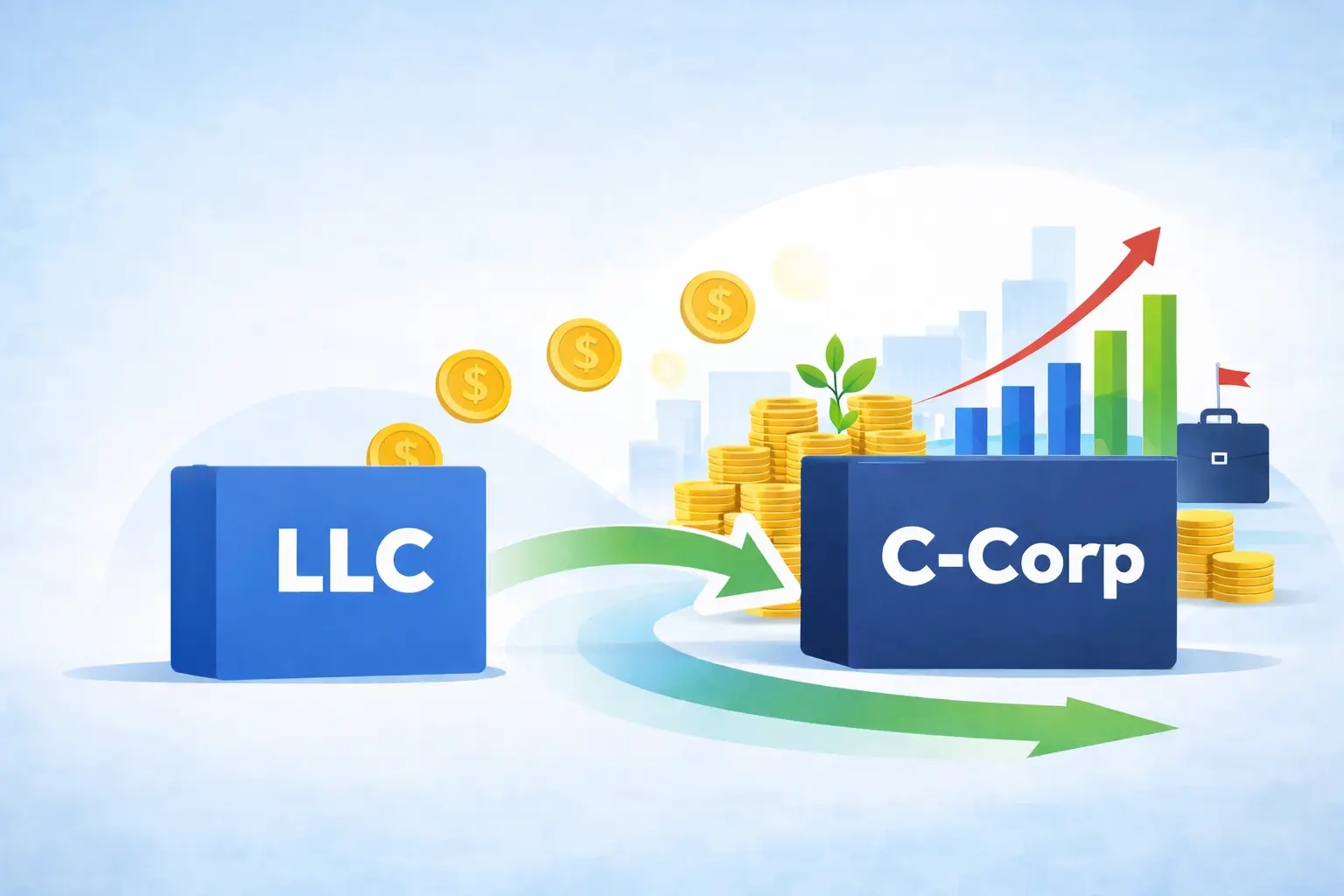
Many founders start as LLCs to save costs and pivot to C-Corps when ready to raise first significant funding rounds. While statutory conversions are possible, they are complex legal events that require careful timing. The common path involves bootstrapping as an LLC for tax benefits, then converting to a corporation before institutional fundraising, when investor requirements necessitate a corporate structure.
Timing the Conversion for Optimal Funding
Converting just before priced rounds represents standard practice satisfying investor requirements while allowing early tax flexibility. Investors often require Delaware C-Corp status specifically before closing Series Seed or Series A rounds. Conversion timing impacts QSBS benefits, tax consequences, and administrative complexity.
Founders should plan conversions to allow adequate time for legal work, tax planning, and investor due diligence, without rushing under funding-deadline pressure. Most conversions require 30-60 days to complete.
Potential Tax Triggers and Liquidation Risks
The IRS may view conversions as deemed liquidations of LLCs, potentially triggering taxable gains if entities hold highly appreciated intellectual property. The importance of maintaining clean charts of accounts and obtaining clear valuations before moving from membership interests to corporate stock cannot be overstated. Understanding taxation triggers helps founders avoid unexpected tax liabilities.
Proper structuring can minimize or defer tax consequences, but professional tax guidance proves essential. The potential tax impact of conversion frequently influences whether founders form an LLC or a C-Corp initially. For many technology startups with significant intellectual property value, starting as C-Corps avoids conversion tax issues entirely.
Resetting the QSBS Five-Year Clock
The five-year holding period for Section 1202 tax benefits starts only after the C-Corp conversion is complete. For many founders, this delay is the primary reason to start as a C-Corp from inception rather than convert later. A founder converting to a C-Corp in year two, then exiting in year six, misses QSBS benefits, while starting as a C-Corp provides full benefits.
This critical pitfall means that founders expecting exits within 5-10 years should carefully consider forming a C-Corp from day one. The millions in potential QSBS tax savings often outweigh the LLC tax benefits during early, bootstrapped phases.
The Essential Role of Compliance and Professional Support
Regardless of the structure chosen, entities' legal standing depends on adherence to state-level administrative requirements. Both LLCs and Corporations must maintain good standing through timely filings, fee payments, and regulatory compliance. Failure to maintain compliance can result in administrative dissolution, eliminating liability protection and creating serious legal and tax consequences.
The Registered Agent as a Growth Partner
Both LLCs and Corps must appoint startup registered agents to receive service of process and state notices. For tech startups, using professional services like InCorp's registered agent services ensures no legal deadlines are missed, regardless of where founders are physically located. Professional agents provide privacy protection, reliable notice receipt, and compliance monitoring, preventing costly oversights.
Startup founders frequently work remotely, travel internationally, or relocate offices as companies grow. Professional registered agents ensure continuity of legal notice receipt despite founder mobility. The modest annual cost prevents catastrophic consequences of missed legal notices or administrative dissolution.
Leveraging Real-Time Monitoring with EntityWatch®
InCorp's proprietary system monitors state records in all 50 states, providing automated alerts for upcoming annual report deadlines and franchise tax payments. This proactive oversight is essential for maintaining Good Standing and represents a mandatory requirement for venture capital due diligence processes. Investors conducting due diligence verify corporate good standing before closing funding rounds.
The system provides centralized tracking across multiple states, particularly valuable as startups expand. Real-time monitoring prevents administrative dissolution, which could derail funding rounds or expose the organization to liability. The automated compliance tracking allows founders to focus on building their businesses rather than on calendar management.
Centralizing Multi-State Foreign Qualification
As tech startups hire remote employees or open satellite offices, they must register as foreign entities in those new states. Each state requires separate filings, fees, and ongoing compliance obligations. A national provider can manage multiple filings through a single dashboard, reducing administrative burden on founding teams.
Multi-state compliance grows exponentially complex as startups scale geographically. Professional services centralize management, ensure timely filings, and provide expert guidance on state-specific requirements. This proves particularly valuable for startups with distributed teams across numerous states.
Build the Right Foundation Before You Scale
The right choice depends on whether startups prioritize immediate tax efficiency through LLCs or long-term institutional scalability through C-Corps. Most venture-backed technology companies ultimately operate as Delaware C-Corporations due to investor requirements, QSBS benefits, and standardized equity structures. However, bootstrapped lifestyle businesses or startups deferring fundraising may benefit from LLC flexibility and tax advantages.
Explore InCorp's specialized LLC and Corporation formation services to help launch tech startups on a professional foundation. Proper formation lays a strong foundation for growth, fundraising, and eventual exits. The EntityWatch® system maintains compliance necessary for venture capital readiness and long-term success.
Visit InCorp's business services to discover comprehensive solutions supporting tech startup formation, compliance, and growth across all jurisdictions.
FAQ's
Can a tech startup change its entity type more than once?
Yes, but multiple structural changes increase legal complexity, accounting costs, and tax risk, so they should be avoided unless there are clear strategic reasons. Each conversion triggers legal fees, potential tax consequences, and administrative burden. Founders should carefully plan the initial structure to align with long-term goals rather than make multiple changes.
Does the founder's country of residence affect the LLC vs. C-Corp decision?
Yes. Non-U.S. founders often face additional tax and withholding complications with pass-through entities, making C-Corps more practical in many cases. International tax treaties, foreign tax credits, and withholding obligations create complexity for non-resident LLC members. C-Corp structures often prove simpler for international founders establishing U.S.-based companies.
Are accelerator programs biased toward one structure?
Most U.S.-based accelerators strongly prefer or require startups to be Delaware C-Corporations before acceptance. The standardized structure facilitates accelerator investment, Demo Day presentations, and subsequent fundraising. Founders applying to competitive accelerators should form as C-Corps or plan conversions before program start dates.
Can an LLC issue convertible notes or SAFEs?
While possible, these instruments are harder to structure in LLCs and less familiar to investors, which can slow negotiations. Convertible notes and SAFEs were designed for corporate structures with stock conversion mechanisms. Adapting these instruments for LLC membership interests requires custom documentation and legal work, creating friction in fundraising processes that already prove challenging for early-stage companies.
How does choosing a C‑Corp vs. LLC affect a startup's ability to raise venture capital?
Most venture capitalists and institutional investors strongly prefer, and often require, a Delaware C‑Corp because corporate law, preferred stock, and standard incorporation documents match their fund structures and legal expectations. While an LLC is a valid legal entity, its pass‑through taxation, profits interests, and less formal management structure usually create friction for venture funds, making it harder to raise institutional capital.
Why is Qualified Small Business Stock (QSBS) such a big deal for tech founders and early investors?
If a startup qualifies as a C‑Corporation issuing Qualified Small Business Stock under Section 1202, founders and early investors may exclude a large portion of capital gains (often up to 100% of the greater of $10 million or 10x basis) when they sell. These QSBS tax advantages can translate into substantial tax savings at exit and are only available when the company is structured as a C‑Corp that meets specific requirements, not when it is an LLC taxed as a pass‑through.
How does double taxation actually work for a C‑Corp compared to pass‑through taxation for an LLC?
A C‑Corp pays corporate income tax on its profits at the corporate level, and then shareholders pay taxes again on dividends, creating "double taxation" on distributed earnings. In contrast, an LLC taxed as a pass‑through entity does not pay corporate taxes; business income flows directly to the owners' personal tax returns, where they pay income tax (and often self‑employment taxes) once, which can reduce the overall tax burden for smaller, profitable businesses.
What tax considerations matter when deciding whether to convert an LLC to a C‑Corp later?
Converting an LLC to a C‑Corp can be treated as a taxable event for federal tax purposes, especially if the LLC holds appreciated intellectual property or other assets, potentially triggering capital gains. The conversion may also restart QSBS holding periods and change how business income and losses appear on owners' personal tax returns, so founders should weigh future fundraising and exit plans against the immediate tax implications before changing tax status.
Why do some small tech businesses stay LLCs instead of becoming C‑Corps?
Smaller tech businesses that do not plan to raise venture capital or issue multiple classes of stock often value the simpler tax filing, pass‑through taxation, and flexible profit distribution of an LLC. For these companies, limited liability protection combined with fewer corporate formalities and the ability to use business losses on owners' personal tax returns can provide meaningful tax benefits without the complexity of a full corporate management structure.
Disclaimer: This content is intended for general educational and informational purposes only and does not constitute legal, tax, or accounting advice. Every effort is made to keep the information current and accurate; however, laws, regulations, and guidance can change, and no representation or warranty is given that the content is complete, up to date, or suitable for any particular situation. You should not rely on this material as a substitute for advice from a qualified professional who can consider your specific facts and objectives before you make decisions or take action.
Share This Article:
Stay in the know!
Join our newsletter for special offers.