

Three co-founders launched a consulting LLC without a written LLC operating agreement, relying on handshake deals about ownership and profits. When one founder wanted to exit after two years, disputes erupted over buyout price and profit distribution. The remaining members spent $35,000 in legal fees and six months in mediation because no written agreement existed. A properly drafted operating agreement would have prevented the entire dispute.
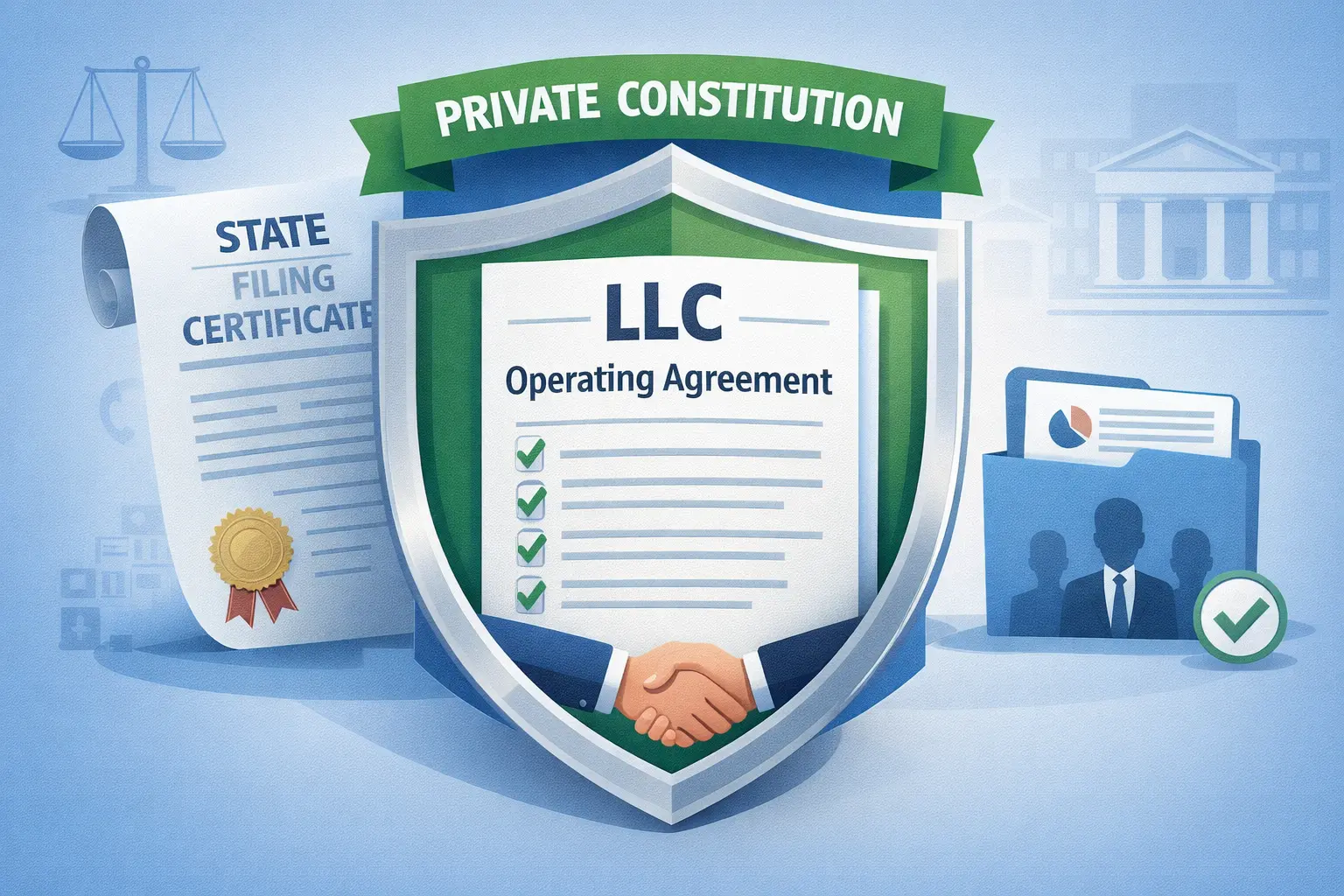
The LLC Operating Agreement serves as the "private constitution" of the business—the primary governing contract between members. While Articles of Organization create the entity with the state, the Operating Agreement controls the internal mechanics of how the business functions.
The 2026 legal and tax landscape carries particular significance. Federal beneficial ownership reporting rules under the Corporate Transparency Act have changed substantially since 2024, and under FinCEN’s current interim final rule, entities created in the United States are exempt from federal BOI reporting while certain foreign entities may still have reporting obligations. At the same time, current federal tax law continues to affect LLC profitability, distributions, and depreciation planning, making it important to align your operating agreement with current tax guidance rather than older Tax Cuts and Jobs Act assumptions. Industry surveys suggest that a majority of LLCs operate without written operating agreements, meaning many companies are governed by default state rules, which increases legal risk and internal disputes.
Understanding operating agreement requirements by state and incorporating 2026 provisions protects your investment. This guide breaks down essential clauses every LLC needs.
The Core Statutory Pillars of the Agreement
The foundational elements establish the LLC's identity and ensure compliance with state regulations.
Entity Identification and Purpose Clauses
Specify the legal name to match state filings exactly as it appears on the Articles of Organization. Include the principal place of business using a physical street address—no P.O. boxes per most state requirements.
The "Business Purpose" clause should be intentionally flexible. Rather than narrowly defining activities, use broader language like "any lawful business activity permitted under state law." This prevents the need for amendments when expanding services.
Document the state of formation and specify which state's laws govern the agreement for multi-state operations.
Registered Agent Designation
Formally name the registered agent to ensure a clear point of contact for service of process and state notices. Professional registered agent services provide reliability and privacy. When evaluating options, consider questions to ask before hiring a registered agent, including availability guarantees and multi-state coverage.
The agreement should specify procedures for changing the registered agent, including member approval requirements and notification timelines.
Term and Duration
State whether the LLC is perpetual or set for a specific term. Perpetual duration suits most businesses, while fixed-term LLCs work well for real estate projects or joint ventures.
For fixed-term LLCs, include provisions for extending the term and specify what happens upon expiration. This dissolution clause prevents ambiguity about the LLC's lifespan.
Ownership, Capital, and Tax Optimization
Ownership interests and capital management affect member rights and tax obligations. The 2026 tax landscape provides opportunities to optimize tax treatment through careful agreement drafting.
Initial Capital Contributions and Valuation
Clearly list what each member contributes—cash, property, intellectual property, or services—and the agreed-upon valuation. Capital contributions establish each member's ownership percentage and voting rights unless specified otherwise.
For non-cash contributions, document the method used to determine fair market value. If a member contributes equipment valued at $50,000, specify whether the valuation is based on an independent appraisal, tax basis, or mutual agreement.
Record the contribution schedule if members plan staged investments over time.
Mandatory vs. Discretionary Capital Calls
Define whether members can be forced to contribute additional funds and the consequences if a member fails to meet a capital call. The consequences typically include dilution penalties or transfer restrictions. Document the exact dilution formula to prevent disputes.
Alternative consequences include forfeiture provisions, subordination of distribution rights, or forced sale of the non-participating member's interest.
Profits, Interests, and QBI Optimization
Incorporate language to maximize the Section 199A Qualified Business Income Deduction, which allows eligible pass-through entities to deduct up to 20% of qualified business income. Section 199A was originally scheduled to sunset after 2025, but 2025 federal tax legislation made the deduction permanent while also adjusting parts of the deduction framework. Because eligibility thresholds, service-business limitations, and deduction calculations can change with inflation adjustments and future guidance, members should confirm current rules with a qualified tax professional rather than relying on generic template language.
For multi-member LLC agreement structures, consider whether profit distribution follows ownership percentages or uses a different allocation. Special allocations must have "substantial economic effect" under IRS rules.
Address guaranteed payments to active members separately from profit distributions. Document how the LLC will handle depreciation deductions, specifying how they allocate among members. Under current federal tax law, bonus depreciation was previously scheduled to phase down, but 2025 legislation restored 100% bonus depreciation for qualifying property placed in service after January 19, 2025, making it important to draft tax provisions based on current law rather than older phase-out schedules.
2026 Transparency and Federal Reporting Compliance
Federal beneficial ownership reporting rules should still be considered when drafting an operating agreement, but businesses should not assume that every LLC currently must file a BOI report with FinCEN. Under FinCEN’s March 2025 interim final rule, U.S.-created entities and U.S. persons are exempt from BOI reporting, while certain foreign entities remain subject to federal reporting requirements.

Beneficial Ownership Information (BOI) Reporting Obligations
Include a clause requiring all members to provide the identification and ownership details needed for any applicable beneficial ownership filing obligations, with indemnification provisions for the LLC if a member's failure to cooperate results in penalties. This clause should be drafted broadly enough to address current and future reporting obligations, because BOI rules have changed significantly and may change again through regulation, legislation, or court action.
The agreement should mandate that members provide updated information within 30 days of any changes. Include indemnification, holding individual members responsible for penalties arising from their failure to provide accurate information.
New York LLC Transparency Act Alignment
For entities doing business in New York, transparency rules require special attention, but the New York LLC Transparency Act is narrower than many early summaries suggested. Current guidance indicates that the law primarily applies to LLCs formed under the law of a foreign country and authorized to do business in New York, while LLCs formed in the United States are generally exempt from New York reporting under the current framework.
If your LLC is a covered foreign LLC in New York, the agreement should require members to cooperate with any required beneficial ownership disclosures or exemption attestations and authorize a manager or designated officer to make those filings on the company’s behalf. Because the New York rules use their own procedures and exemption concepts, companies with New York exposure should confirm current filing obligations before relying on standard LLC templates.
Information Rights and Audit Access
Define member access to financial records, essential for preventing fraud and ensuring transparency during audits. Establish whether members can review records on-site only or request copies, whether advance notice is required, and what time periods records must cover.
For managed LLCs, specify reporting requirements to non-managing members. Quarterly financial statements and annual tax returns keep all members informed.
Tax Allocations and Distribution Strategies
The LLC's financial handling under the 2026 tax codes requires careful provisions. Understanding overlooked small business tax deductions helps maximize benefits.
Partnership vs. S-Corp Tax Election
Document the chosen tax status. For profitable LLCs in 2026, the S corporation election remains a top strategy for reducing self-employment tax, potentially saving $8,000 to $15,000 annually for businesses with net income over $80,000. However, savings depend on facts such as owner compensation, payroll setup, reasonable salary determinations, state tax treatment, and IRS scrutiny, so fixed savings estimates should be avoided unless they are tied to a specific fact pattern.
The agreement should specify who makes tax elections and how decisions are approved. Understanding LLC vs S-Corp vs C-Corp distinctions helps inform these decisions.
Tax Distribution Requirements ("Tax Cash-Out")
Include a mandatory clause requiring the LLC to distribute enough cash to members to cover personal tax liabilities from pass-through income. Calculate tax distributions using an assumed rate of 35-40% applied to each member's allocated income.
Specify whether tax distributions occur quarterly or annually, and whether they come before other distributions.
2026 Depreciation Considerations
Align the agreement with current depreciation rules and specify how deductions are allocated among members. Because bonus depreciation rules have changed in recent tax legislation, the agreement should not lock the company into outdated assumptions about phase-down percentages. Document whether depreciation allocations follow ownership percentages or special formulas that maintain substantial economic effect under IRS regulations.
Transfer Restrictions and "The 5 Ds" (Exit Strategies)
Exit protocols prevent chaos when a member wants to leave or is forced to exit the business. The agreement should address voluntary transfers (sales) and involuntary transfers (death, disability, bankruptcy) with equal specificity.

The Right of First Refusal (ROFR)
Ensure existing members have the first opportunity to buy out a departing member's share before it can be sold to an outside party. The ROFR clause should specify the exact procedure: how the selling member notifies the LLC, the timeframe for other members to exercise their purchase rights (typically 30-90 days), and whether purchasing members can buy proportionally or on a first-come, first-served basis.
Triggering Events: Death, Disability, Divorce, Debt, and Disagreement
Detail buy-sell agreement LLC provisions specifying how a member's interest is valued and purchased upon one of these life-altering events—the "5 Ds" that research shows cause most forced ownership transitions.
Death triggers valuation and purchase by surviving members or the LLC itself. Specify whether the purchase is mandatory or optional, and whether life insurance funds the buyout. Disability requires defining the level of incapacity that triggers buyout rights and how long the disability must last before a forced exit occurs. Divorce raises complex issues when a member's spouse acquires LLC membership rights through property division. Most agreements prohibit transfers to ex-spouses. A member's debt and personal bankruptcy create risks of creditor involvement. Many agreements require immediate buyout if a member's interest becomes subject to a charging order. Disagreement provisions allow deadlocked members to force resolution.
Valuation Methodologies
Commit to a specific formula—Book Value, EBITDA Multiplier, or Professional Appraisal—to avoid litigation over price during an exit. Each methodology yields different results and significantly affects exit planning. Many agreements use formula-based valuation to trigger events such as death or disability, but require an appraisal for voluntary sales to ensure fair market value.
Management Structure and Decision-Making Authority
The distribution of power within the entity significantly affects daily operations and strategic direction. The LLC management structure determines who can bind the LLC to contracts, hire employees, make financial commitments, and represent the company to third parties.
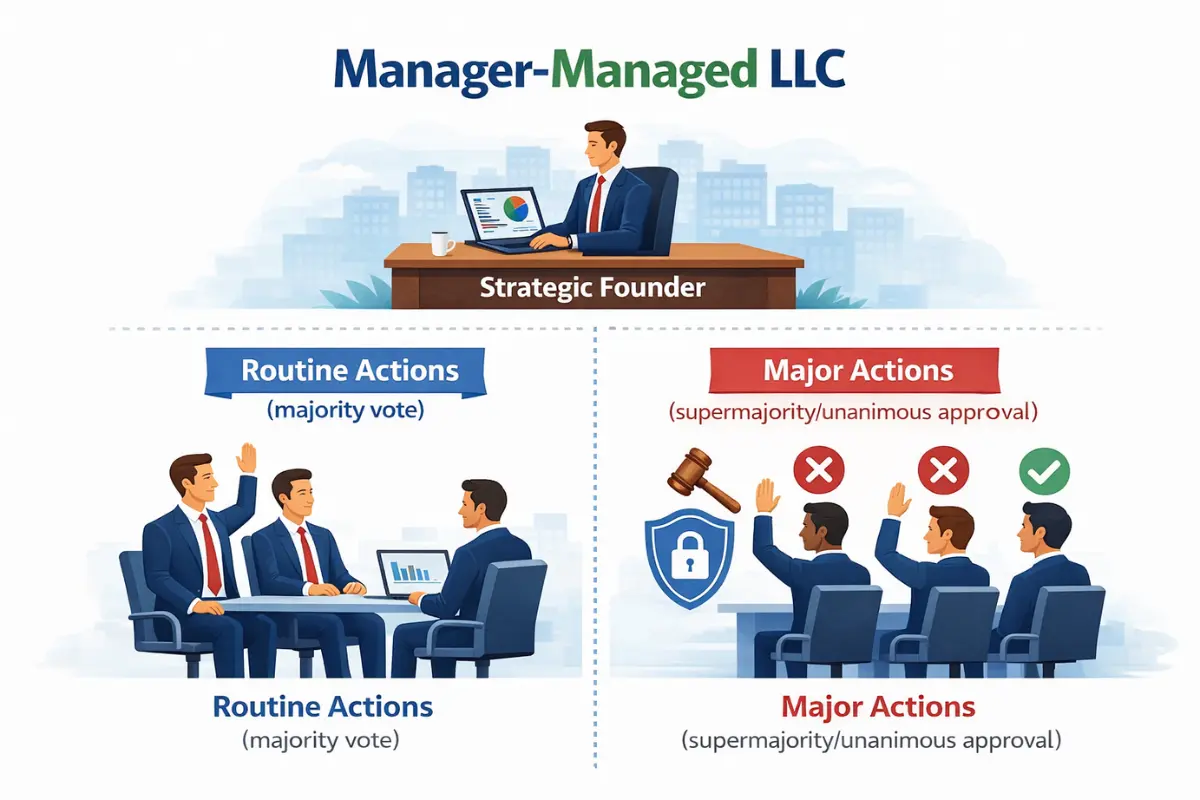
Explicitly state which model is being used—member-managed or manager-managed. In 2026, many growing service businesses are moving to "Manager-Managed" structures, allowing founders to focus on strategy while designated managers handle daily operations. Member-managed LLCs operate like partnerships, where all members participate in management, while manager-managed LLCs operate more like corporations with designated managers directing operations.
Distinguish between "Routine Actions" requiring simple majority approval and "Major Actions" requiring unanimous or supermajority consent to protect member interests. Major actions typically include taking on debt exceeding specified thresholds (commonly $25,000-$100,000 depending on LLC size), selling all LLC assets or merger transactions substantially, amending the operating agreement itself, admitting new members or changing ownership structure, changing the LLC's business purpose or dissolving the entity, and making distributions exceeding normal quarterly amounts.
Establish the standard of care for managers and members, including non-compete and confidentiality clauses to protect the LLC's proprietary trade secrets and customer relationships. Fiduciary duties require managers and managing members to act in the LLC's best interest, avoid conflicts of interest, and maintain the confidentiality of sensitive business information.
LLC member rights should be clearly enumerated, including voting rights on major decisions, information rights to inspect the books and records, distribution rights to share in profits, and transfer rights subject to restrictions in the agreement.
Dispute Resolution and Dissolution
The "end-game" procedures prevent long-term legal deadlocks and provide clear paths for resolving conflicts before they destroy the business. A well-drafted dispute resolution clause can save tens of thousands in litigation costs and preserve business confidentiality.
Require that internal disputes be settled through private mediation and arbitration rather than public courtrooms to preserve business privacy and reduce costs. The typical escalation provides for negotiation between the members, followed by formal mediation with a neutral third party, and, if earlier methods fail to resolve the conflict, binding arbitration as successive steps.
Specify the arbitration organization (the American Arbitration Association is most common for business disputes), the number of arbitrators (one for smaller disputes under $100,000, three for major conflicts), and how arbitrator selection occurs. Include cost allocation provisions—typically splitting arbitration costs equally unless one party acted in bad faith.
Define the order of operations for closing the business under the dissolution clause: paying creditors and lenders first, returning members' capital contributions second, and finally distributing the remaining assets according to profit-sharing percentages. The dissolution priority prevents disputes during wind-down by establishing who gets paid in what order.
Most agreements follow this priority: (1) outside creditors receive full payment, (2) member loans to the LLC are repaid, (3) original capital contributions are returned, (4) remaining assets are distributed per profit-sharing percentages. This structure ensures outside creditors are paid first (protecting member limited liability protection), original investments are returned second, and profits are distributed last.
Include procedures for voluntary dissolution requiring unanimous or supermajority member approval, and specify whether business succession clause provisions allow the LLC to continue despite member departure. Understanding corporate dissolution procedures helps ensure a clean business wind-down when necessary.
Get Your Agreement 2026-Ready Today
A comprehensive 2026 Operating Agreement serves as the best defense against internal disputes and federal non-compliance penalties. The single-member LLC operating agreement requires the same careful drafting as multi-member versions to demonstrate a separation between the owner and the entity, thereby protecting limited liability.
The agreement proves particularly crucial during bank loan applications, annual compliance filings, dispute resolution, IRS audits, member exits, and BOI reporting obligations under the Corporate Transparency Act.
Explore InCorp's business services to ensure formation documents meet modern legal standards and 2026 compliance requirements. InCorp's document preparation services handle operating agreement drafting, registered agent appointment through professional services, and ongoing compliance monitoring to maintain Good Standing status.
InCorp is not a law firm and does not provide legal or financial advice. This information is educational. Readers should consult with qualified legal and tax professionals.
Consider a professional review of your LLC agreement template rather than relying solely on free online forms that may not address 2026 updates. Templates provide useful starting points but rarely address industry-specific issues, multi-state operations, or complex ownership structures without customization. InCorp's business services offer professional document preparation with experienced legal counsel.
FAQ's
Can an LLC have more than one operating agreement on file?
No. An LLC should operate under a single, controlling Operating Agreement at any given time. Any changes are handled through formal amendments approved in accordance with the amendment procedures specified in the agreement—typically requiring unanimous or supermajority approval by members. Having multiple agreements creates confusion about which provisions govern and can lead to disputes over which version controls specific situations.
Is an Operating Agreement required to be notarized or filed with the state?
In most states, no. Operating Agreements are internal documents and are typically not filed publicly with the Secretary of State or other authorities. The agreement remains private between members, unlike Articles of Organization, which become public record accessible to competitors. However, notarization may add evidentiary strength if disputes arise, demonstrating the document's authenticity and the signers' identities at the time of execution. Some lenders or banks may require notarized agreements before extending credit to demonstrate proper LLC formality.
Can an Operating Agreement override state default LLC rules?
Yes, in many cases. The agreement may modify default statutory rules, provided it does not violate mandatory state or federal laws that cannot be waived by contract. Most LLC statutes provide default rules that apply only "unless otherwise provided in the operating agreement," giving members substantial freedom to customize their governance structure. However, certain provisions cannot be waived—such as the duty of loyalty, the duty of care in some states, and statutory dissolution grounds. Review your state's LLC act to identify which provisions are mandatory versus default rules that can be modified.
Does an Operating Agreement apply to single-member LLCs as well?
Yes. Even single-member LLCs benefit from an operating agreement that demonstrates separation between the owner and the entity for liability protection. Courts examining whether to pierce the corporate veil look for evidence that the LLC operated as a distinct entity rather than the owner's alter ego. A written operating agreement, even for a single member, provides documentary evidence of this separation and proper business formality. The agreement should still address the management structure, capital contributions, distribution procedures, and dissolution procedures to demonstrate the LLC's independent operation, separate from the members' personal affairs.
How does an updated LLC operating agreement help protect my personal assets?
A well drafted operating agreement reinforces that the limited liability company is a separate legal entity, distinct from its owners, by documenting capital contributions, management structure, and formal decision making processes. When the LLC consistently follows the written operating agreement instead of relying on verbal agreements, it strengthens limited liability protection and helps prevent creditors or courts from trying to reach members' personal assets in legal trouble involving the business.
What key provisions should most operating agreements include to support long-term success?
Most operating agreements should clearly cover ownership percentages and voting rights, capital contributions and profit distribution, management structure (member managed or manager managed), dispute resolution and dissolution procedures, and rules for admitting or removing members. Including specific language for various scenarios gives business owners clear guidelines when disagreements arise and helps new business owners avoid being governed solely by the state's default rules.
Is a template operating agreement enough, or should it be customized for my company?
An operating agreement template can provide basic information and a starting framework, but it rarely addresses the specific needs of your ownership structure, financial arrangements, or industry risks. Customizing the agreement with expert guidance from legal professionals ensures that key provisions, like how major decisions are made or how one partner can be bought out, actually fit your company and protect your business in real‑world scenarios.
Do single-member LLCs really need an operating agreement?
Yes. Even though there is only one owner, single member LLCs benefit from a written operating agreement that documents the business structure, management, and financial provisions. This vital document helps demonstrate that the LLC is being operated as a separate legal entity, which supports limited liability status and may be important when dealing with lenders, potential investors, or questions about personal liability.
How does an operating agreement support smooth operations in multi-member LLCs?
In multi member LLCs, the operating agreement serves as the central reference for how members share ownership interest, how profits and losses are allocated, and who has authority over different types of decisions. By setting out clear operational conditions, such as which major decisions require unanimous consent versus a majority owner vote, the agreement reduces conflict among business partners and keeps management focused on running the company rather than renegotiating rules during a dispute.
Disclaimer: This content is intended for general educational and informational purposes only and does not constitute legal, tax, or accounting advice. Every effort is made to keep the information current and accurate; however, laws, regulations, and guidance can change, and no representation or warranty is given that the content is complete, up to date, or suitable for any particular situation. You should not rely on this material as a substitute for advice from a qualified professional who can consider your specific facts and objectives before you make decisions or take action.