

An accounting firm owner discovered during tax preparation that she'd overlooked thousands in eligible deductions. Missing the qualified business income deduction alone cost her $8,000. After the One Big Beautiful Bill Act (OBBBA) passed in July 2025, permanently restoring 100% bonus depreciation and extending key provisions, she worked with a tax professional to understand all available LLC tax deductions and saved $18,000 the following year.
The Limited Liability Company operates as a pass-through entity where business profits and losses flow directly to owners' personal tax returns, avoiding double taxation. Understanding how to maximize business expense deductions in 2026 requires staying current with OBBBA provisions, annual inflation adjustments, and IRS guidance.
Staying up to date allows LLC owners to maximize cash flow and reduce their effective tax rates. Understanding tax implications specific to your LLC structure helps ensure compliance. According to Business Initiative surveys, many small businesses utilize the QBI deduction and bonus depreciation benefits, significantly affecting overall tax liability.

Key 2026 Tax Deduction Updates for LLCs
The 2026 tax year brings important updates driven by the One Big Beautiful Bill Act (OBBBA) of July 2025, including permanent 100% bonus depreciation, adjusted deduction limits, and inflation-indexed thresholds. Understanding incorporation options helps business owners choose optimal structures. Pass-through entities, such as most LLCs, pay taxes on individual returns, and proper deductions can dramatically lower taxable income, according to tax expert Manish Chanda.
The Permanent 20% Qualified Business Income (QBI) Deduction
The Section 199A deduction remains permanent following the Tax Cuts and Jobs Act, allowing eligible LLC owners to deduct up to 20% of their business income. The qualified business income deduction (QBI) can save tens of thousands of dollars annually for profitable LLCs, making it one of the most significant tax breaks for LLC owners.
For 2026, estimated phase-out thresholds are approximately $201,750 for single filers and $403,550 for joint filers (note: final 2026 thresholds will be published in IRS Revenue Procedure 2025-38; 2025 thresholds were $191,950/$383,900). Below these thresholds, eligible taxpayers claim the full 20% deduction. Above these amounts, the deduction may be limited based on W-2 wages or qualified property.
Specified service trades or businesses (SSTBs) face additional restrictions, including consulting, law, accounting, health, and financial services. Understanding QBI deduction mechanics helps maximize this benefit.
Key Takeaways
-
The 2026 landscape is unusually favorable for LLCs because OBBBA made the 20% QBI deduction permanent and restored 100% bonus depreciation for qualifying assets, creating major opportunities for tax savings when planning equipment purchases and income levels.
-
Section 179 expensing limits and standard deductions have been significantly increased for 2026, and the business mileage rate is set at 72.5 cents per mile, so LLC owners should revisit whether to use mileage vs. actual expenses and how to structure first‑year write‑offs.
-
Ordinary and necessary business expenses—home office, digital marketing, professional services, and ongoing operating costs—remain the core of LLC tax planning and are deductible whether the owner uses the standard or itemized deduction on their personal return.
-
Employers can combine enhanced retirement-plan startup credits under SECURE 2.0 with deductions for health insurance and HSA contributions to lower current tax liability while improving benefits, which is especially valuable for small LLCs competing for employees.
-
Compliance details like issuing 1099‑NEC forms for contractors, correctly classifying commuting vs. business travel, and respecting hobby‑loss and passive‑activity rules are essential to keep deductions intact and avoid audit adjustments.
2026 Bonus Depreciation: 100% Deduction Restored
For 2026, the One Big Beautiful Bill Act (OBBBA) enacted in July 2025, permanently restored 100% bonus depreciation for qualifying property placed in service. This represents a significant improvement over the previously scheduled phase-down that would have reduced bonus depreciation to 20% in 2026. The depreciation and amortization benefit now provides immediate full expensing for qualifying equipment purchases.
Qualifying property includes most tangible personal property with recovery periods of 20 years or less, certain computer software, and qualified improvement property. LLC owners making significant equipment purchases in 2026 can now deduct 100% of the cost in year one, providing substantial cash flow benefits for capital-intensive businesses.
Section 179 Deduction Limits
For 2026, the Section 179 deduction limit is estimated at approximately $1.3 million, with phase-out beginning around $3.27 million in total equipment purchases. Section 179 allows businesses to immediately expense qualifying equipment, providing significant first-year deductible business expenses.
LLC owners can strategically combine Section 179 with the restored 100% bonus depreciation under OBBBA to maximize first-year deductions. With 100% bonus depreciation now permanent, most qualifying equipment can be fully expensed in year one.
Updated 2026 Standard Deductions and Mileage Rates
The IRS makes annual inflation adjustments that impact how LLC owners choose between standard and itemized deductions on personal returns. Understanding the difference between standard and itemized deductions helps optimize tax planning.
2026 Standard Deduction Levels
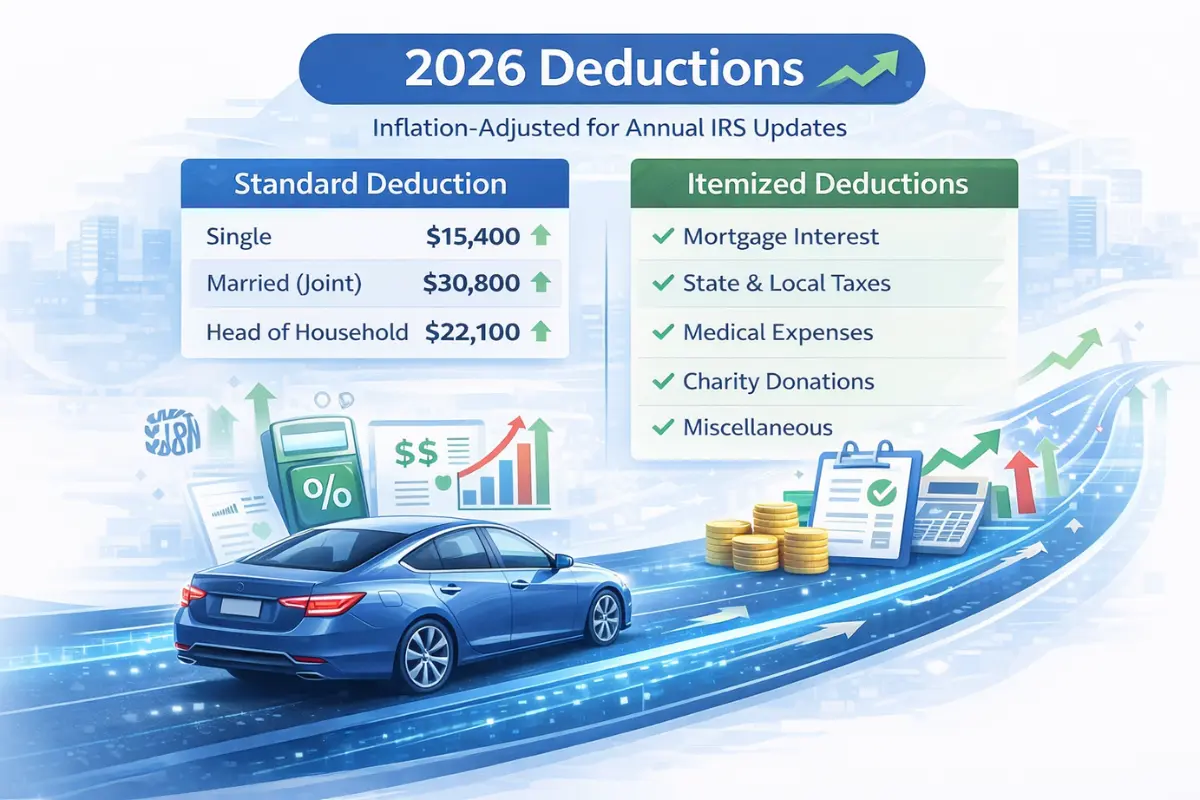
The estimated standard deduction amounts for 2026 are:
-
Single / Married Filing Separately: $16,100
-
Married Filing Jointly: $32,200
-
Head of Household: $24,150
These amounts represent the baseline deduction available to all taxpayers regardless of actual itemized expenses, providing simplified tax filing for many LLC owners whose itemized deductions fall below these thresholds.
2026 Standard Mileage Rate
The business mileage deduction is estimated at 72.5 cents per mile for 2026, reflecting higher fuel and maintenance costs. This simplified method allows LLC owners to deduct vehicle and travel expenses without tracking actual costs for gas, repairs, insurance, and depreciation. Owners must maintain a contemporary mileage log documenting dates, destinations, business purposes, and miles driven to substantiate this deduction during potential audits.
Strategic Business Operations Deductions
Ordinary and necessary business expenses remain the bedrock of LLC tax planning, providing dollar-for-dollar reductions in taxable income. Understanding IRS deductions for LLCs ensures compliance and maximizes tax savings. These deductible business expenses are available regardless of whether owners take the standard or itemized personal deduction. The IRS defines ordinary expenses as common in your industry, while necessary expenses are helpful for your business operations.
Home Office and Virtual Workspace
LLC owners can deduct home office expenses using either the Simplified Method ($5 per square foot up to 300 square feet, maximum $1,500) or the Actual Expense Method (pro-rata share of mortgage, utilities, insurance, repairs).
The home office must serve as the principal place of business or be used exclusively for client meetings. Detailed guidance on home-based business tax deductions helps maximize this deduction.
Advertising, Marketing, and Digital Presence
LLC owners can deduct 100% of costs for website development, SEO services, social media advertising, and email marketing software. These deductible business expenses include domain registrations, hosting fees, professional photography, graphic design services, and promotional events.
Professional Services and Education
The professional fees deduction includes legal fees for business matters, accounting services for bookkeeping and tax preparation, and business consulting. Professional coaching or certifications that improve skills in your current business are fully deductible.
Employee-Related Tax Credits and Incentives
LLCs with employees can access valuable tax credits that provide dollar-for-dollar reductions in tax liability, making them more valuable than deductions that only reduce taxable income. Payroll and benefits deductions include all employer-paid payroll taxes, workers' compensation insurance, health insurance deduction premiums, and qualified retirement plan contributions.
Retirement Plan Startup Credits
The SECURE 2.0 Act offers tax credits covering up to 100% of administrative costs for starting new retirement plans for up to 3 years. Small businesses with 50 or fewer employees can claim up to $5,000 in annual credits for setup and administration costs. Additional credits apply for employer contributions to employee accounts, with retirement plan tax credits potentially reaching $16,500 when combining all available incentives.
These credits significantly reduce the cost of establishing 401(k), SIMPLE IRA, or SEP-IRA plans, making retirement benefits more accessible for small LLCs competing for quality employees.
Employee Benefits Deductions
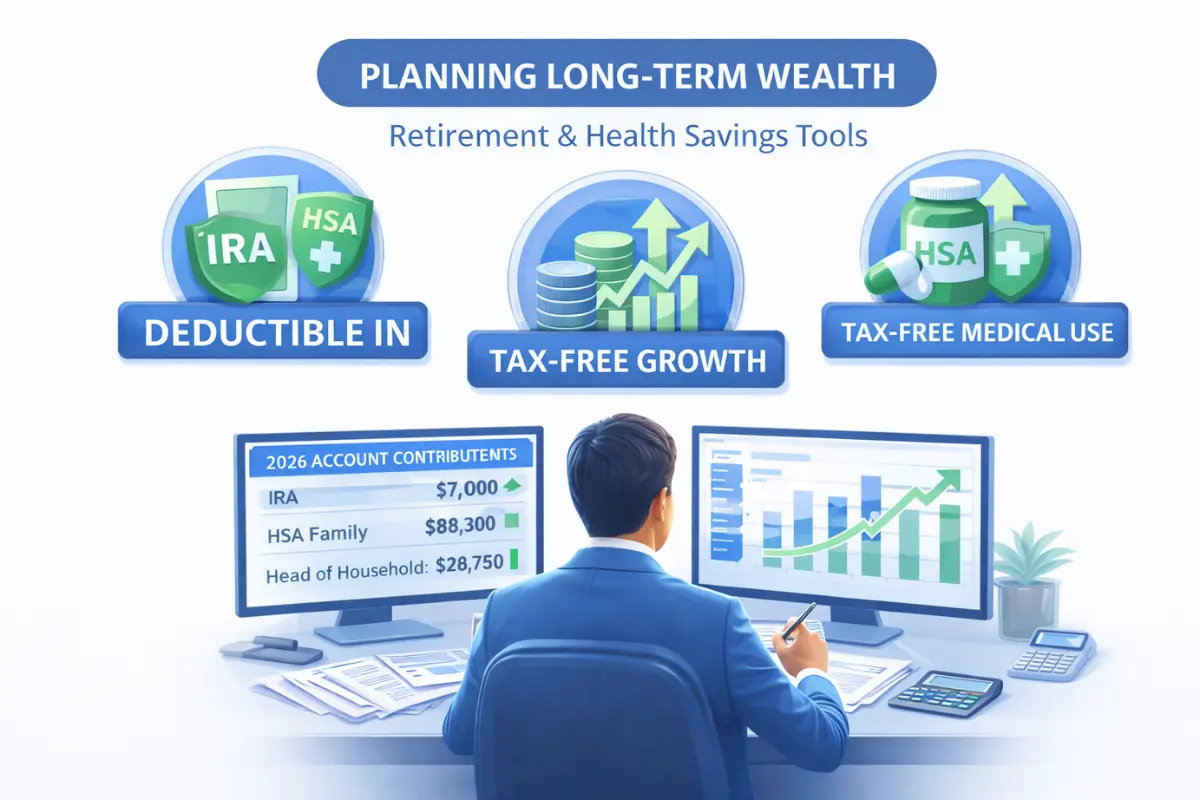
Employer contributions to employee health insurance, retirement plans, and fringe benefits are fully deductible. For 2026, HSA contribution limits are estimated at $4,300 for individual coverage and $8,550 for family coverage, with additional $1,000 catch-up contributions for those 55 and older.
Maximizing Retirement and Health Savings
Self-employed LLC owners can use tax-advantaged accounts to reduce taxable income, build wealth, and protect against medical expenses. These strategies provide immediate tax deductions, tax-deferred growth, and tax-free withdrawals for qualified purposes.
Retirement options include SEP-IRAs, Solo 401(k)s, SIMPLE IRAs, and traditional or Roth IRAs. Updated contribution limits allow up to $70,000 in combined contributions (plus catch-up contributions for those 50 and older). The health insurance deduction allows self-employed LLC owners to deduct premiums for medical, dental, and vision insurance.
The 2026 HSA contribution limits reach $4,300 for individual coverage and $8,550 for family coverage, with an additional $1,000 catch-up for those 55 and older. HSA contributions are "triple-tax-advantaged": deductible when contributed, growing tax-free, and withdrawn tax-free for qualified medical expenses. Unlike FSAs, HSA balances roll over indefinitely.
Essential Reporting Requirements and Compliance
Administrative requirements affecting deductions must be addressed to avoid compliance issues. Staying current prevents costly mistakes and audit triggers.
1099-NEC Reporting for Contractors
For 2026, LLC owners must issue Form 1099-NEC to any contract labor expenses totaling $600 or more during the year. This threshold remains unchanged. Failure to issue required 1099 forms can result in penalties ranging from $50 to $290 per form.
The IRS has proposed changes to 1099 reporting requirements, including adjustments to Form 1099-K thresholds, but the 1099-NEC $600 threshold for direct contractor payments remains in effect.
Research and Development Costs
Under current law, domestic Research and Development costs must be amortized over five years. This requirement continues through 2026. Technology companies and manufacturers should account for this five-year amortization when planning R&D investments.
Interest Expense Limitations
Business interest expense deductions remain subject to Section 163(j) limitations. For most businesses, interest expense is deductible up to 30% of adjusted taxable income calculated using EBIT (earnings before interest and taxes). This limitation particularly affects capital-intensive businesses with significant debt financing.
Avoiding Common Deduction Pitfalls and Audit Triggers
Aggressive gray area deductions can lead to IRS scrutiny, penalties, and interest charges that eliminate any perceived tax savings. Understanding the clear boundaries between deductible business expenses and non-deductible personal costs protects LLC owners from audit risk and ensures that tax audit proof documentation supports all claimed deductions.
Commuting vs. Business Travel
Driving from home to a fixed office location constitutes non-deductible commuting, regardless of whether the office is owned, rented, or home-based when it serves as the principal place of business. Vehicle and travel expenses are deductible when traveling between two business locations, from the office to client sites, or when the personal residence qualifies for the home office deduction and establishes a tax home. Maintaining detailed logs that distinguish commuting from business travel is essential during audits.
Personal vs. Business Meals
Business meals are generally 50% deductible and must have a clear business purpose, with documentation of attendees, the business relationship, and the topics discussed. Meals while traveling for business or provided to employees at company events may qualify for different deduction percentages. Lavish meals or solo meals without a business purpose are not deductible.
Bookkeeping for deductions requires maintaining receipts, contemporaneous logs, and clear documentation separating business from personal expenses. The best protection against audit adjustments comes from treating the LLC as a separate entity, maintaining dedicated bank accounts, and keeping meticulous records.
Optimize Your 2026 Tax Strategy Today
The 2026 tax landscape offers significant opportunities for proactive LLC owners with OBBBA's permanent 100% bonus depreciation. Strategic planning requires understanding how deductions interact with the QBI deduction and self-employment tax calculations. Coordinating major equipment purchases to maximize Section 179 and bonus depreciation, maximizing retirement contributions, and documenting all office supplies and business expenses ensure optimal outcomes.
The difference between average and excellent tax planning frequently exceeds $10,000 annually for established LLCs.
Explore InCorp's business formation and compliance services to ensure your LLC is structured for maximum tax efficiency. Understanding the distinction between Good Standing vs Compliance helps maintain eligibility for all available deductions.
InCorp is not a law firm and does not provide legal or financial advice. This information is educational. Readers should consult with qualified tax professionals.
The EntityWatch® system helps LLC owners stay ahead of state-level filing deadlines and maintain Good Standing. Visit InCorp's business services to discover comprehensive solutions supporting tax planning, compliance, and growth.
FAQ's
Do LLC tax deductions differ by state in 2026?
Yes. While federal deductions remain consistent nationwide, states may disallow or modify certain deductions when calculating state taxable income. For example, some states don't conform to federal bonus depreciation rules or limit deductions for business interest expense. State-level rules for Section 179 deductions, net operating loss carryforwards, and QBI deductions vary significantly. LLC owners should review state-specific tax guidance or consult tax professionals familiar with their state's conformity to federal tax law.
Can newly formed LLCs claim deductions in their first tax year?
Yes. Eligible startup cost deductions and operational expenses are deductible even if the LLC operated for only part of the year. LLCs can deduct up to $5,000 of startup costs in the first year, with any amount exceeding this limit amortized over 180 months. Once the business begins active operations, all ordinary and necessary expenses incurred become immediately deductible. Obtaining an EIN from the IRS establishes the business's tax identity and enables proper tracking of deductions from day one.
Are deductions affected if an LLC has no profit in 2026?
Losses may still be reported and potentially offset other income, depending on IRS passive activity and at-risk rules. Pass-through losses flow to owners' personal returns, where they can offset wage income, investment income, or other business profits subject to certain limitations. Material participation requirements determine whether losses are immediately deductible or must be suspended until the activity generates income or is disposed of. Net operating losses that exceed all income sources may be carried forward to future tax years indefinitely under current law.
Do part-time or side-hustle LLCs qualify for the same deductions?
Yes, provided the activity is operated with a genuine profit motive and proper records are maintained. The IRS presumes a profit motive if the business shows profit in at least three of five consecutive years. Hobby loss rules disallow deductions exceeding income for activities lacking profit intent. Part-time LLCs qualify for all the same deductions as full-time businesses, including home office deductions, vehicle expenses, equipment purchases, and the QBI deduction. Maintaining professional business practices, separate bank accounts, and detailed documentation of tax breaks for LLC owners proves a profit motive during potential audits.
How can I keep my business deductions separate from personal expenses to avoid problems at tax time?
Open a dedicated business bank account and use it exclusively for business income, business loans, and deductible business expenses such as legal fees, accounting fees, business insurance premiums, and office supplies. Keeping business and personal finances separate makes it easier to track write offs, document small business tax deductions, and prove to a tax professional or auditor that transactions are truly related to business operations, not personal spending.
Which startup and organizational costs can an LLC usually deduct in the first year?
Many pass through business owners can deduct a portion of startup costs—like market research, initial advertising, and certain professional fees—and organizational costs such as state filing fees and legal fees for drafting the operating agreement. Subject to IRS limits, some startup and organizational costs may be written off in the first year, with the remainder amortized over time, helping reduce taxable income even when the LLC is just getting established.
How do home office expenses work for LLC owners in 2026?
If you regularly and exclusively use part of your home as your principal place of business or for meeting clients, you may qualify for the home office deduction. You can either use the simplified method (a flat rate per square foot) or the actual expense method, which allocates a share of mortgage interest, rent, utilities, property taxes, and certain repairs to your home office; in both cases, you must keep clear records and avoid mixing personal and business use in the same space.
Are retirement contributions and health insurance premiums tax‑favored for self‑employed LLC owners?
Yes. Eligible self employed LLC owners can often deduct contributions to qualified retirement plans (like a SEP‑IRA or Solo 401(k)) as business deductions or above‑the‑line adjustments that lower adjusted gross income. Many can also deduct health insurance premiums for themselves and their families, which reduces taxable income on their personal tax return and can provide substantial long‑term tax savings when coordinated with a qualified tax professional.
What are some of the most common small business tax deductions that LLC owners overlook?
Commonly missed deductions include business insurance premiums, a portion of cell phone and internet bills used for business, business meals with a documented business purpose, parking fees and tolls for business travel, and small recurring costs like accounting software or cloud storage. Pass through entities may also overlook valuable credits, such as the work opportunity tax credit, that can directly reduce a tax bill instead of merely lowering taxable income.
Disclaimer: This content is intended for general educational and informational purposes only and does not constitute legal, tax, or accounting advice. Every effort is made to keep the information current and accurate; however, laws, regulations, and guidance can change, and no representation or warranty is given that the content is complete, up to date, or suitable for any particular situation. You should not rely on this material as a substitute for advice from a qualified professional who can consider your specific facts and objectives before you make decisions or take action.