

A tech startup spent six months developing their product and signed their first major client only to discover their Articles of Incorporation had been rejected due to a naming conflict. They lost the client contract and delayed their launch by four months.
Situations like this usually come down to misunderstandings about what Articles of Incorporation are and what states require.
Articles of Incorporation (also known as a Certificate of Incorporation or Corporate Charter) are the foundational legal document filed with the Secretary of State to form a corporation. This document acts as the "birth certificate" of the business, officially establishing it as a separate legal entity formation distinct from its owners. The SBA reports that small businesses make up 99.9% of all U.S. firms, with many choosing formal legal structures such as corporations or LLCs.
While specific requirements vary by state in 2026, most jurisdictions require a core set of mandatory provisions for approval of the filing.
Key Takeaways
-
A rejected Articles of Incorporation filing can delay launches and cost major client relationships, especially when issues like name conflicts aren’t caught early with a proper name search.
-
Articles of Incorporation function as the foundational “birth certificate” of a corporation, establishing it as a separate legal entity and defining core details like name, address, purpose, governance, and stock structure.
-
Most states require the Articles to include a compliant corporate name, a physical principal business address (no P.O. boxes), and a registered agent with a street address in the state to receive legal and government documents.
-
The Articles must clearly describe the corporation’s purpose, authorized shares, classes of stock, and par value to support future fundraising, protect investor rights, and avoid repeated amendments as the business grows.
-
Governance details such as the incorporator, initial board of directors, and corporate duration (usually perpetual) are typically included so the corporation has a defined decision-making structure from day one.
-
Optional provisions like director/officer liability limitations, indemnification, and preemptive rights—can strengthen protection for leadership and tailor shareholder rights beyond default state rules.
-
Articles of Incorporation are public record, while bylaws remain internal; corporations often need certified copies of their Articles for banking, licensing, or qualifying to do business in other states.
-
Filing the Articles is only the first step; ongoing compliance, a reliable registered agent, and monitoring tools like InCorp’s EntityWatch® help maintain good standing, avoid missed annual reports, and preserve limited liability protection.
Essential Mandatory Provisions
Every state requires basic information to identify and communicate with the new corporation. These mandatory provisions form the foundation of your certificate of incorporation and must be complete and accurate for state approval.
Corporate Name
The corporate name must include a corporate designator such as "Corporation," "Incorporated," "Limited," or abbreviations like "Inc.," "Corp.," or "Ltd." The name must be distinguishable from existing entities in that state.
State databases provide online name search tools to check availability before filing. Understanding corporation and LLC name requirements helps avoid costly rebranding after formation.
Most states prohibit the use of certain words, such as "bank," "insurance," or "university," without additional documentation proving licensure or regulatory approval.
Principal Business Address
The principal business address identifies the physical location of the corporation's main office. Most states prohibit the use of a P.O. Box for this requirement. The address appears on public records and serves as the official location for business communications.
This address doesn't need to be expensive commercial real estate—a home office qualifies if the corporation conducts business there.
Registered Agent Information
Every corporation must designate a registered agent—a person or service authorized to receive legal "service of process" and official government mail. The registered agent must have a physical street address in the state of formation and be available during normal business hours.
Understanding the responsibilities of a registered agent clarifies why this role is critical. The registered agent receives lawsuit notices, tax documents, and annual report reminders. Missing these notices can result in default judgments or administrative dissolution.
While corporations can designate an officer as a registered agent, professional services offer significant advantages, protecting personal privacy and ensuring reliable receipt of documents.
Business Purpose
The business purpose clause states the corporation's intended activities. In 2026, most states allow a "general purpose" clause, typically worded as "to engage in any lawful activity", providing maximum operational flexibility.
General-purpose clauses eliminate the need to amend Articles whenever the corporation expands into related business lines. Some states require specific purpose statements for professional corporations or nonprofit corporations.
Capital Structure and Stock Authorization
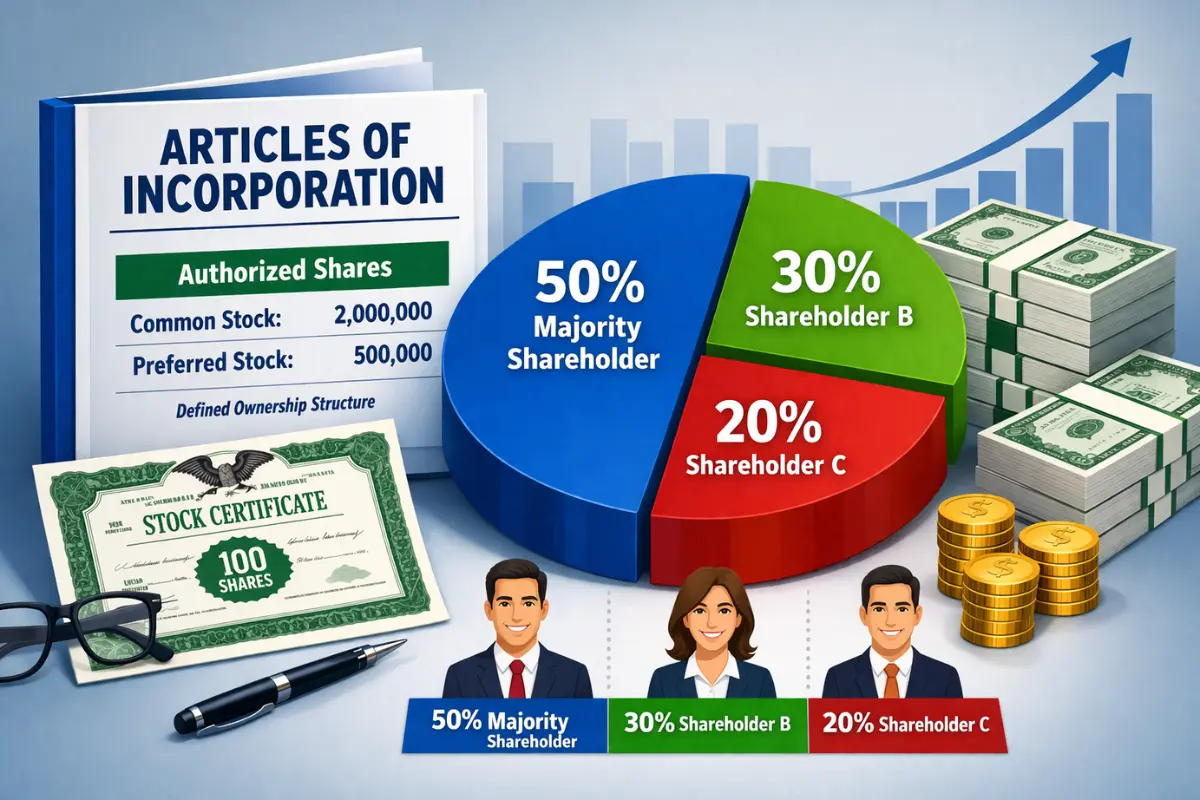
Because shareholders own corporations, the Articles must define the shareholder structure and ownership framework. These provisions establish how ownership is divided, what rights different shareholders possess, and how the corporation will raise capital through equity. The corporate governance structure depends on properly documenting authorized shares, share classes, and par value in the Articles to ensure legal compliance and investor confidence.
Authorized Shares
Authorized shares represent the maximum number of shares the corporation is legally allowed to issue. This number should be set high enough to accommodate future growth without requiring amendments.
Delaware allows corporations to authorize millions of shares with minimal impact on filing fees. California charges higher fees for corporations authorizing over 1 million shares.
Authorized shares don't need to be issued immediately. The Articles specify the authorization ceiling, while the board of directors determines actual issuance.
Classes of Stock
If the corporation will have multiple tiers of ownership—such as Common Stock and Preferred Stock—the Articles must outline the specific rights, preferences, and voting powers of each class.
Understanding the business valuation of multi-tiered entities becomes critical when creating multiple share classes. The Articles must specify for each class: voting rights, dividend rights, liquidation preferences, conversion rights, and redemption provisions.
Par Value
Par value represents the nominal face value assigned to each share. Most corporations set par value at a fraction of a cent ($0.001 or $0.0001 per share) for tax and accounting purposes.
Some states use par value to calculate franchise taxes or filing fees. Setting the par value extremely low essentially eliminates concerns about the minimum issuance price.
Governance and Incorporator Details
The Articles detail the individuals responsible for the entity's initial creation and management, establishing a corporate governance structure from inception. The incorporator signs and files the document, while the initial board of directors manages the corporation's early operations and adopts bylaws to guide ongoing decision-making.
Incorporator Information
The incorporator is the person or entity who signs and files the Articles with the state. The incorporator can be anyone—a founder, attorney, or corporate service provider.
The incorporator's authority is temporary. If the Articles name initial directors, the incorporator's role ends upon filing. If not, the incorporator elects the initial board, then steps aside.
Initial Board of Directors
Many states require the Articles to list the names and addresses of individuals who will serve as the first board of directors until the first annual shareholder meeting. The initial board adopts bylaws, appoints officers, and conducts organizational activities.
The number of required directors varies by state. Delaware requires only one director. California requires at least three directors unless the corporation has fewer than three shareholders.
Duration of the Corporation
Nearly all corporations list duration as "perpetual," meaning the business exists indefinitely unless formally dissolved. Perpetual duration is one of the corporation's key advantages; the entity continues to exist regardless of changes in shareholders.
Some corporations formed for specific projects can specify an end date.
Optional and Protective Provisions
Beyond mandatory requirements, the Articles can include additional clauses customizing the corporation's legal protections and internal rules. These optional provisions override default state law rules, tailoring the corporation to specific needs.
Liability Limitation
Many Articles include provisions limiting director and officer liability for breaches of fiduciary duty to the extent permitted by state law. These clauses protect directors from personal financial liability for good-faith business decisions that turn out poorly.
Liability limitations typically protect against ordinary negligence but not intentional misconduct, fraud, or illegal acts. This protection helps attract qualified board members who might hesitate to serve due to liability concerns.
Preemptive Rights
Preemptive rights clauses grant existing shareholders the right to purchase new shares before they're offered to outside investors, helping them maintain their ownership percentage.
Most modern state corporation laws make preemptive rights optional—shareholders don't have them unless the Articles specifically grant them. Corporations planning venture capital fundraising typically exclude preemptive rights to streamline investment rounds.
Indemnification
Indemnification provisions state that the corporation will pay for legal defense costs if directors or officers are sued in their professional capacity. This protection applies when directors act in good faith and in the corporation's best interests.
State law often provides default indemnification rules, but including explicit language in the Articles strengthens these protections and demonstrates a commitment to protecting those who serve.
Post-Filing Compliance and the Role of InCorp
Filing the Articles is only the first step—the document must be supported by ongoing administrative discipline to maintain corporate compliance and preserve liability protection.
Bylaws vs. Articles
While Articles of Incorporation are public records filed with the state that contain high-level structural facts, bylaws are private, internal rules governing day-to-day operations. Articles establish what the corporation is; bylaws explain how it operates.
Bylaws can't contradict the Articles. The Articles function as the supreme governing document, with bylaws subordinate to them.
Registered Agent Reliability
Using a professional service like InCorp ensures that the address listed in the Articles remains current and that the corporation is immediately notified of legal actions. Understanding what a registered agent service provides clarifies the value beyond simple mail forwarding.
Professional registered agents scan and digitally forward documents immediately upon receipt, ensuring time-sensitive legal notices reach corporate officers within hours.
EntityWatch® Monitoring
InCorp's EntityWatch® system helps corporations track the "Effective Date" listed in their Articles and stay compliant with annual reports and other state deadlines. The system monitors state records in all 50 states, sending automated reminders before deadlines to prevent missed filings and administrative dissolution.
EntityWatch® proves particularly valuable for corporations qualified to do business in multiple states. Each state has different annual report deadlines, filing fees, and reinstatement procedures. EntityWatch® consolidates all deadlines into a single dashboard.
Form Your Corporation with Properly Filed Articles of Incorporation
The Articles of Incorporation are the critical first step in building a professional, scalable business structure. Properly drafted Articles establish limited liability protection, enable stock issuance for fundraising, create perpetual existence beyond founder tenure, and provide the legal framework for corporate governance and shareholder structure. Filing correct incorporation filing requirements with complete corporate formation documents protects your corporation from rejection delays and ensures smooth state approval.
Explore InCorp's business services to ensure your certificate of incorporation is drafted and filed correctly according to your state's 2026 regulations. From name availability searches to registered agent requirements and ongoing compliance monitoring, InCorp provides comprehensive support throughout the corporation formation process and beyond.
InCorp is not a law firm and does not provide legal or financial advice. This information is educational. Readers should consult with qualified legal and tax professionals.
Use InCorp's EntityWatch® system to monitor your corporation's standing and protect the legal foundation established by your Articles. Understanding how to incorporate a business correctly from the start prevents costly corrections, maintains limited liability protection, and positions your corporation for long-term success.
FAQ's
Can Articles of Incorporation be amended after filing?
Yes. Corporations can file Articles of Incorporation amendments (called "Articles of Amendment") with the state to update information such as name changes, stock structure adjustments, or registered agent changes. The amendment process typically requires the board of directors' approval and, for significant changes, such as increasing the number of authorized shares or changing shareholder rights, may also require shareholder approval. Amendments must be filed with the same state agency that accepted the original Articles, usually the Secretary of State, along with the required filing fee. Once approved, the amendments become part of the public record and supersede the original provisions they modify.
Are Articles of Incorporation public record?
Yes. Once filed and approved, Articles of Incorporation become publicly accessible through the state's business registry. Anyone can search the Secretary of State database to view a corporation's name, registered agent, principal address, authorized shares, and other information included in the Articles. This public accessibility serves important purposes; it allows potential business partners to verify corporate existence, enables creditors to identify the registered agent for service of process, and provides transparency about corporate structure. Bylaws, conversely, are private documents not filed with the state.
What happens if the Articles are rejected by the state?
The state will typically issue a notice explaining deficiencies, allowing corrections and resubmission. Common rejection reasons include name conflicts with existing entities, incomplete information, incorrect filing fees, or missing required provisions. Most states provide a window (typically 30-60 days) to correct deficiencies and refile without paying an additional filing fee. If the corporation doesn't correct the issues within the allowed timeframe, the filing is abandoned, and the corporation must start over with a new submission and a new filing fee. Working with experienced formation services reduces the risk of rejection.
Do all corporations need certified copies of their Articles?
Not always, but certified copies are often required for banking, licensing, or foreign qualification purposes. Banks typically request certified copies when opening corporate accounts to verify the corporation's legal existence and the identities of its authorized signers. Professional licensing boards may require them to issue business licenses. When qualifying to do business in another state (foreign qualification), that state's filing office usually requires certified copies of the home state Articles. Certified copies include an official seal and signature from the Secretary of State confirming the document's authenticity. Corporations should obtain several certified copies at formation to have them available when needed, as requesting them later involves additional fees and processing time. The EIN application process with the IRS may also request Articles as proof of corporate formation.
Do small business owners need Articles of Incorporation to get personal liability protection?
No. Articles of Incorporation are required to form a corporation, but small business owners can also obtain limited liability through other business entities, such as a limited liability company (LLC) using an operating agreement instead of Articles. What matters for personal liability protection is that you form a distinct legal entity (corporation or LLC) and keep business and personal finances separate, including maintaining a corporate bank account and proper corporate records.
How do Articles of Incorporation and corporate bylaws work together in the incorporation process?
Articles of Incorporation (or corporate charter) are filed with the state's Secretary of State to create the legal existence of the corporation and include basic business information such as the corporate name, principal office address, registered agent, authorized shares, and business purpose. Corporate bylaws are internal documents adopted after you file Articles; they create the detailed legal framework for corporate structure, shareholder meetings, corporate duties, and decision‑making rules.
What tax and fee obligations should new corporations expect after they file Articles of Incorporation?
Beyond the state filing fee to file Articles, corporations may owe ongoing franchise taxes, corporate taxes or pass‑through income tax (for S corporation elections), and state tax registration requirements such as sales tax registration. Most corporations must also obtain a federal employer identification number (EIN), pay income tax at either the entity or shareholder level depending on whether they are a C corporation or S corporation, and budget for annual reports and other legal filings.
Do I still need business licenses and permits if I form a corporation or LLC?
Yes. Forming a separate legal entity does not replace the need for obtaining business licenses, health permits, or other approvals from local and state government agencies. Even if you have strong liability protection through a C corp, S corp, or LLC, you must meet all licensing and regulatory requirements for your business purpose to avoid legal complications and fines.
How does forming a corporation or LLC help protect my personal assets from the company's debts?
When you form a corporation or limited liability company, the business becomes a distinct legal entity that is generally responsible for its own obligations, which can help shield your personal assets from the company's debts and lawsuits. To maintain this personal liability protection, most small business owners must keep proper corporate records, use a business address and corporate identifier on legal documents, avoid mixing business and personal finances, and stay current on annual reports and ongoing compliance obligations.
Disclaimer: This content is intended for general educational and informational purposes only and does not constitute legal, tax, or accounting advice. Every effort is made to keep the information current and accurate; however, laws, regulations, and guidance can change, and no representation or warranty is given that the content is complete, up to date, or suitable for any particular situation. You should not rely on this material as a substitute for advice from a qualified professional who can consider your specific facts and objectives before you make decisions or take action.