
Freelance LLC: Steps to Legally Transition from Freelance to LLC


A graphic designer working from home lost everything when a client sued over an alleged copyright violation. The designer had been freelancing for five years, earning six figures annually, but never formed an LLC. When the lawsuit was settled, the judgment exceeded her insurance coverage. Operating as a sole proprietor meant no separation between business and personal assets; one lawsuit destroyed her financial security.
The transition from default sole proprietorship to a formal Freelance LLC represents a professional milestone for independent workers. While freelancing starts with just a skill and a client, scaling a business in 2026 requires the legal and financial "firewall" that an LLC provides. Studies estimate that there will be about 73 million freelancers in the U.S. in 2025, reflecting the expanding scope and reach of freelance work. Globally, there are approximately 1.57 billion freelancers, making up nearly half of the worldwide workforce.
This guide outlines the exact steps required to dissolve your sole proprietorship and rebuild as a compliant, protected corporate entity. Understanding freelancer liability protection and the structural benefits of an LLC for independent contractor work ensures you can scale without risking personal assets.
Key Takeaways
-
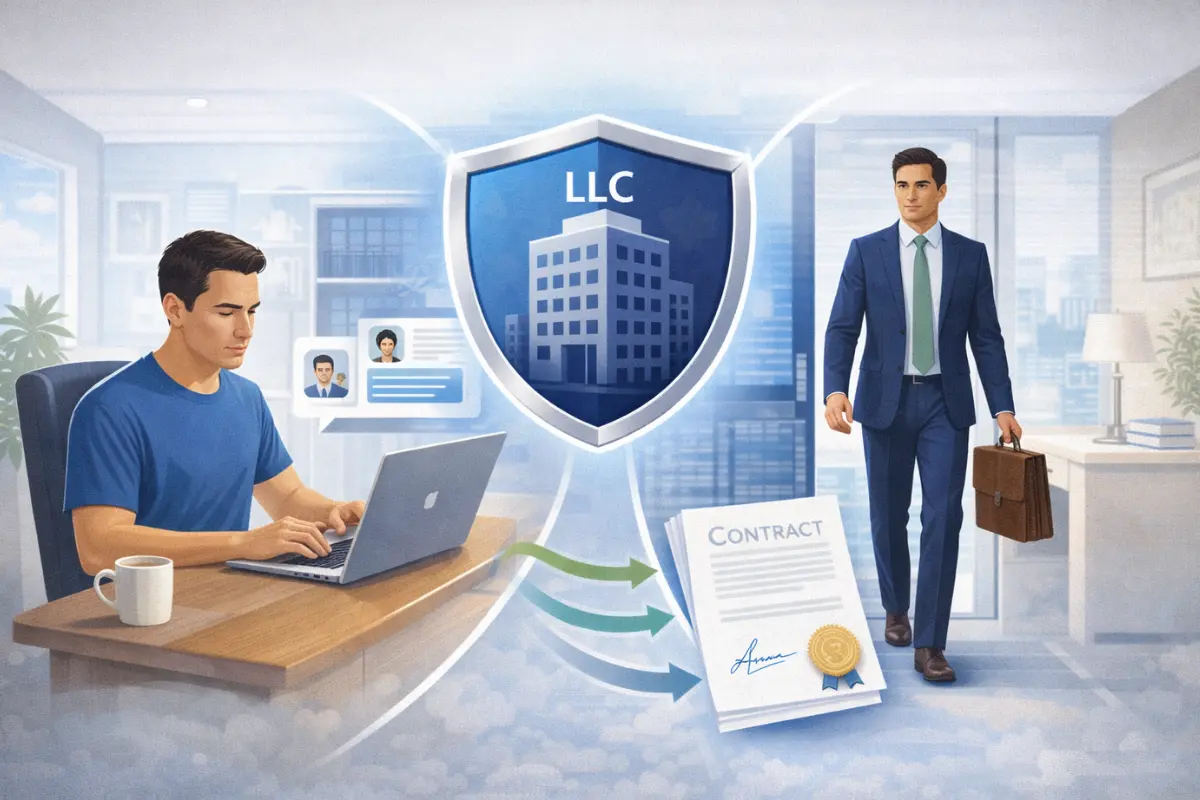
Transitioning from a default sole proprietorship to an LLC creates a legal “firewall” that separates your personal assets from business liabilities when freelancing income and client exposure grow.
-
Forming a freelance LLC requires state-level steps—clearing a unique name, appointing a registered agent, filing Articles of Organization, and adopting an operating agreement—to establish a separate legal entity.
-
A new LLC generally needs its own EIN, dedicated bank accounts, and clean bookkeeping so income and expenses are clearly traced to the entity, preserving liability protection and simplifying taxes.
-
Existing freelance contracts, licenses, and insurance policies should be migrated to the LLC, with updated W‑9s and client notices, so the entity—not the individual—is the party on the hook for future work.
-
New LLCs must also handle modern compliance requirements like BOI reporting deadlines and ongoing state filings; using tools such as EntityWatch® and professional registered agent services helps avoid missed reports and loss of good standing.
Step 1: Confirming Name Availability and Branding Rights
Your LLC name must be distinguishable from every other business entity registered in your state of formation. Even if you've been freelancing under a "Doing Business As" (DBA) name, you must check its availability specifically for LLC registration.
Search your Secretary of State's online database to ensure the name is available and doesn't infringe on existing trademarks. Ensure the name includes the mandatory designator; most states accept "LLC," "L.L.C.," or "Limited Liability Company."
Understanding fictitious business names helps clarify the difference between DBA registration and formal LLC formation. A DBA provides no limited liability protection. An LLC creates a separate legal entity that protects personal assets.
Step 2: Selecting a Professional Registered Agent
You must appoint a registered agent with a physical address in the state of formation to receive service of process and state notices. This legal requirement exists in all 50 states.
Freelancers working from home should avoid acting as their own agent. Your home address becomes public record when listed on state filings. You must be physically present during business hours to accept legal documents, which is impossible if you're traveling or working remotely.
A professional service like InCorp's registered agent services provides a presence that protects your home address from appearing on public databases. Professional agents ensure you never miss critical legal or tax deadlines. Missing service of process could result in a default judgment; you lose the case automatically.
Step 3: Drafting and Filing Articles of Organization
The Articles of Organization (also called Certificate of Formation) serve as the birth certificate of your LLC, establishing legal entity separation that protects personal assets.
Detail the essential information required: business name, registered agent details, management structure (member-managed vs. manager-managed), and effective date. Most single-member freelance LLCs choose a member-managed structure.
Submit the documents to the Secretary of State along with the mandatory filing fee, ranging from $40 to $500 depending on the state. Processing times vary: some states approve within 5-7 business days, others take 4-6 weeks.
Review New York's Articles of Organization requirements to understand state-specific filing procedures.
Step 4: Implementing a Formal Operating Agreement
While some states don't legally require a written operating agreement for single-member LLCs, it's essential for protecting your freelance business structure. This agreement outlines financial and operational rules that are vital to the "piercing the corporate veil" defense if someone sues you personally.
Document that you are the sole member and that the LLC is a separate entity following its own governance rules. Courts examining whether to pierce the veil look for evidence that you treated the LLC as distinct from yourself.
Use this document to specify management procedures and the disposition of assets if you dissolve the entity or bring on a partner. Address business compliance procedures, meeting requirements, and record-keeping standards.
Understanding whether you need an operating agreement for your LLC clarifies both legal requirements and practical benefits.
Step 5: Obtaining a New Federal Employer Identification Number (EIN)
A freelancer's existing sole proprietor EIN or Social Security Number cannot be used for the new LLC. The IRS requires a new EIN because the LLC is a distinct taxpayer.
Apply for the EIN application for free through the IRS website; this number will be used for all W-9s, tax filings, and banking. The online application provides your EIN immediately upon completion.
In 2026, most banks require this EIN before opening a business account. Single-member LLCs receive EINs even without employees. You'll use this number on Schedule C filing when reporting business income and when applying for business credit.
Obtain your EIN through InCorp's EIN application service for streamlined processing with guaranteed accuracy.
Step 6: Finalizing the Financial "Hard Reset"
Co-mingling personal and business funds is the fastest way to lose your LLC's liability protection. Courts can pierce the corporate veil if you fail to maintain clear financial separation.
Close any accounts associated with your former sole proprietorship or DBA. Open a new business checking and savings account strictly in the name of the LLC using your new EIN and approved Articles of Organization.
Update your bookkeeping software to treat all income and expenses as LLC-owned, ensuring a clean paper trail for the transition year. All post-formation revenue and expenses must flow exclusively through the LLC accounts.
Building business credit requires maintaining separate accounts and consistently using the LLC's EIN.
Step 7: Transitioning Contracts and Client Relationships
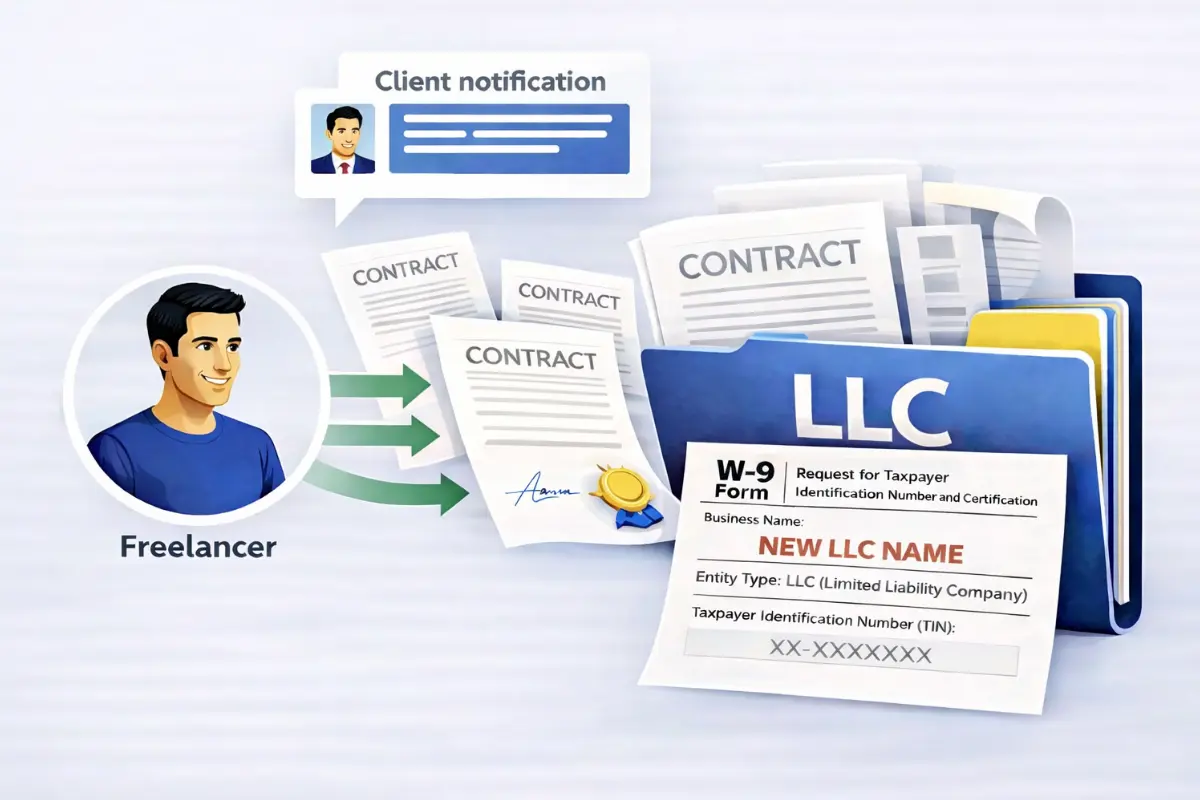
All existing contracts were legally entered into with you (the individual) and must now be transferred to the LLC. Your clients contracted with you personally, not your LLC—legally distinct parties.
Notify regular clients of your "entity change" and provide them with a new Form W-9 reflecting the LLC's name and EIN. Send professional transition notices 30-60 days before your LLC's effective date.
Draft an "Assignment of Contract" or simple amendment to ensure the LLC legally performs all future work. Contract assignment transfers obligations from you individually to your LLC, with client consent.
Ensure all professional liability (E&O) insurance policies are updated to list the LLC as the primary insured party. Your existing independent contractor status insurance covered you personally; it won't cover LLC activities.
Understanding contract management during ownership transitions helps prevent disruptions to client relationships.
Step 8: Meeting Federal BOI Reporting Mandates
All new LLCs formed in 2024 must file a BOI report with FinCEN within 90 days of formation (dropping to 30 days for entities formed in 2025 and later).
Failure to file carries significant penalties: $500 per day (up to $10,000 total) plus potential criminal penalties for willful violations.
Provide your identification and the LLC's formation details through the secure FinCEN BOI portal immediately after receiving state approval. Single-member LLCs report one beneficial owner—yourself.
Report any changes within 30 days if ownership, address, or identification information changes.
Step 9: Establishing Ongoing Compliance with EntityWatch®
The transition from the "set it and forget it" nature of freelancing to active LLC maintenance demands new discipline. Sole proprietors face no annual filing requirements, but LLCs must maintain "Good Standing" with the state.
Falling out of Good Standing can lead to administrative dissolution and loss of your liability shield. Once dissolved, all liability protection disappears retroactively.
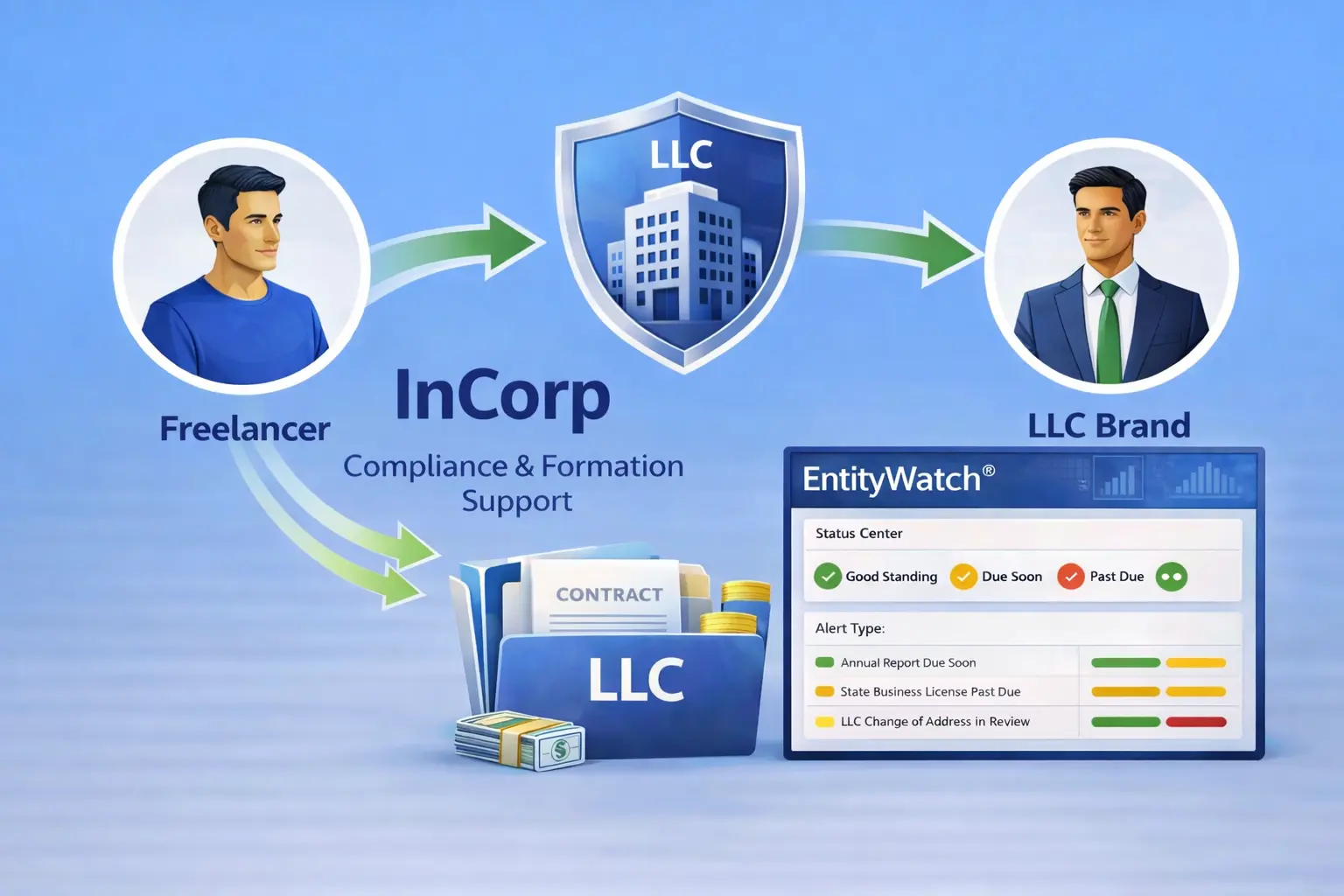
Use InCorp's EntityWatch® system to monitor state records for upcoming annual report deadlines automatically. EntityWatch® tracks filing requirements across all 50 states and sends automated reminders before deadlines.
Commit to a monthly review of your LLC's "statutory health" to ensure all licenses, fees, and reports are up to date. Estimated quarterly taxes require payments in April, June, September, and January.
Take the Next Step from Freelancer to Fully Formed LLC
While the transition involves administrative hurdles, the result is a professionalized brand with robust legal defense. The sole proprietorship-to-LLC conversion protects personal assets, enhances credibility with corporate clients, and provides tax flexibility through an S Corp election for freelancers when income reaches appropriate levels.
Explore InCorp's business services to manage your transition from freelancer to business owner. From LLC formation to registered agent services to ongoing compliance monitoring, InCorp provides the infrastructure to support successful transitions.
InCorp is not a law firm and does not provide legal or financial advice. This information is educational. Readers should consult with qualified legal and tax professionals.
Understanding freelance tax benefits and maintaining compliance preserves the legal protections that make LLC formation worthwhile.
FAQ's
Can a freelance LLC choose to be taxed as an S Corporation later?
Yes. After formation, an LLC may elect S Corporation tax status by filing Form 2553 with the IRS if eligibility requirements are met. This election typically makes sense when net income exceeds $70,000-$80,000 annually, as S Corp status can reduce self-employment tax by splitting income between salary (subject to employment tax) and distributions (not subject to employment tax). However, S Corps require payroll processing, reasonable compensation determinations subject to IRS scrutiny, and additional tax filings, including Form 1120S.
Will forming a freelance LLC affect my personal credit score?
No. Forming an LLC does not directly impact your personal credit score. The LLC is a separate legal entity with its own credit profile. However, personal guarantees on business loans can still tie your personal credit to the loan, affecting your credit if the LLC defaults. Additionally, some business credit cards require personal guarantees, making you personally liable for unpaid balances and potentially impacting your personal credit.
Do I need a new business license after forming a freelance LLC?
Possibly. Some cities and counties require new business licenses when the legal structure changes, even if business activity remains the same. If you held a business license as a sole proprietor under your personal name or DBA, you'll likely need to apply for a new license under the LLC's legal name. License requirements vary by jurisdiction and industry; check with your city clerk's office and county licensing department to determine specific requirements for your location.
Can I convert my sole proprietorship into an LLC without stopping operations?
Yes. Most freelancers transition seamlessly by forming an LLC, transferring contracts, and updating client information, all while continuing to serve existing clients. The process involves administrative changes rather than operational shutdowns. However, you must clearly document the transition date, ensure all post-formation work is billed through the LLC, and maintain a clear separation between pre-formation (sole proprietor) and post-formation (LLC) finances. Overlap periods require careful accounting to properly allocate income and expenses to the correct tax year and entity.
Do I need a separate business bank account for my new freelance LLC?
Yes. Opening a dedicated business bank account for your freelance LLC is critical to keep personal and business funds separate and maintain the corporate veil. Mixing personal and business finances can undermine liability protection and make it harder to track business income, expenses, and tax deductions.
Will forming an LLC change how I pay income tax on my freelance income?
For a single member LLC, the IRS usually treats the entity as a "disregarded entity," so you still report business income and expenses on Schedule C with your personal tax return. You continue to pay income tax and self-employment taxes on net income, but you gain liability protection because the LLC is a separate legal entity for state-law purposes.
Does forming a freelance LLC help me avoid double taxation?
Yes, in most cases. A standard single member LLC is not subject to corporate taxation; instead, profits "pass through" to you and are taxed once on your personal return. Double taxation generally applies to traditional C corporations, not to an LLC that is taxed as a sole proprietorship or elects S corporation status.
When should a freelance LLC consider electing S corporation status?
An S corporation election may be worth exploring when your net freelance income is consistently high enough that potential tax savings justify added complexity. With an S corp election, part of the LLC's profits can be paid as salary (subject to payroll taxes) and the rest as distributions (not subject to self-employment taxes), but you must pay yourself a reasonable salary and handle payroll and extra filings with help from a tax professional.
Disclaimer: This content is intended for general educational and informational purposes only and does not constitute legal, tax, or accounting advice. Every effort is made to keep the information current and accurate; however, laws, regulations, and guidance can change, and no representation or warranty is given that the content is complete, up to date, or suitable for any particular situation. You should not rely on this material as a substitute for advice from a qualified professional who can consider your specific facts and objectives before you make decisions or take action.
Share This Article:
Stay in the know!
Join our newsletter for special offers.