
LLC vs Nonprofit: Exploring the Legal and Financial Divide in 2026


A social entrepreneur secured $50,000 in seed funding to launch a community education program. She filed as an LLC to maintain ownership—then discovered major grant opportunities required 501(c)(3) organization status, which her LLC structure made impossible to obtain. She had to dissolve and restart as a nonprofit, losing momentum and partners.
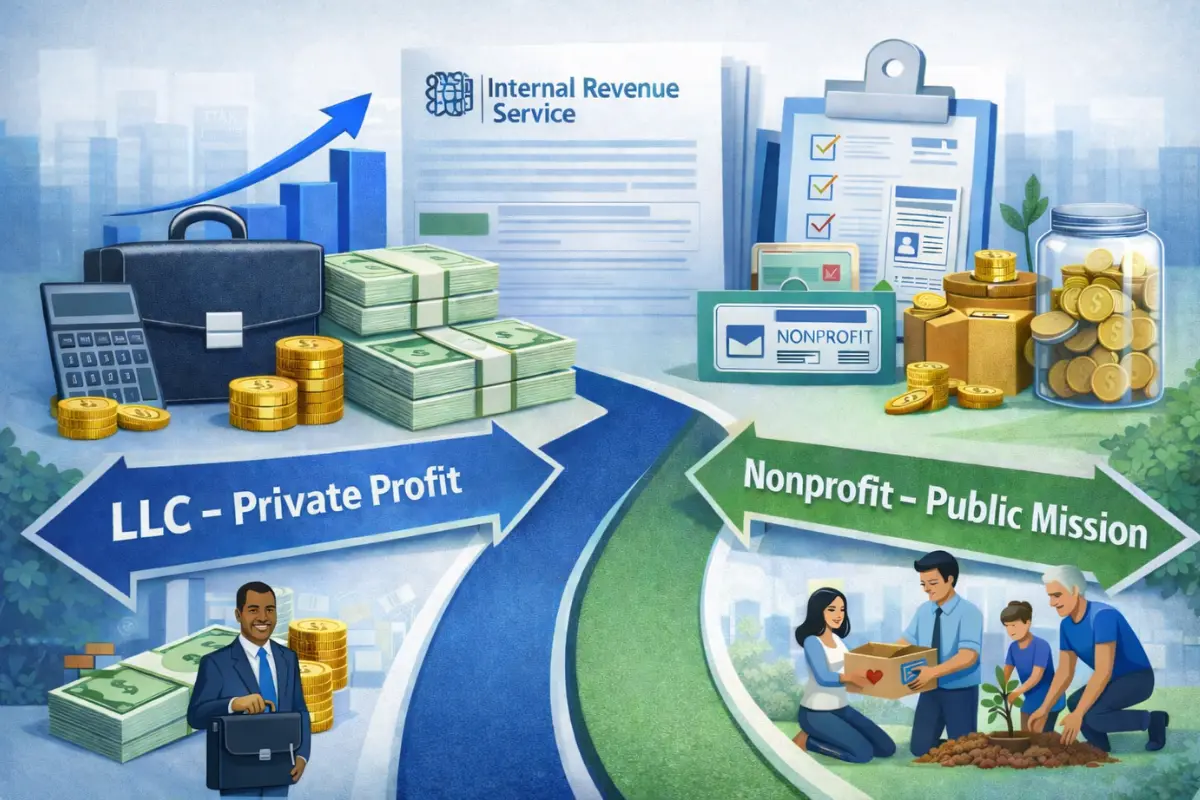
The LLC vs Nonprofit decision represents the primary fork in the road for new ventures: pursuing private profit through a Limited Liability Company or serving the public good through a Nonprofit Corporation. In 2026, the distinction involves fundamental differences in legal ownership, tax codes, and operational freedoms. Over 1.5 million nonprofit organizations are registered in the U.S., making nonprofits a major segment of the economy.
This guide compares the two structures across liability, taxation, and governance to help you decide which framework fits your mission.
Key Takeaways
-
An LLC is designed to generate and distribute profit to its members, while a nonprofit is “ownerless” and must reinvest all surplus into its mission under the non‑distribution constraint.
-
Only qualifying nonprofits with 501(c)(3) status can offer tax‑deductible donations and access most grants and institutional funding; LLCs generally cannot, which makes entity choice critical for mission‑driven founders seeking philanthropy‑based revenue.
-
Governance structures differ sharply: LLCs can be managed by a single member with broad flexibility, whereas nonprofits require a board of directors with fiduciary duties and more formal oversight, meetings, and reporting.
-
While some states allow “nonprofit LLCs,” the IRS will usually only recognize an LLC as tax‑exempt if all members are already tax‑exempt organizations and the operating agreement mirrors nonprofit rules, so most founders use a nonprofit corporation instead.
-
Nonprofits can own for‑profit subsidiaries (such as LLCs) to run commercial activities and generate additional revenue, but profits must ultimately support the exempt purpose and are subject to complex tax and compliance rules.
Foundational Differences: Purpose and Ownership
While both LLCs and nonprofits provide a legal "shield" protecting individuals from business liabilities, they serve different masters and operate under fundamentally different economic models. The business vs nonprofit comparison reveals that purpose and ownership are the primary dividing lines between these structures.
LLC: Private Equity and Profit Motive
The LLC functions as a for-profit vehicle owned by "members" who hold an economic interest in the company. These members invest capital, make operational decisions, and receive profits distributed directly as personal income.
A member owning 60% of an LLC typically receives 60% of the profits. Understanding which state is best for LLC formation for non-residents becomes critical when members live across different jurisdictions.
The LLC benefits include pass-through taxation, operational flexibility, and the ability to distribute all profits to members without restriction. Learn more about comprehensive LLC advantages.
Nonprofit: Public Benefit and "Ownerless" Status
A nonprofit corporation has no owners or shareholders—it is held in "public trust" to serve charitable, educational, religious, scientific, or other socially beneficial purposes.
The "non-distribution constraint" mandates that all revenue after expenses must be reinvested into the mission rather than paid out as dividends. A nonprofit generating $100,000 in surplus cannot distribute it to founders or staff as profit; instead, the surplus is used to support programs or build reserves.
Founders cannot sell a nonprofit or transfer ownership interests. The organization exists independently of any individual, governed by a board of directors that serves as fiduciaries, ensuring mission fulfillment.
Tax Treatment and the 501(c)(3) Advantage
The IRS views LLCs and nonprofits through radically different lenses in 2026, with tax status often serving as the deciding factor for organizations relying on external funding.
Pass-Through Taxation for LLCs
LLCs avoid double taxation by passing profits and losses directly to members' personal tax returns. The LLC itself typically doesn't pay federal income tax—instead, each member reports their share on appropriate tax forms.
Members are responsible for self-employment taxes on their share of earnings (15.3% on net earnings for Social Security and Medicare). Understanding pass-through business taxation clarifies why this structure appeals to small business owners.
Tax Exemption and Donor Deductibility for Nonprofits
A nonprofit corporation can apply for 501(c)(3) status, exempting it from federal income tax. To obtain tax-exempt status, most nonprofits must file IRS Form 1023; applications have increased as mission-driven founders use this path for charitable work.
Meeting 501(c)(3) exemption requirements demands demonstrating exclusive operation for exempt purposes, with no private benefit and no substantial political activity.
The nonprofit's unique ability to offer tax deductions to donors creates critical fundraising incentives. Donors contributing to a 501(c)(3) can deduct charitable donations from taxable income. A donor in the 32% tax bracket effectively reduces a $10,000 donation to $6,800 after tax savings—unavailable for LLC contributions.
Governance Structures: Flexibility vs. Formal Oversight
The nonprofit vs LLC comparison reveals stark contrasts in management requirements and decision-making authority.
The Operating Agreement vs. Corporate Bylaws
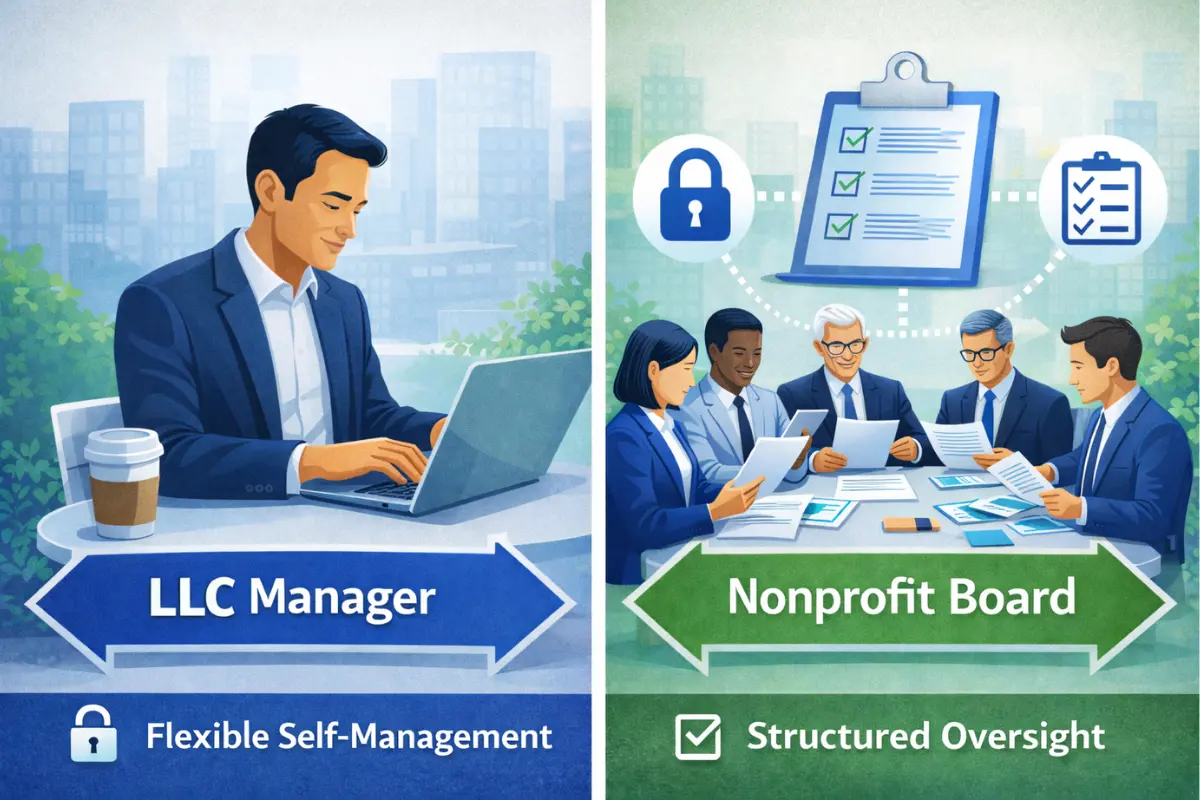
LLCs use an operating agreement to set their own rules, often with no requirement for meetings or formal votes. The operating agreement can establish any management structure that members desire.
Understanding whether you need an operating agreement for your LLC clarifies that, while most states don't require one, having one can prevent disputes.
Nonprofits must adopt nonprofit bylaws that comply with strict state and federal rules regarding transparency, meeting frequency, and decision-making authority. These requirements ensure public accountability.
Member Management vs. Board of Directors
A single person with total control can run an LLC. The member-managed LLC allows owners to make decisions without consulting anyone, enabling rapid responses to market changes.
Nonprofits must have a Board of Directors, typically at least three unrelated individuals, to ensure the mission is served responsibly. Board members owe fiduciary duties, including loyalty and care, legally requiring them to act in the organization's best interests.
The difference in governance structures reflects fundamental philosophical distinctions: LLCs trust private owners to pursue profit, while nonprofits require collective oversight to protect the public benefit.
Funding and Financial Sustainability
The business vs nonprofit comparison reveals that legal structure strictly dictates how entities raise capital and sustain operations.
Raising Capital for LLCs
LLCs secure funding through owner investment, traditional bank loans, investor equity purchases, or revenue from sales and services. Members can contribute capital in exchange for increased ownership percentages.
Venture capital and angel investors commonly fund LLCs, exchanging capital for equity stakes. This funding model scales with business growth and profitability potential.
Fundraising and Grants for Nonprofits
Nonprofits rely on public donations, private foundation grants, corporate sponsorships, and government funding that is strictly unavailable to for-profit LLCs. Grant-making foundations and government agencies specifically restrict funding to tax-exempt organizations.
Individual donors contribute because of tax deductibility and mission alignment. The funding model creates stability through diversified sources but imposes restrictions on use, reporting requirements, and administrative costs.
Can an LLC Be a Nonprofit? The 2026 Reality
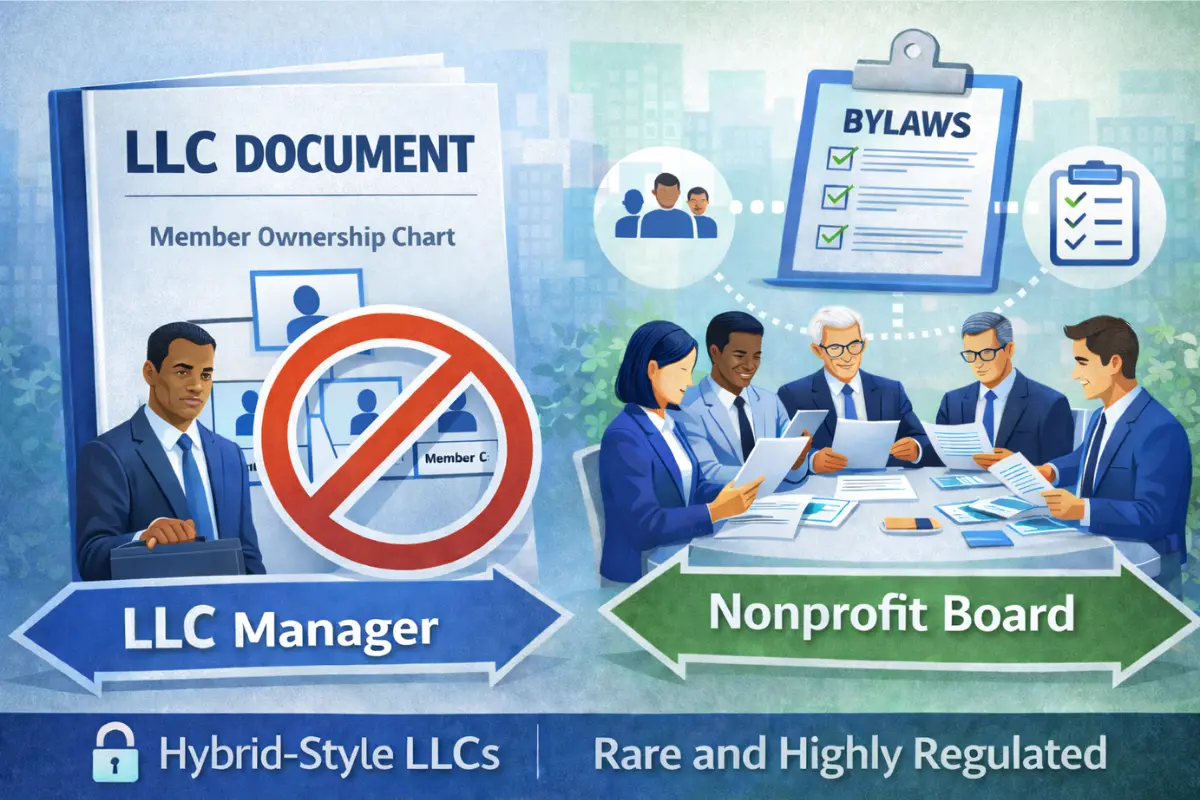
The "Nonprofit LLC" hybrid exists legally in some states, but remains rarely the best path. The IRS typically only grants 501(c)(3) status to an LLC if all its members are already tax-exempt organizations.
This requirement creates a significant barrier. An LLC with even one individual member cannot obtain federal tax-exempt status, regardless of charitable intentions.
States including Delaware, California, Michigan, Minnesota, and Texas permit nonprofit LLC formation under state law, but state authorization doesn't guarantee federal tax exemption. Most mission-driven founders discover that forming a traditional nonprofit corporation proves simpler and more effective.
Choosing the Right Structure: The Deciding Factors
Choose an LLC if:
-
You want to own the business and its assets
-
You plan to distribute profits to yourself or partners
-
You want full control without a board of directors
-
You are starting a traditional retail or service business
-
You need maximum operational flexibility
-
You plan to sell the business or take on equity investors
Choose a Nonprofit if:
-
You want to serve a specific charitable or social cause
-
You want to apply for government or private foundation grants
-
You want to offer tax deductions to your donors
-
You are comfortable with public financial disclosure through annual reporting (Form 990)
-
Your mission serves public benefit rather than private profit
-
You can commit to board governance and regulatory compliance
The decision ultimately depends on whether your primary goal is to build personal wealth or to advance a public mission. Neither structure is superior; they simply serve different purposes.
Protecting Your Entity with Professional Representation
Whether you choose an LLC or a Nonprofit, you must maintain a Registered Agent to remain compliant. Professional services like InCorp keep your personal address off public records and provide a stable point of contact with the state during leadership transitions.
InCorp's EntityWatch® system tracks annual report deadlines for both for-profit and nonprofit entities, preventing administrative dissolution in all 50 states. For nonprofits, missing annual reporting (Form 990) filings can trigger IRS revocation of tax-exempt status.
Form the Right Entity for Your Mission with Confidence
The choice between an LLC and a Nonprofit defines the financial DNA of your organization for years to come. The nonprofit formation requirements demand significant paperwork and ongoing compliance, but unlock tax exemptions and grant eligibility. Understanding nonprofit liability protection and profit distribution restrictions helps clarify which structure serves your goals.
Explore InCorp's business services to launch your LLC or Nonprofit Corporation with professional precision. From filing Articles of Incorporation to maintaining registered agent services and compliance monitoring, InCorp provides comprehensive support throughout your entity's lifecycle.
InCorp is not a law firm and does not provide legal or financial advice. This information is educational. Readers should consult with qualified legal and tax professionals.
Use InCorp's EntityWatch® system to monitor your entity's standing and maintain the compliance necessary for long-term impact. Understanding the public benefit corporation option and other hybrid structures may also inform your decision as mission-driven business models continue evolving in 2026.
FAQ's
Can a nonprofit pay salaries to its founders or staff?
Yes. Nonprofits can pay reasonable compensation for services rendered, provided payments align with market value and support the organization's mission. The IRS scrutinizes executive compensation to ensure it doesn't represent disguised profit distribution, but fair salaries for actual work are permitted and expected. Many nonprofit founders serve as paid Executive Directors, receiving competitive salaries comparable to those at similarly sized organizations in their sector.
Can an LLC later convert into a nonprofit organization?
In most cases, an LLC must dissolve and form a new nonprofit corporation, though some states allow statutory conversion procedures. The conversion process requires transferring assets to the new nonprofit entity, adopting bylaws, establishing a board of directors, and filing IRS Form 1023 for tax-exempt status. The IRS examines these conversions carefully to ensure founders aren't improperly benefiting from the transition or avoiding taxes on appreciated assets.
Do nonprofits need to file annual federal forms?
Yes. Most tax-exempt organizations must file IRS Form 990 annually to maintain their federal tax-exempt status. Form 990 becomes public record, providing transparency about nonprofit finances, governance, and activities. Small nonprofits with gross receipts under $50,000 can file the simpler Form 990-N (e-Postcard), while larger organizations face extensive reporting requirements. Failure to file for three consecutive years triggers automatic revocation of tax-exempt status.
Can a nonprofit own a for-profit subsidiary?
Yes. A nonprofit may create or own a taxable subsidiary LLC or corporation, provided profits support the nonprofit's exempt purpose. The subsidiary operates as a regular for-profit business, pays taxes on its income, and distributes profits to the nonprofit parent as dividends. This structure allows nonprofits to engage in commercial activities without jeopardizing their tax-exempt status, segregating business risk from charitable operations while generating sustainable revenue to support their missions.
How does the risk profile differ between an LLC and a nonprofit in 2026?
An LLC primarily manages risk around contracts, customers, and commercial services, with liability protection focused on shielding owners' personal assets from business debts and lawsuits. A nonprofit corporation must also address risks tied to charitable purpose, donor expectations, public disclosure, and compliance with tax‑exempt rules, fundraising regulations, and employment law, making its legal risk profile broader and more mission‑driven.
How does unrelated business income tax (UBIT) affect nonprofits that run business activities?
When a tax‑exempt organization regularly carries on a trade or business that is not substantially related to its charitable or educational purpose, the net income from those activities can be subject to unrelated business income tax. Nonprofits can still pursue these business activities, but they must track unrelated business taxable income separately and file the required tax forms, ensuring that commercial ventures do not undermine overall tax‑exempt status.
Can a nonprofit organization engage in joint ventures with for‑profit businesses?
Yes, nonprofits can enter joint ventures with for‑profit companies when the structure and agreements ensure that the nonprofit's participation furthers its charitable or educational purpose. To protect c 3 tax‑exempt status, the nonprofit must retain enough control over the venture to safeguard its mission, avoid improper private benefit to a private shareholder, and allocate income and expenses clearly for tax purposes.
How do donor expectations and public disclosure obligations differ for nonprofits compared to LLCs?
Nonprofits rely heavily on charitable giving and are expected to provide detailed financial reports and information about how funds support the organization's mission. Many nonprofits must file annual public returns and make key documents available upon request, while LLCs generally have no public disclosure requirement about profits, expenses, or owners, focusing instead on private financial reporting to members and tax authorities.
What legal compliance steps should new nonprofits prioritize after receiving IRS approval of tax‑exempt status?
Once nonprofit status is granted, organizations should adopt and follow clear policies on conflicts of interest, fundraising events, use of independent contractors vs. employees, and handling of personal expenses to avoid misclassification or private benefit. Training staff and board members on compliance obligations—such as filing annual reports, adhering to state law fundraising rules, and honoring restrictions on funds—helps prevent legal challenges and protects long‑term tax‑exempt status.
Disclaimer: This content is intended for general educational and informational purposes only and does not constitute legal, tax, or accounting advice. Every effort is made to keep the information current and accurate; however, laws, regulations, and guidance can change, and no representation or warranty is given that the content is complete, up to date, or suitable for any particular situation. You should not rely on this material as a substitute for advice from a qualified professional who can consider your specific facts and objectives before you make decisions or take action.
Share This Article:
Stay in the know!
Join our newsletter for special offers.