
How to Choose a Registered Agent Without Costly Compliance Mistakes


A small business owner listed herself as the registered agent to save money. Six months later, a process server arrived at her home office during a client meeting, delivering lawsuit documents in front of customers. Understanding how to choose a registered agent properly could have prevented this uncomfortable situation and protected both her privacy and professional reputation.
A registered agent serves as the entity's official point of contact for receiving service of process and state correspondence. While every LLC and corporation is legally required to have one, the choice of agent can significantly impact the entity's privacy and administrative efficiency. Registered agent requirements vary by state, but all jurisdictions mandate specific criteria to maintain compliance.
The goal of this guide is to help business owners identify common pitfalls and follow a professional process for selecting a reliable representative. Poor registered agent selection can result in missed legal notices, loss of good standing, or even administrative dissolution. Failure to maintain a registered agent can lead to state-imposed fines, often ranging from $50 to $500, plus the risk of suspension, dissolution, or loss of good standing, according to the U.S. Chamber of Commerce.

Key Takeaways
-
Choosing the right registered agent is critical for protecting your privacy, maintaining good standing, and preventing default judgments or administrative dissolution.
-
Serving as your own registered agent (or naming an employee) can expose your home or office address on public record and create availability gaps that lead to missed legal notices.
-
A registered agent must have a physical in‑state street address and be reliably available during normal business hours; virtual addresses and P.O. Boxes do not satisfy state requirements.
-
Prioritizing the cheapest provider can backfire through hidden fees, limited technology, and weak compliance support that increase long‑term risk and cost.
-
Businesses planning multi‑state operations should choose a national provider from the start to avoid repeated agent changes, extra filings, and fragmented document workflows.
-
Professional agents with automated compliance tools (like EntityWatch®‑style monitoring) help you track annual reports and other deadlines so you stay in good standing across all jurisdictions.
-
Evaluating document delivery speed, security protocols, and online portal functionality is just as important as reviewing price and basic service descriptions.
-
A professional registered agent acts as a filter and centralized point of contact for official correspondence, reducing administrative noise and ensuring rapid response to critical notices.
-
Using a commercial registered agent creates a stable, permanent address on state records, allowing you to move or restructure your business without constant filing changes.
-
Centralized, professional registered agent services create an audit trail for legal notices and support proactive, scalable compliance as your business grows.
5 Common Mistakes to Avoid When Selecting a Registered Agent
Many business owners treat the appointment of an agent as a mere formality, which can lead to long-term operational risks. Understanding these common mistakes helps entities avoid the compliance penalties and administrative headaches that result from poor decisions regarding registered agents. Each mistake carries specific consequences that can disrupt business operations and create unnecessary legal exposure.
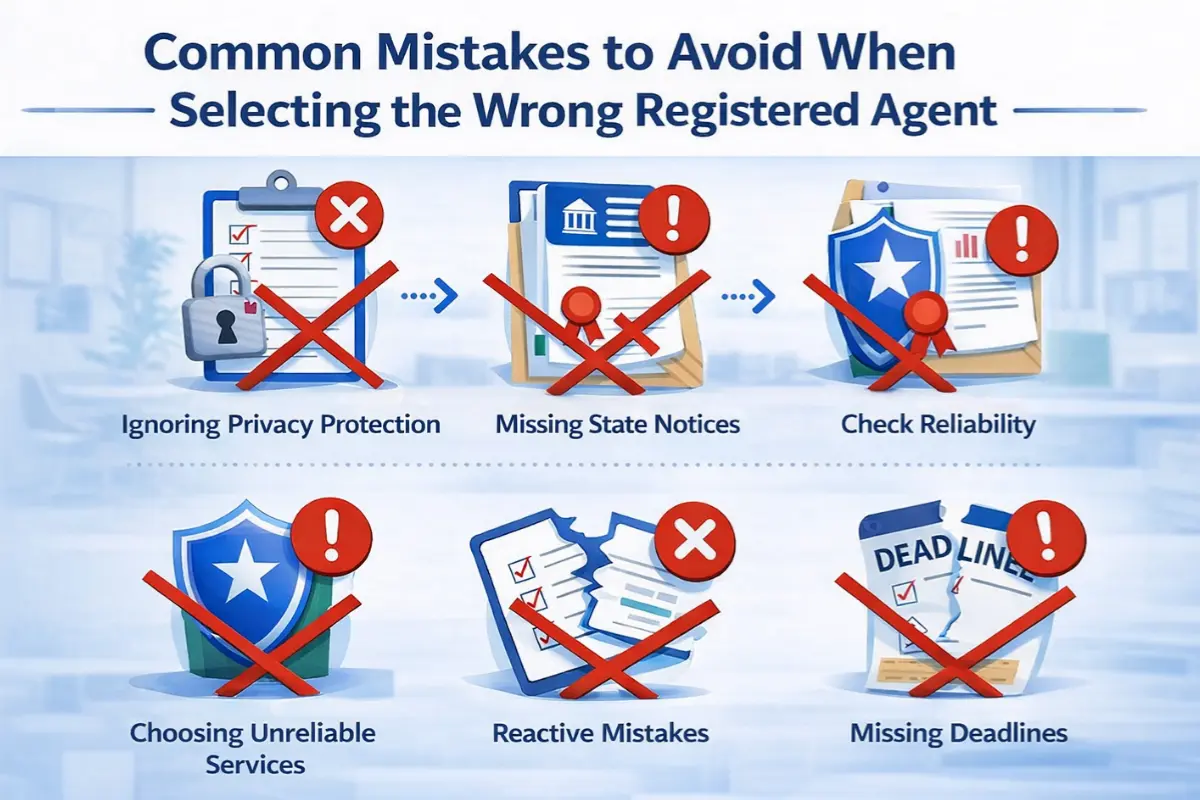
Appointing Yourself or an Employee as the Agent
Listing a personal or office address in public records can lead to loss of privacy and unwanted solicitations. The privacy risks extend beyond inconvenience to potential security concerns for business owners and their families.
This choice requires the individual to be physically present at that specific location during all standard business hours, which is often impractical. Lunch breaks, meetings, vacations, and sick days create gaps in availability that can result in missed official legal notices. Business Initiative explains how home addresses become public records and the privacy implications for business owners.
Choosing a Provider Based Solely on the Lowest Price
Budget services may lack essential infrastructure, such as secure digital document portals or national coverage. The cheapest options often operate with minimal staffing, limited technology systems, and restricted geographic reach.
Hidden fees for document forwarding or late notifications can quickly exceed the cost of a premium provider. Some low-cost services charge per-page scanning fees, rush delivery charges, or premium rates for electronic document access.
Budget providers may also lack the compliance monitoring systems that help businesses track state filing requirements and avoid missed deadlines.
Relying on a Non-Commercial Agent Without a Physical Office
State law mandates that registered agents maintain a physical address requirement, not a P.O. Box.
Using an unreliable friend or family member can result in missed legal notices, potentially leading to default judgments against the entity. Well-meaning individuals may travel for extended periods, change residences, or simply forget the importance of forwarding time-sensitive documents immediately.
Virtual address solutions do not meet state requirements, but understanding the alternatives helps businesses make informed decisions about proper registered agent representation.
Neglecting to Verify National Coverage
Businesses planning to expand into other states should avoid agents who only operate in a single jurisdiction. Multi-state operations require registered agents in every state where the entity conducts business or is formally registered.
Switching agents during an expansion creates unnecessary administrative work and additional filing fees. Each state charges fees for registered agent changes, typically ranging from $25 to $100 per entity. National providers eliminate these transition costs by providing consistent coverage as businesses expand.
Coordinating multiple registered agents across different states introduces operational complexity, diverting attention from core business activities. Business owners must maintain separate relationships with multiple providers, track different renewal dates, and manage various document delivery systems.
Failing to Check for Automated Compliance Monitoring
An agent who only forwards mail without providing filing reminders leaves the entity at risk of missing annual report deadlines. Basic registered agent services focus solely on receiving and forwarding documents, without any proactive compliance support.
A lack of proactive monitoring can cause the entity to fall out of good standing with the state. Loss of good standing status prevents businesses from conducting certain transactions, defending lawsuits, or maintaining necessary licenses.
Automated compliance monitoring systems track filing deadlines and send proactive reminders before due dates arrive. These systems eliminate the burden of manual tracking and significantly reduce the risk of missed obligations.
Professional Steps for Choosing the Right Registered Agent
A systematic approach to evaluating and appointing a service provider supports the entity's long-term goals. Rather than treating registered agent selection as a quick checkbox in the formation process, successful businesses invest time in identifying providers that offer comprehensive support aligned with their operational needs and growth plans. The best registered agent service delivers value through reliability, technology, and proactive compliance support.
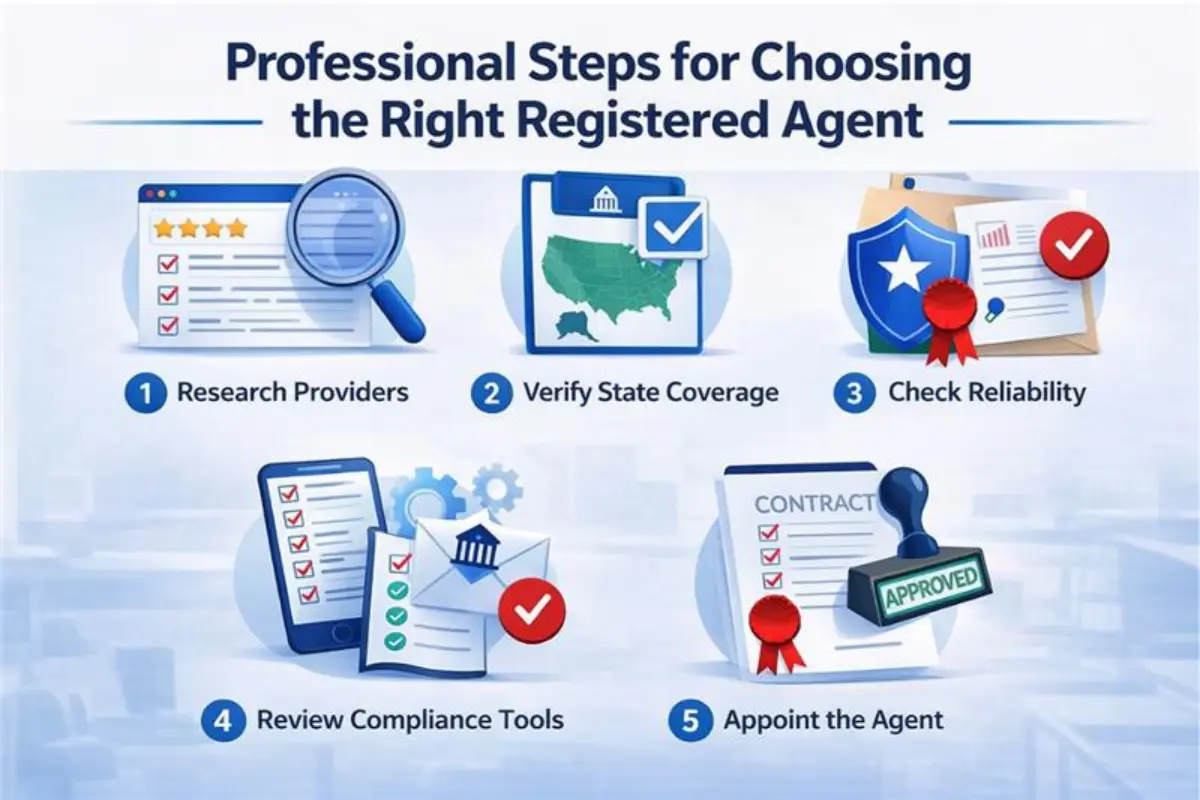
Evaluate the Provider's Physical Presence and Infrastructure
Look for providers with brick-and-mortar offices in all 50 states to ensure consistent service as the business grows.
A physical presence ensures the agent is always available to receive service of process during legal business hours. Court process servers verify that recipients maintain actual offices at listed addresses before delivering legal documents. Physical offices also provide backup systems when primary personnel are unavailable, ensuring uninterrupted document reception.
Review the Document Delivery and Security Protocols
Same-day electronic document scanning and secure online access to all received notices prove essential for time-sensitive legal matters. Electronic delivery systems provide redundancy—if physical mail is delayed, businesses still receive scanned copies, enabling prompt action.
The provider should have robust data security measures to protect sensitive legal information. Government correspondence and legal documents often contain confidential business information, trade secrets, or sensitive financial data. Securing scanned documents requires professional-grade protocols that protect against data breaches and unauthorized access.
Assess Available Compliance and Monitoring Tools
Look for proprietary systems, such as InCorp's EntityWatch®, that help track state deadlines and entity status.
These tools help the business avoid accidental oversights and late fees by providing automated alerts. Proactive notifications arrive weeks before deadlines, providing adequate time to prepare required documents and gather necessary information.
Compare Long-Term Value and Transparent Pricing
Look for multi-year discounts that provide professional-grade service at a lower annual rate. Professional registered agent service providers often offer significant savings for multi-year commitments. Three-year or five-year agreements can reduce annual costs by 30% to 50% compared to annual renewals.
Ensure that the service includes the cost of forwarding all official state and legal documents without per-page or per-item surcharges. Hidden fees undermine transparent pricing and create unexpected costs that accumulate over time. Clear pricing structures enable accurate budget planning and prevent unpleasant surprises that can damage provider relationships.
Balancing Legal Obligations with Professional Representation
Avoiding the mistakes mentioned above represents only the first step in protecting the entity's legal standing.
A professional registered agent acts as a bridge between state regulatory requirements and the entity's internal management. Understanding registered agent responsibilities clarifies how professional representation supports business operations beyond merely receiving documents.

Shifting from Reactive to Proactive Compliance
A professional agent helps move an entity away from emergency filing—where documents are handled only after a deadline has passed—toward a planned administrative schedule.
A proactive approach, supported by automated alerts, reduces the risk of late fees and helps maintain a consistent record of good standing with the Secretary of State. Good standing status also simplifies expansion into new states, as foreign qualification applications require certificates demonstrating compliance in the home state.
The Registered Agent as a Filter for Official Correspondence
A commercial agent distinguishes between junk mail, solicitations, and high-priority legal or state documents. Professional registered agents screen incoming correspondence, identifying truly important documents and filtering out misleading solicitations that waste management time.
This filtering service ensures that management's time is spent on business operations rather than sorting through administrative noise, while preventing any critical notice from being ignored.
Professional registered agent services provide systematic approaches to correspondence management that individual business owners cannot replicate.
Maintaining Operational Continuity During Growth
Professional representation provides stability when a business changes its internal staff or relocates its primary office. The registered agent for LLC operations remains constant on state records, even as underlying business operations evolve. This stability prevents compliance disruptions during transition periods when internal administrative capacity may be strained by change management.
Because the registered agent's address remains constant in state records, the entity avoids the need for frequent, costly amendments to its public filings whenever its internal footprint changes. Professional registered agents absorb this stability function, allowing businesses to relocate offices without triggering cascading compliance requirements.
Centralizing Multi-State Administrative Requirements
A single point of contact for entities that operate in multiple jurisdictions simplifies administrative coordination.
A national provider helps harmonize different state requirements into one management portal, allowing the business to maintain a uniform compliance standard regardless of where it operates. The consolidated view eliminates the complexity of tracking obligations separately in each state through fragmented systems.
Establishing an Audit Trail for Legal Notices
Professional document logging provides the entity with a clear, time-stamped record of when legal notices were received and delivered. These records become critical evidence in legal disputes where the timing of notice matters or when questions arise about whether proper service occurred.
This record-keeping is an essential component of professional governance and can be vital if the entity ever needs to prove timely receipt of documents in a legal proceeding.
Select the Right Registered Agent Today
Choosing a registered agent is a critical administrative decision that helps safeguard an entity's privacy and compliance. The selection process requires careful evaluation of provider capabilities, pricing structures, and service features. Business owners who invest time in selecting a proper registered agent avoid costly mistakes that result from prioritizing price over reliability or treating the decision as a mere formality.
Understanding how to choose a registered agent involves balancing multiple factors, including privacy protection, compliance monitoring, national coverage, and long-term value. The right provider functions as a strategic partner supporting business growth rather than merely forwarding mail.
Explore InCorp's registered agent services and the EntityWatch® system to help manage your business obligations professionally. InCorp's national presence, advanced compliance monitoring, and multi-year pricing options provide comprehensive support for businesses at every growth stage.
Contact InCorp to learn how national representation and expert filing support can help protect your entity's good standing across all jurisdictions. Change registered agent processes are straightforward when working with professional providers who understand state requirements. Visit InCorp's business services to discover comprehensive solutions supporting business formation, compliance, and growth.
FAQ's
Can I change my registered agent after forming my business?
Yes. Most states allow you to change your registered agent by filing a simple amendment or statement of change, usually with a modest state fee. The process typically requires completing a change-of-registered-agent form, obtaining consent from the new registered agent, and submitting the form to the Secretary of State. Business owners should ensure continuous registered agent coverage during transitions by appointing the new agent before terminating the previous relationship.
Does a registered agent need to understand my industry?
No industry-specific knowledge is required. The agent's primary responsibility is handling legal and state documents accurately and on time. Registered agents focus on document receipt, forwarding, and compliance monitoring rather than providing business advice or industry expertise. This separation allows registered agents to serve businesses across all industries effectively while maintaining specialized expertise in compliance requirements and legal document handling.
Will hiring a professional registered agent affect my business taxes?
No. A registered agent does not influence how your business is taxed or how tax filings are handled. The registered agent's role is limited to receiving official correspondence and legal documents on behalf of the business. Tax classification, filing obligations, and liability remain unchanged by the selection of a registered agent. However, registered agents may forward tax notices and compliance reminders from state revenue departments, helping businesses maintain awareness of filing obligations.
Is a registered agent required if my business has no physical office?
Yes. Even fully remote or online businesses must maintain a registered agent with a physical in-state address. State law requires registered agents in every jurisdiction where the business is legally formed or qualified to do business, regardless of whether the business maintains offices or employees in that jurisdiction. Remote businesses particularly benefit from professional registered agents who provide the required physical presence while operating virtually.
Can one registered agent manage multiple entities I own?
Yes. Commercial providers can represent multiple entities under one account, which helps streamline document access and compliance tracking. Many business owners form separate LLCs for different properties, business lines, or to isolate liability. Professional registered agents offer volume pricing for multiple entities, consolidate all documents into a single portal, and provide unified compliance monitoring across the entire business portfolio. This approach significantly reduces administrative burden compared to managing registered agents separately for each entity.
How do I choose a registered agent without costly compliance mistakes?
Select a professional registered agent service with a physical street address in the state, proven service of process procedures, and strong compliance support tools like reminders for annual report filing deadlines and other obligations. Evaluating compliance tracking features, online access, and service reliability helps businesses track obligations systematically and avoid missed legal notices or lapses in good standing status.
What registered agent requirements should I look for before appointing one?
Most states require your registered agent to maintain a physical address (not a P.O. Box) in the state of formation or qualification and to be available at that registered agent's address during regular business hours to receive legal and state documents. You should also confirm that the agent promptly forwards documents, provides organized document management systems or a secure client portal, and meets any specific state‑level LLC registered agent requirements.
When is a professional registered agent service better than being my own registered agent?
Using your home or office as your own registered agent can expose personal addresses and residential and personal data on public records and create gaps in availability during business hours, which poses significant operational risks. A professional registered agent provider offers a stable professional registered agent address, reliable document handling, and compliance reminders so you can simplify business operations while maintaining proper agent designation and business entity compliance.
How do I evaluate the best registered agent service for a business operating in multiple states?
Expanding businesses should favor registered agents that offer nationwide registered agent services, consistent registered agent coverage, and centralized platforms that simplify access to legal and government documents across all jurisdictions. Look for commercial registered agents with a provider's commercial address in each state, immediate online access to important documents, and features supporting LLC operations such as consolidated compliance tracking and multi‑state service of process management.
What should I review in a registered agent service's pricing and scope before signing up?
Annual fees range widely in the registered agent service market, so transparency in evaluating pricing structures is essential; avoid providers that have vague or hidden fees for legal document delivery, online access, or other legal documents. The right registered agent service will clearly state what's included (such as compliance support tools, secure client portals, and professional document handling) and encourage you to seek qualified legal professionals or a law firm for any specific legal or financial advice outside the scope of official correspondence handling.
Disclaimer: This content is intended for general educational and informational purposes only and does not constitute legal, tax, or accounting advice. Every effort is made to keep the information current and accurate; however, laws, regulations, and guidance can change, and no representation or warranty is given that the content is complete, up to date, or suitable for any particular situation. You should not rely on this material as a substitute for advice from a qualified professional who can consider your specific facts and objectives before you make decisions or take action.
Share This Article:
Stay in the know!
Join our newsletter for special offers.