

Every founder reaches a moment where the next move in the business is bigger than what got them to today. Hiring another rep, opening a second location, or stretching the team another notch are the levers most owners reach for first, and they work right up until they stop. The reason they stop is rarely the market. It is that "more revenue" and "more capacity" are different problems with different solutions, and the strategy that drives business growth in the early years is not the same strategy that compounds in the later ones.
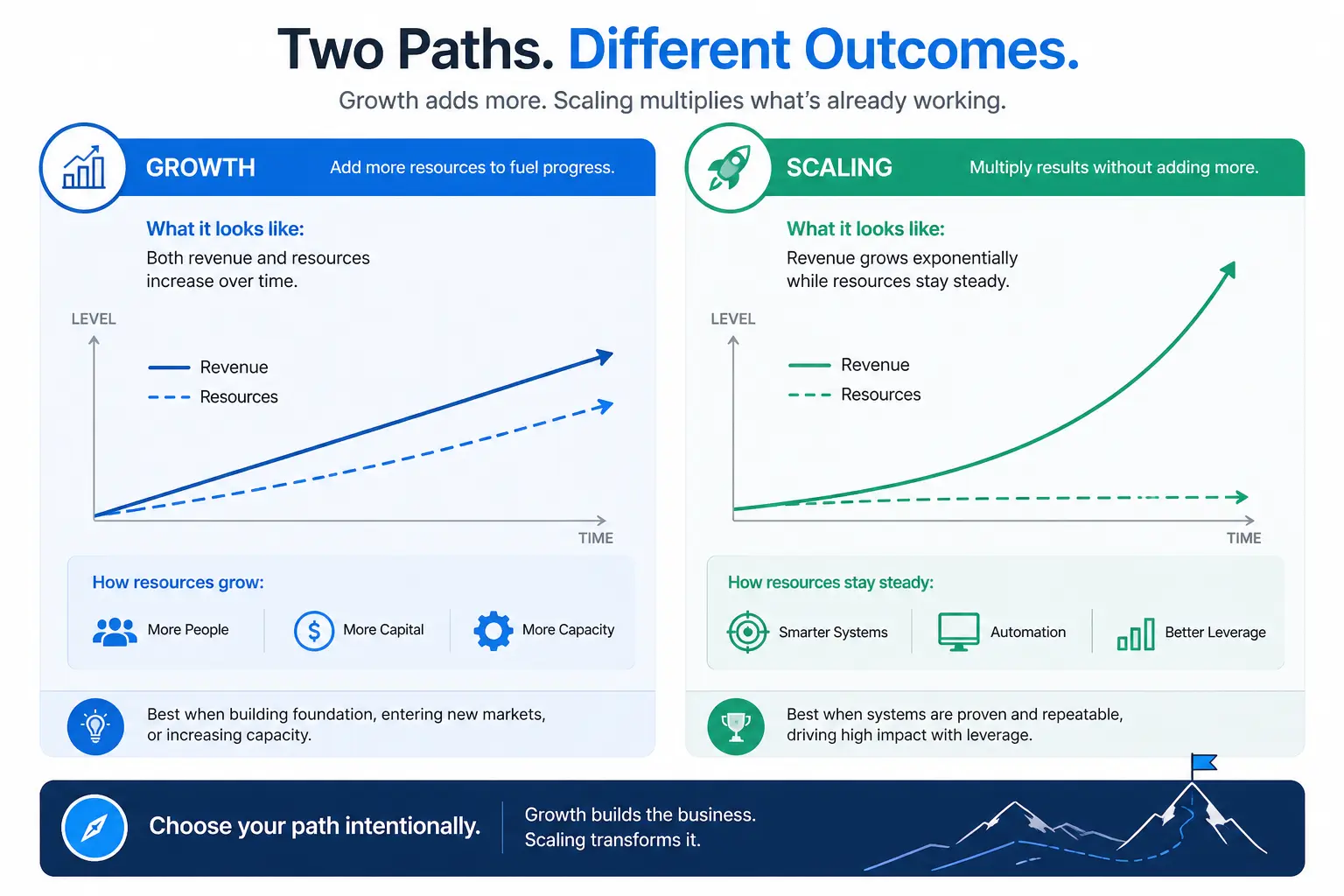
That distinction is what the language of growth versus scaling captures. Roughly 74% of high-growth startups fail because they scale before they are ready, and the ones that scale at the right time grow about 20 times faster than the ones that move too soon. The two terms get used interchangeably in casual conversation, but they describe different things: growth adds revenue by adding resources, while scaling adds revenue without adding the same resources. Telling the two apart is what makes the next quarter's hire, system investment, or state expansion either a lever or a leak. For founders working through that decision, an administrative partner like InCorp can handle the business formation, multi-state filings, and EntityWatch® compliance tracking that sits underneath any serious expansion plan, so the team's attention stays on the operating choices.
From here, the guide covers what business growth actually means, what scaling looks like in practice, the practical differences between the two, the signals that a business is ready to scale, the strategies that make scaling work, and the structural foundations that keep expansion from breaking the company underneath it.
Key Takeaways
-
Business growth adds revenue by adding resources like people, locations, and spend, while business scaling adds revenue without a proportional increase in costs by improving systems and efficiency.
-
Most companies grow first to prove product‑market fit and build a paying customer base, then shift toward scaling once revenue is stable and operational capacity is consistently maxed out.
-
A business is ready to scale when it has predictable revenue, clear financial and operational metrics, documented processes, and a model that can handle more volume without sacrificing quality.
-
Effective scaling strategies focus on automation, standardized operations, and technology infrastructure so that revenue per employee and profit margins improve as the business expands.
-
Structural foundations like the right business entity, multi‑state registrations, and ongoing compliance are essential to support expansion and prevent legal or regulatory issues from derailing growth.
What Is Business Growth?
Business growth is the kind of expansion that moves in a straight line with resources. Revenue growth comes from adding inputs: more reps, more locations, more marketing spend, more equipment. Costs rise alongside revenue, and the ratio between them stays roughly steady. Growth is also where almost every business starts. Before a company can build anything that compounds, it needs a customer base that pays, a price the market accepts, and a delivery model that holds together. Small businesses account for 46.4% of private sector workers and 62.7% of net new jobs since 1995, and most of them operate in a pure growth phase for years before the question of scaling becomes relevant.
Common Business Growth Strategies
The standard business growth playbook looks similar across industries: increase marketing spend to bring in more leads, expand the product or service catalog, hire additional staff to handle the demand, open new locations, or enter adjacent markets. Each move requires a direct capital or labor investment for every incremental gain in revenue. The SBA's grow-your-business resources walk through the practical mechanics for owners working through these decisions.
When Growth Hits a Ceiling
Growth strategies tend to flatten at the point where the next dollar of revenue costs about the same as the dollar before it. Hiring a fifth salesperson can lift revenue, but the salary, benefits, training, and management overhead eat into the profit margin the fifth person was supposed to add. A company can keep adding resources, but if expenses rise at the same rate as revenue growth, the business is not becoming more valuable. That ceiling is usually the signal that pure revenue growth is no longer the right lever and a shift toward scaling is worth considering.
What Is Business Scaling?
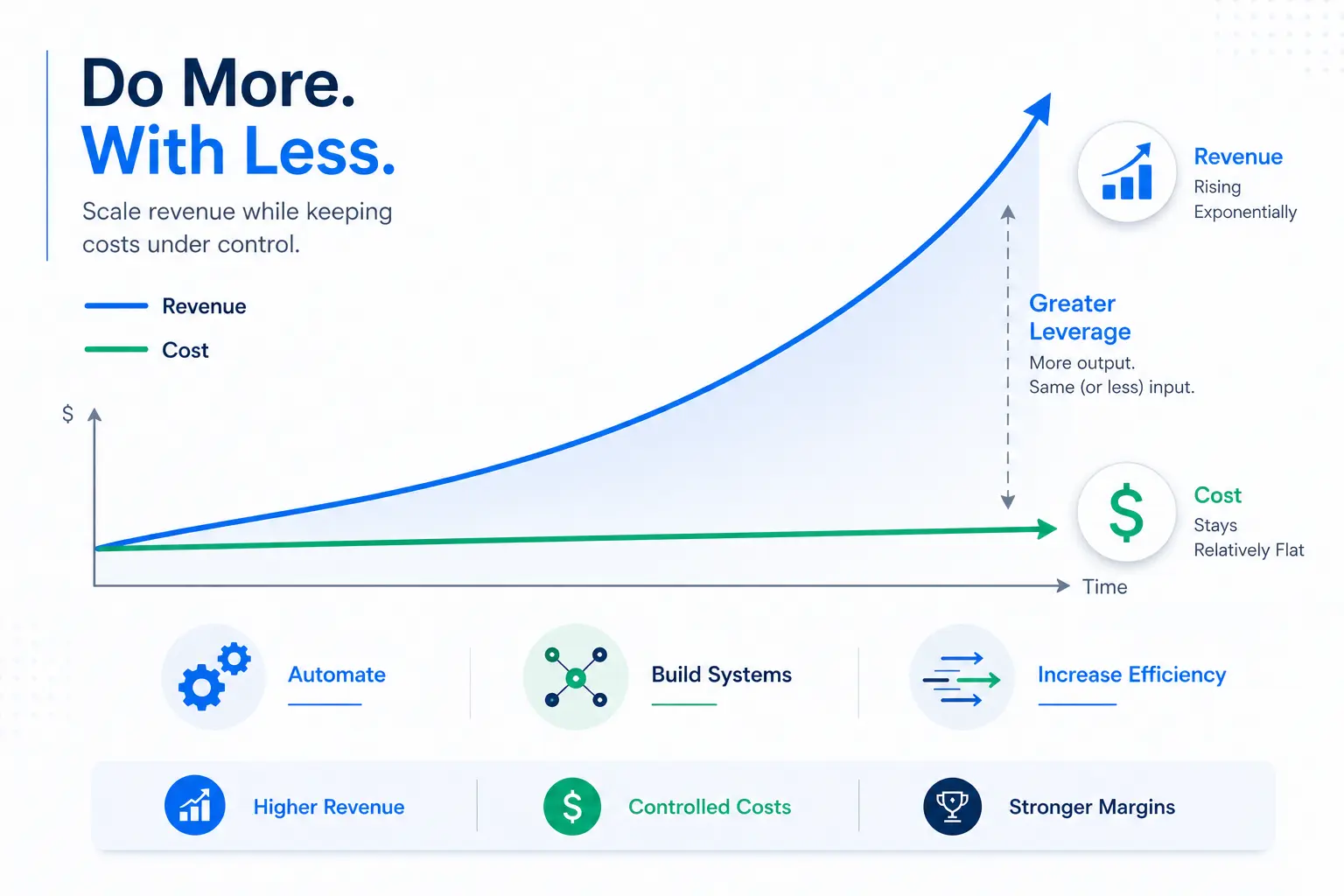
Scaling is the version of expansion where revenue moves faster than costs. The defining trait of a scalable business model is operational efficiency that improves as the business gets bigger. A software product that already serves 1,000 customers can usually serve 10,000 with roughly the same infrastructure. A consulting firm that has packaged its methodology into a curriculum can teach 100 cohorts with the same effort it once took to teach one. Whatever the industry, scaling means doing more with the same resources, not doing more by hiring more.
Key Characteristics of a Scalable Business
A handful of characteristics signal that a business has the bones of scalability: repeatable processes that do not require manual touch for every new customer, automation that absorbs volume without proportional staffing, standardized operations that can be replicated in new geographies, and revenue per employee that climbs rather than plateaus. The unit economics improve as volume grows. That is what separates a scalable business model from a business that simply has high revenue.
Examples of Scaling in Practice
A professional services firm builds templates and workflows that let three account managers handle the work of five. A product company automates customer onboarding so the support team grows at half the rate of the customer base. A consultant turns her methodology into an online course that serves thousands without an hour of one-on-one time. The shared feature: each business invested in systems and processes instead of headcount. The Entrepreneur article on scaling versus growing covers the same dynamic from a strategic-decision angle.
Key Differences Between Business Growth and Scaling
Growth and scaling are not mutually exclusive. Most companies grow first and scale later. The trouble starts when a business pursues the wrong one at the wrong time, which stalls progress or burns capital. The table below sets the two side by side.
| Dimension | Growth | Scaling |
|---|---|---|
| Resource Allocation | Adds resources proportionally with revenue | Leverages existing resources to handle more volume |
| Cost Structure | Costs rise alongside revenue | Costs hold steady or fall as revenue rises |
| Profit Margin Impact | Top-line revenue rises, margins may stay flat | Margins improve as volume grows |
| Management Approach | Hands-on oversight of new resources | Systems-level thinking and process design |
| Timeline | Can begin immediately | Requires foundational investment in business infrastructure |
The InCorp comparison of entity types covers the structural side of the same decision, since the entity form a business chooses also shapes which path is easier to pursue.
Signs Your Business Is Ready to Scale
Scaling before the business is ready is one of the most common reasons companies fail. Approximately 20% of small businesses do not survive year one, and 50% close by year five, with premature or poorly planned expansion among the top contributing factors. A handful of operational signals tend to show up when a business is genuinely ready to scale.
Consistent Revenue and Demand
Stable, predictable revenue is the precondition for everything that comes next. Scaling amplifies what already works, so the underlying business model has to be validated before the amplifier gets turned on. Product-market fit is the term most operators use for that validation. If a business is still adjusting its core offering, scaling will only amplify the problems, not solve them.
Operational Capacity Is Maxed Out
When the team is consistently at capacity, customers are dropping off because of bandwidth, or fulfillment times are slipping, the current model has reached its limit. The instinct is to hire, but hiring is a growth move. The scaling move is to build systems that let the existing team handle more volume: automation, process documentation, and tooling. The right move depends on whether the business has the data and product foundation to support either.
Clear Metrics and Financial Visibility
Scaling without clear metrics is the classic pattern behind premature scaling failures. Customer acquisition cost, customer lifetime value, cash flow, and profit margin all need to be visible and trending in the right direction before scaling decisions get locked in. Maintaining strong financial oversight and compliance practices is what keeps the company in good standing through the expansion. The InCorp resource on business licensing covers the regulatory side that often gets neglected during fast-moving expansions.
Strategies for Scaling a Business
Scaling requires deliberate investments in systems and business infrastructure, not faster hiring. Four strategies cover most of the scaling decisions an entrepreneur will make.
Automate Repeatable Processes
Automation is the foundation of every scalable business model. Invoicing, onboarding, scheduling, customer notifications, and data entry are common candidates because they happen often, follow predictable rules, and cost time at every repetition. Software handles those tasks without errors and at zero marginal cost per repetition, which improves operational efficiency and frees the team to focus on the work that actually requires judgment.
Standardize Operations
Standard operating procedures are what let a business hire and onboard without resetting the quality bar. Documented processes reduce dependency on the founder or any single individual, and they produce a consistent customer experience as the company scales across locations or geographies. Standardization is especially important for service businesses, where the variable in the equation is often a specific person's expertise.
Invest in Technology Infrastructure
The right business infrastructure is the difference between scaling smoothly and stalling out. CRM systems, project management platforms, cloud-based collaboration tools, and customer-data systems support more customers, projects, and transactions without proportional headcount. The investment cost is real, but the cost per unit served drops as volume rises, which is what improves the profit margin over time.
Focus on Customer Retention
Customer acquisition is more expensive than customer retention by every available measure. Scaling strategies that improve retention (loyalty programs, better onboarding, proactive support) lift revenue per customer, raise lifetime value, and give the business a stable revenue growth base to fund further sustainable growth. The SBA's guide to funding business growth covers the capital side that often pairs with retention-driven scaling.
Structural Foundations That Support Scaling
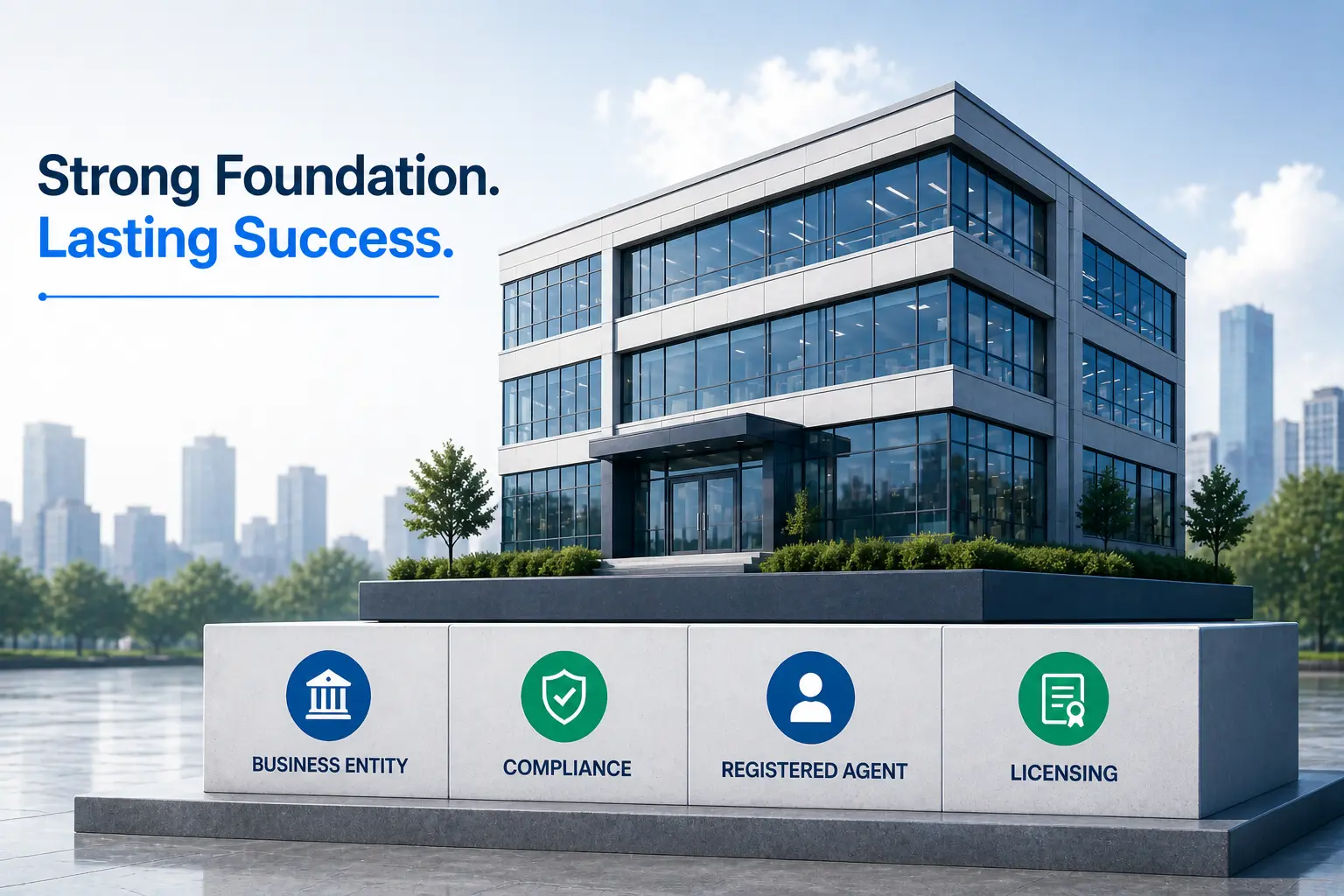
Scaling is not only an operational question. The legal and administrative structure of the business has to expand with it, and a business that outgrows its original structure can hit compliance gaps, liability exposure, or filings that stack up faster than someone can manage them.
Choosing the Right Business Entity
The business structure that fits a sole proprietor running on a single laptop is rarely the same business structure that fits a multi-employee operation expanding into new states. An LLC offers liability protection, tax flexibility, and operational simplicity that work for many growing businesses. A corporation is often the better fit for businesses raising venture capital or planning to issue stock. Entrepreneurs at this lifecycle moment often find that the business formation and ongoing compliance work pile up faster than the team can keep up with. A partner like InCorp manages the entity formation, multi-state filings, and EntityWatch® compliance tracking through one system, which makes the structural side a tracked workflow rather than a fire drill once expansion starts. The InCorp overview of LLC benefits covers the trade-offs that come with that choice.
Multi-State Compliance and Foreign Qualification
Market expansion across state lines triggers a layer of compliance that most growing businesses encounter for the first time. A business operating outside its state of formation typically has to register as a foreign entity in each new state, file the appropriate paperwork, and maintain a registered agent in every jurisdiction. Failing to register can mean penalties, loss of the right to bring lawsuits in that state, and compliance issues that tend to surface at the worst time. Market expansion done deliberately, with the foreign qualification work in place before revenue starts flowing through the new state, is what keeps the legal side aligned with the operational side.
Ongoing Compliance and Business Continuity
Scaling increases the surface area of compliance. Annual reports, registered agent designations, business licenses, and tax filings have to be maintained in every state where the business operates, and the requirements rarely align cleanly from one state to the next. Proactive compliance and business continuity planning help prevent the disruption that comes from missing a filing during a period of rapid expansion.
Build the Foundation for Sustainable Growth with InCorp
Growth adds revenue by adding resources. Scaling adds revenue without adding the same resources. Most businesses do both at different points in their lifecycle, and knowing which one the business needs at a given moment is one of the more important entrepreneurial calls. Sustainable growth comes from making that call deliberately rather than by default, and from a business structure that can hold up under either strategy.
Whether the next move is forming a new entity, registering in additional states, or building a compliance system that holds up under expansion, the structural foundation matters as much as the operational strategy. The InCorp LLC formation service handles entity formation, registered agent designation, and ongoing compliance tracking in all 50 states, so the structural side stays ready as the operational side scales toward sustainable growth.
FAQ's
What is the difference between scaling and growing a business?
Growing a business means increasing revenue by adding resources such as employees, locations, or capital, with costs rising at a similar rate. Scaling a business means increasing revenue without a proportional increase in costs, usually through automation, systems, and operational efficiency. Most businesses grow first and then scale once they have established stable revenue and product-market fit.
How do I know when my business is ready to scale?
Key signals include consistent and predictable revenue, validated product-market fit, repeatable and documented operational processes, and a team consistently working at capacity. Financial metrics like customer acquisition cost, customer lifetime value, and cash flow should be stable. If the business is still refining its core offering, scaling may be premature.
What are the risks of scaling too fast?
Premature scaling is one of the leading causes of business failure. Approximately 74% of high-growth startups fail because they scale before the business model is validated. Risks include overextending finances, hiring faster than the business can support, outpacing quality control, and creating compliance gaps when expanding across state lines.
What business structure is best for scaling?
The right business structure depends on the company's goals. An LLC offers flexibility, liability protection, and simpler compliance, which makes it a common choice for small businesses preparing to scale. Corporations may suit businesses seeking venture capital or planning to issue stock. Entrepreneurs should evaluate tax, funding, and multi-state needs before choosing.
Do I need to register in other states if I scale my business nationally?
A business operating in states other than its state of formation typically has to file for foreign qualification in each additional state, pay filing fees, and appoint a registered agent in that jurisdiction. Failing to register can result in fines, loss of legal standing, and back taxes.
How can a small business owner tell if they should focus on growth or scaling first?
If your main challenge is getting more clients or more revenue at all, you are still in a business growth phase and should focus on validating product‑market fit and bringing in steady demand. When you already have consistent revenue and increased demand but profit margins are flat or shrinking as you add resources, it is a sign you should focus on scaling efficiently rather than just chasing more growth.
What key metrics should entrepreneurs watch when deciding how to scale a business?
Business owners should track customer acquisition cost, customer lifetime value, gross margin, and overall profit margins to see whether revenue increases are actually translating into more money kept in the business. A good sign that it is time to scale is when revenue growth is strong, customer retention is healthy, and you can see clear ways to serve more customers without costs rising at the same rate.
How does customer retention factor into business scaling vs growth?
Customer retention is a major lever for scaling because keeping existing customers longer improves revenue without requiring the same level of marketing spend as acquiring new business. When a company builds systems that increase repeat business and customer lifetime value, it can grow revenue and market share while adding fewer new resources, which supports higher profit margins over time.
What role do internal processes play in scaling a business successfully?
Internal processes are critical for scaling because they determine whether a company can meet demand without hiring full‑time employees for every new client or location. Standardized workflows, clear handoffs between team members, and the right tools for service delivery and communication help many businesses handle more output at roughly the same level of resources.
Is opening multiple offices always a sign of successful scaling?
Opening multiple offices or new locations is more often a growth move than pure scaling, because it usually requires significant new resources like office space, staff, and local marketing. It becomes an example of scaling only when the underlying business model and systems are efficient enough that each new office can generate more revenue than it costs to operate, improving the company's overall profit margins rather than just increasing revenue.
Disclaimer: This content is intended for general educational and informational purposes only and does not constitute legal, tax, or accounting advice. Every effort is made to keep the information current and accurate; however, laws, regulations, and guidance can change, and no representation or warranty is given that the content is complete, up to date, or suitable for any particular situation. You should not rely on this material as a substitute for advice from a qualified professional who can consider your specific facts and objectives before you make decisions or take action.