
How to Draft an LLC Partnership Agreement for Multiple Owners


Starting a business with partners is one of the more energizing moments in a founder's career, and the early momentum tends to push paperwork down the priority list. Even strong partnerships face costly disputes when ownership, profit, and decision-making terms have never been written down. An LLC partnership agreement sets the rules in advance, while everyone is still aligned.
LLCs represent 85% of all new business entity formations in the U.S. as of 2025, with roughly 21.6 million active LLCs nationwide. Multi-member LLCs carry a heavier documentation burden than single-member entities because each additional owner introduces another set of expectations the agreement must reconcile. For founders working through that process, an administrative partner like InCorp can handle the foundational filings (articles of organization, registered agent designation, EntityWatch® compliance tracking), so the team's attention stays on the terms that need to be negotiated.
This guide covers what an LLC partnership agreement is, the key provisions it should include, how to draft one step by step, common mistakes to avoid, and when to revisit an existing agreement.
Key Takeaways
-
An LLC partnership agreement (multi‑member operating agreement) turns handshake deals between co‑owners into written rules for ownership, profits, management, and exits.
-
Every multi‑member LLC should have a written operating agreement, and some states effectively require one, because otherwise state default rules decide profit splits, voting rights, and management authority.
-
Core provisions include member information and ownership percentages, capital contributions, profit and loss allocations, management structure and voting thresholds, transfer and buy‑sell terms, dispute resolution, and dissolution procedures.
-
Drafting a strong agreement means forming the LLC first, agreeing on key terms among the members, then using a template or checklist and, ideally, having an attorney review the final document before everyone signs.
-
Common mistakes—relying on state defaults, vague or missing buyout provisions, ignoring deadlock scenarios, and commingling business and personal funds—can undermine both the partnership relationship and the LLC’s liability protection.
What Is an LLC Partnership Agreement
An LLC partnership agreement translates a verbal handshake among co-owners into terms a court, a bank, or an investor can actually read. The more formal name is the multi-member LLC operating agreement, and both terms refer to the same internal document. It defines who owns what, how profits move under the LLC's default pass-through taxation, who can sign on the LLC's behalf, and what happens when a member leaves. Unlike the articles of organization, it is not filed with the state. It supports the LLC's liability protection by showing that the business operates as a separate legal entity. The InCorp overview of whether you need an operating agreement for your LLC covers the foundational case.
Why Every Multi-Member LLC Needs One
Five states (California, Delaware, Maine, Missouri, and New York) legally require LLCs to maintain a written operating agreement. In every other state, the requirement is practical: without an agreement, state default rules govern profit distribution, voting rights, and management authority, and those defaults rarely match what the members intended.
Banks and lenders also tend to ask for the agreement before opening accounts. Courts look at whether the LLC has been operated as a separate legal entity when deciding whether to pierce its liability protection, and a current operating agreement helps that case. The InCorp guide to single-member versus multi-member LLC structures outlines where the documentation demands diverge.
Operating Agreement vs. Partnership Agreement
The operating agreement vs partnership agreement question comes up because the two documents serve similar functions for different entity types. An operating agreement governs an LLC and preserves the liability protection that shields members' personal assets. A partnership agreement governs a general or limited partnership, where at least one partner remains personally liable.
A multi-member LLC is classified as a partnership for federal income tax purposes by default, which means it files IRS Form 1065 for LLCs taxed as partnerships and issues each member a Schedule K-1. The pass-through taxation overlap does not make the documents interchangeable.
Key Provisions Every LLC Partnership Agreement Should Include
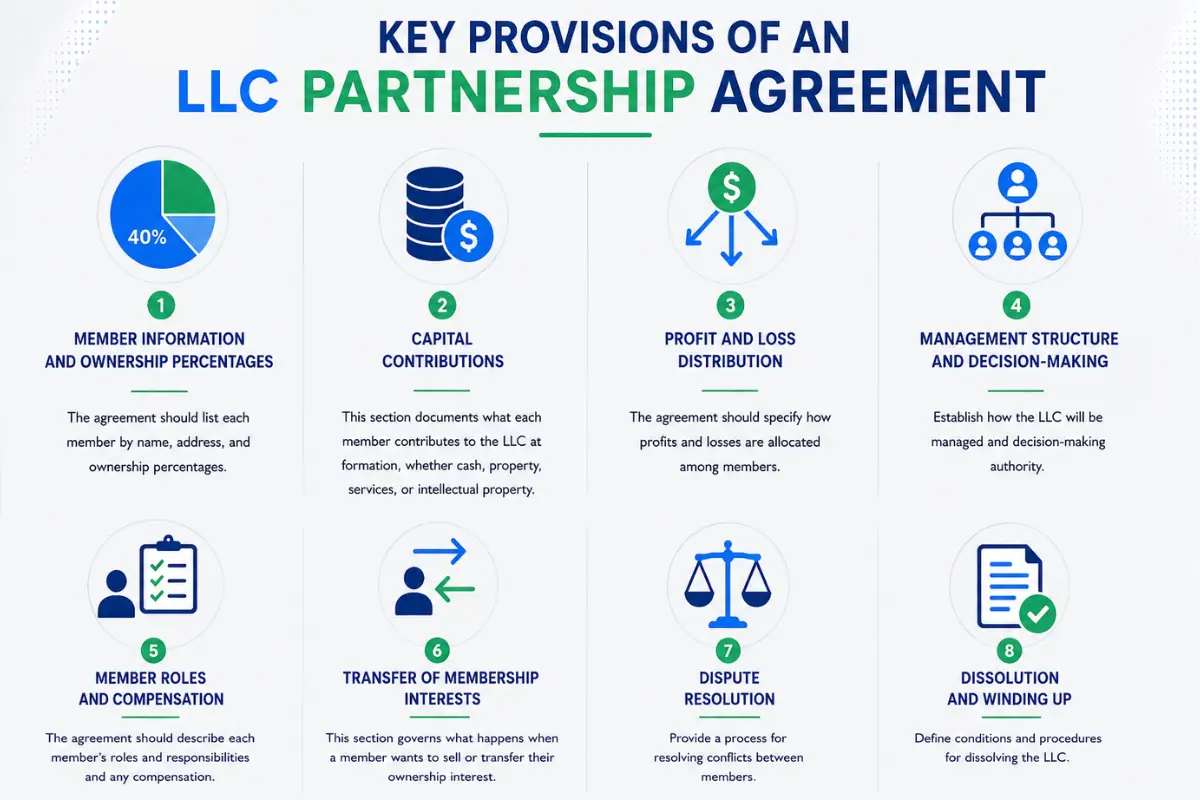
A complete LLC partnership agreement covers eight core areas, detailed below.
Member Information and Ownership Percentages
Every member should be listed by legal name, address, and ownership percentage. The ownership percentage typically tracks each member's capital contributions, though members can agree to a different split if one person is bringing labor or intellectual property instead of cash. The percentages here usually govern voting rights and profit-sharing by default.
Capital Contributions
This section documents what each member puts in at formation, whether cash, property, equipment, or services rendered. It should describe how additional capital contributions can be requested later, and what happens if a member cannot meet a future call. A capital account for each member prevents disputes about who put in what.
Profit and Loss Distribution
A multi-member LLC profit-sharing agreement can follow ownership percentages, capital contributions, or any custom formula. Because the LLC is taxed on a pass-through basis by default, each member is taxed on their allocated share, whether or not cash is distributed. Without a written profit distribution provision, most states default to splitting profits equally regardless of investment levels, so a member who put in $100,000 and a member who put in $10,000 would receive the same share.
Management Structure and Decision-Making
LLCs operate under one of two management structures: member-managed or manager-managed. A member-managed LLC has all members participate in daily decisions. A manager-managed LLC designates one or more managers while the other members serve as passive investors. The agreement should also map voting thresholds, identifying which decisions require a simple majority, which require a supermajority or unanimous consent (admitting new members, taking on significant debt, selling major assets), and which can be handled by a single manager. The SBA overview of business structures is a useful reference.
Member Roles and Compensation
Members who actively manage the LLC may receive a salary or guaranteed payments in addition to their share of profits, while passive members typically receive only profit distributions. In a member-managed LLC, this often applies to most members; in a manager-managed LLC, it applies mainly to the designated manager. The agreement should spell out each member's role and the compensation tied to it.
Transfer of Membership Interests
This section governs what happens when a member wants to leave or sell their stake. The buy-sell provisions in a typical LLC member buyout agreement include a right of first refusal, restrictions on transfers without member approval, and a defined valuation method. The agreement should also cover involuntary scenarios (death, disability, divorce, bankruptcy), which can otherwise pull the LLC into a court process that the remaining members do not control. The InCorp guide on how to transfer ownership of an LLC covers the mechanics.
Dispute Resolution
Dispute resolution clauses establish a process for handling disagreements before they reach a courtroom. The standard dispute resolution sequence is mandatory mediation, followed by binding arbitration if mediation fails. For LLCs with two members or 50/50 ownership, the agreement should also include a deadlock procedure, such as a neutral third party with binding authority or a shotgun buy-sell clause.
Dissolution and Winding Up
The dissolution section describes when the LLC ends: a unanimous member vote, a triggering event in the agreement, a court order, or completion of the LLC's stated purpose. The agreement should specify how remaining assets are distributed after debts are settled, typically in accordance with each member's capital account balance. The SCORE operating agreement checklist for LLCs and partnerships is a useful sanity check.
How to Draft an LLC Partnership Agreement Step by Step
Drafting happens after the LLC is formed. The work is split into five steps.
Step 1: Form the LLC with the State
The LLC must exist as a legal entity before any work on the operating agreement begins. Filing articles of organization (or a certificate of formation, depending on the state) with the Secretary of State creates the entity and starts the clock on annual compliance. The InCorp LLC formation service files articles of organization in all 50 states, coordinates the registered agent requirement, and uses the EntityWatch® compliance system to keep post-formation deadlines visible.
Step 2: Appoint a Registered Agent
Every LLC must designate a registered agent with a physical address in the state of formation. The registered agent receives service of process and official state correspondence on the LLC's behalf. Using one of the members is legal in most states but comes with trade-offs: the member's name and address become part of the public record, and someone must be physically present during business hours. Many multi-member LLCs use a third-party service instead.
Step 3: Discuss and Agree on Key Terms
Members should work through every major provision conversationally before drafting starts. The conversations that matter most are the uncomfortable ones: each person's role, the profit split under different growth scenarios, who can write checks, and what happens if someone wants out in year two. Surfacing those disagreements early is cheaper than surfacing them in a deposition. The SCORE primer on partnership operating agreements is a useful framework.
Step 4: Draft the Agreement
Drafting happens in one of three ways: members work from an LLC partnership agreement template, an attorney drafts it end-to-end, or members draft from a checklist and pay an attorney to review the final version. For LLCs with equal ownership, a template usually suffices. For LLCs with unequal contributions or outside investors, attorney involvement is generally worth the cost. Attorney review of a self-drafted agreement typically runs $200 to $500. The Chamber of Commerce's guide to drafting an LLC operating agreement covers what a working template should include.
Step 5: Review, Sign, and Store
Every member should read the final draft in full, confirm that it matches what was discussed, and then sign and date the document. Most states do not require the operating agreement to be filed or notarized, though some lenders ask for notarized signatures. A signed copy belongs in the LLC's records, with a digital backup that every member can access.
Common Mistakes to Avoid When Drafting an LLC Partnership Agreement
Four mistakes show up disproportionately in first-time multi-member LLC agreements.
Relying on State Default Rules
When the agreement is silent, state default rules fill the gap, and those defaults are rarely what the members would have chosen. The most common example is profit-sharing: most states default to equal splits regardless of capital contribution, so a member who put in $100,000 and a member who put in $10,000 each receive 50% of profits unless the agreement says otherwise.
Vague or Missing Buyout Provisions
Vague buy-sell provisions turn a member's exit from an administrative event into a courtroom event. The agreement should specify the valuation method (fair market value, book value, or a formula tied to earnings), the payment terms, and the timeline. Without those terms, the departing member and the remaining members arrive at the conversation with different numbers in mind.
Not Addressing Deadlock Scenarios
LLCs with an even number of members, especially two-member LLCs with 50/50 ownership, are uniquely exposed to deadlock. When neither side has enough votes to break a tie, decisions stall, and the only paths to resolution are a court-supervised dissolution or an unplanned buyout. The agreement should include a tiebreaker, such as a neutral third-party mediator with binding authority, or a shotgun clause forcing one member to either buy out the other or sell at the same price.
Failing to Separate Personal and Business Finances
Commingling business and personal funds is the most common reason courts pierce the LLC's veil and hold members personally liable. The agreement should require a separate business bank account, prohibit paying personal expenses from LLC funds, and require members to document any loans. Liability protection is conditional on the LLC operating as a separate entity. The InCorp overview of the benefits of forming an LLC covers the practical mechanics.
When to Update Your LLC Partnership Agreement
An operating agreement is not a one-and-done document. Two years in, after a new hire or expansion into a second state, the original version may no longer describe what is happening inside the LLC.
Common Triggers for Amendment
Several events typically call for an amendment: adding or removing a member, changing ownership percentages, modifying profit distribution, restructuring management authority, taking on significant new debt, expanding into a new state, or a change in state law. The original agreement should describe the amendment process, which usually requires approval by a majority or supermajority of members. The InCorp guide to bringing on a business partner covers the structural side of adding a new member.
Annual Review Best Practice
An annual review, ideally during a formal members' meeting, catches drift between what the document says and what the LLC actually does. Members who treat the review as routine are the ones whose agreements remain usable when a contested issue arises.
Start Your Multi-Member LLC with InCorp
A well-drafted LLC partnership agreement is one of the highest-leverage things multiple owners can do at formation. It works alongside the articles of organization and registered agent designation to form the legal backbone of the business.
The InCorp LLC formation service prepares articles of organization in all 50 states, manages the registered agent requirement, and uses the EntityWatch® compliance system to keep annual filings on schedule, so the founders can spend their planning time on the agreement itself.
FAQ's
What is an LLC partnership agreement?
An LLC partnership agreement, more accurately called a multi-member LLC operating agreement, is a legal document that defines how co-owners share ownership, profits, management, and dispute resolution. It is kept as an internal record among the members rather than filed with the state.
Does a multi-member LLC need an operating agreement?
Yes, an operating agreement is strongly recommended for every multi-member LLC and is legally required in California, Delaware, Maine, Missouri, and New York. Without one, state default rules govern profit distribution, voting rights, and management authority, which often do not match the members' actual intentions.
What is the difference between an operating agreement and a partnership agreement?
An operating agreement governs an LLC and preserves liability protection for its members, while a partnership agreement governs a general or limited partnership, in which at least one partner typically has unlimited personal liability. The correct document depends on the entity type.
How are profits split in a multi-member LLC?
Profit distribution in a multi-member LLC is governed by the operating agreement, which can allocate profits by ownership percentage, capital contributions, or another formula. Without a written agreement, most states default to splitting profits equally, regardless of how much each member invested.
Can you add a new member to an existing LLC operating agreement?
Yes, adding a new member requires amending the operating agreement to reflect the new ownership percentage, capital contribution, and profit-sharing arrangement. The amendment typically requires approval from a majority or supermajority of existing members.
How detailed should an LLC partnership agreement be for multiple owners?
An LLC operating agreement for multiple owners should go beyond basic ownership percentages and include clear rules on capital contributions, voting rights, management structure, profit distributions, admitting new members, and what happens in worst case scenarios such as deadlock, death, or withdrawal. The goal is to give all the members a shared playbook so that day‑to‑day company operations and major decisions are handled consistently and disputes can be resolved by referring back to the document.
How should capital contributions and sweat equity be handled in a multi‑member LLC operating agreement?
The agreement should state the dollar amount or clearly defined value of each owner's initial capital contribution and how future capital calls will work, including what happens if one partner cannot contribute. If some owners contribute sweat equity instead of cash, the agreement needs to spell out how that is translated into ownership interests or profits, so that business partners are on the same page and there is no assumption of equal ownership unless all the members agree to that in writing.
How are ownership percentages and voting rights typically structured for multi‑member LLCs?
Ownership percentages often track capital contributions, but the agreement can allocate voting rights differently if the members agree, such as giving a majority owner more votes or creating multiple classes of membership interests with different voting power. The operating agreement should define which decisions require a simple majority vote, which require a supermajority or unanimous consent, and whether certain management decisions are reserved to managers instead of all members having an equal say.
What is the role of a registered agent and official notices in an LLC partnership agreement?
Every limited liability company must designate a registered agent to receive official notices such as lawsuits and state correspondence, and the agreement should identify who the registered agent is and how changes will be handled. The agreement can also set rules for how the company gives official notices to members—such as by mail or email to a specified address—so there is a clear record of communication for important matters like amendments, capital calls, and member meetings.
How does tax classification (partnership vs. S corp) affect what goes into a multi‑member operating agreement?
By default, a multi‑member LLC is taxed as a partnership, which means the agreement should address how profits, losses, and distributions are allocated among members for tax purposes and who will act as the tax matters partner or partnership representative. If the members elect S corporation treatment, the agreement may need to add specific terms to meet S corp requirements, such as restrictions on the types of owners and ensuring only one class of economic interest, and it is generally wise to have an attorney and tax professional review those provisions.
Disclaimer: This content is intended for general educational and informational purposes only and does not constitute legal, tax, or accounting advice. Every effort is made to keep the information current and accurate; however, laws, regulations, and guidance can change, and no representation or warranty is given that the content is complete, up to date, or suitable for any particular situation. You should not rely on this material as a substitute for advice from a qualified professional who can consider your specific facts and objectives before you make decisions or take action.
Share This Article:
Stay in the know!
Join our newsletter for special offers.