

Licensed professionals opening a practice face a narrower set of entity choices than most business owners. A physician building a private practice, a lawyer branching out from a firm, or a CPA launching an accounting shop often finds that their state blocks the use of a regular LLC and requires a specific variant instead: the Professional Services LLC, commonly known as a PLLC.
The distinction matters. A PLLC exists because states have decided that licensed professionals must remain personally answerable for their own work. No entity structure can wall off a professional from a malpractice claim tied to their own conduct. What a PLLC does is shape how related liability is contained, how a practice is owned, and how its earnings are taxed. For professionals who skip the analysis and default to a standard LLC, the consequence can range from a rejected filing to a board complaint.
This guide walks through what a PLLC is, which professions typically need one, how it compares to a standard LLC and a Professional Corporation, and the steps involved in forming one. InCorp serves as an administrative partner for licensed professionals through this process — handling registered agent coverage, formation document preparation, and ongoing compliance tracking through the EntityWatch® system.

Key Takeaways
-
A Professional Services LLC (PLLC) is a specialized LLC structure for state‑licensed professionals that preserves limited liability for business debts but never shields a professional from their own malpractice.
-
Many states require doctors, lawyers, CPAs, and similar licensed practitioners to use a PLLC or Professional Corporation rather than a standard LLC, and board approval is often needed before the Secretary of State will accept the filing.
-
PLLCs share the same default tax treatment as standard LLCs—pass‑through taxation, with the option to elect S‑corporation status for qualifying practices—so most tax advantages come from elections and planning rather than the “P” label itself.
-
Strong PLLC governance relies on a tailored operating agreement that addresses ownership, profit sharing, decision rights, and what happens if a member loses their license or leaves the practice.
-
Maintaining malpractice insurance, proper entity records, separate finances, and ongoing compliance with both state filings and professional licensing requirements is essential to keep the PLLC’s liability protections intact.
What Is a Professional Limited Liability Company (PLLC)?
A Professional Limited Liability Company is a business structure designed specifically for state-licensed professionals. In most respects it behaves like a standard LLC. It is a separate legal entity, has members rather than shareholders, and is taxed as a pass-through by default. The difference sits in who is allowed to form one and what additional approvals the formation requires.
The reason PLLCs exist is regulatory. Many states prohibit licensed professionals from forming a standard LLC for their practice because the public has a stake in how that practice operates. The PLLC structure codifies that expectation: the entity can own assets, sign leases, and hold contracts, but the licensed professional inside it stays personally accountable for their own work.
These protections have limits, which the dedicated liability section below covers in detail. NerdWallet’s guide to the professional limited liability company lays out the basic contours, though specific mechanics vary by jurisdiction and profession. For context on volume, LLCs represent 85% of all new business formations in the U.S. as of 2025, with approximately 21.6 million active LLCs nationwide.
Which Professions Typically Require a PLLC?
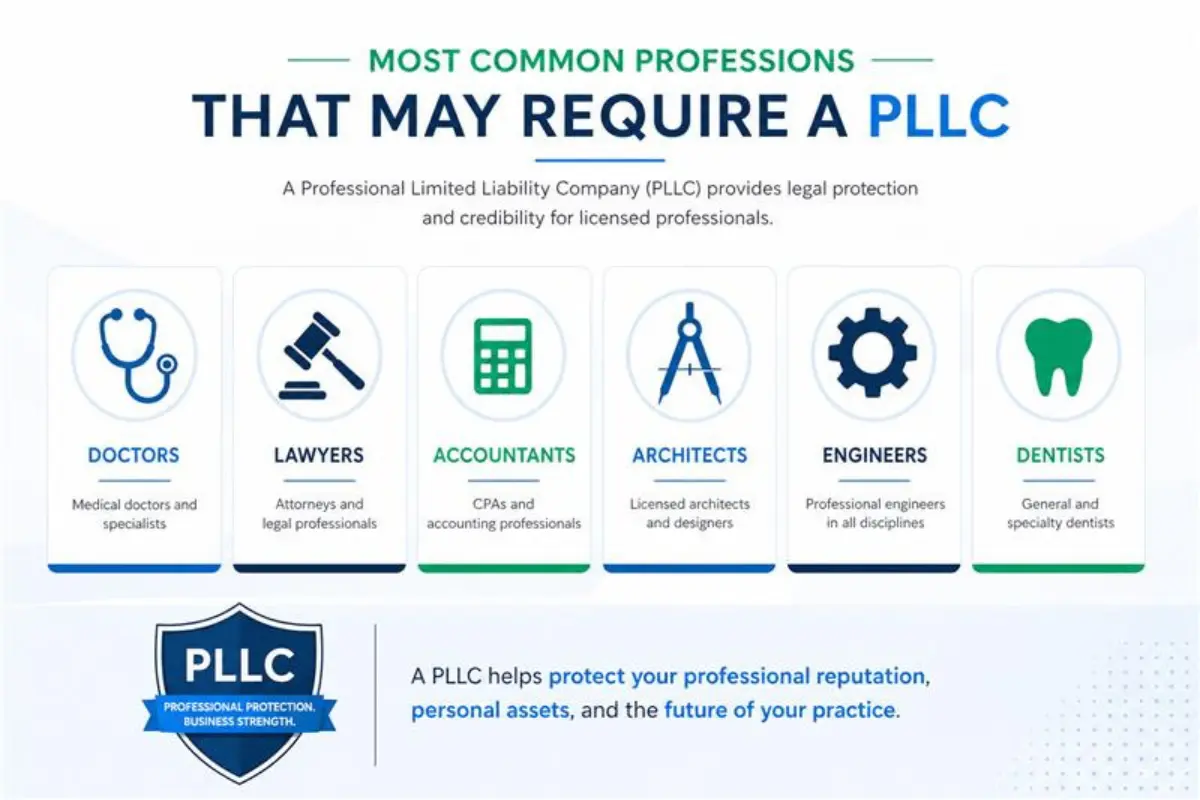
The professions most commonly steered toward PLLC formation are the ones that require an active state license to practice. The specific licensing board that signs off on formation differs by profession, but the general playbook is the same. Common professions subject to PLLC requirements include:
-
Physicians and surgeons
-
Lawyers and attorneys
-
Certified public accountants (CPAs)
-
Architects
-
Engineers
-
Dentists
-
Veterinarians
-
Chiropractors
-
Optometrists
-
Psychologists
-
Land surveyors
A PLLC for doctors opening a private practice, a PLLC for lawyers launching a firm, and a PLLC for accountants starting a CPA shop are the three most common scenarios — each detailed below.
PLLC for Doctors
A PLLC for doctors, sometimes called a physician PLLC, is the default path for most solo and small-group medical practices in states that authorize the entity. Formation typically routes through the state medical board in addition to the Secretary of State. Several states restrict ownership to licensed physicians only, with narrow exceptions for related practitioners such as physician assistants or nurse practitioners. Naming rules often constrain medical specialty terms unless every member holds the matching board certification, and minimum malpractice coverage thresholds may apply as a condition of good standing.
PLLC for Lawyers
A PLLC for lawyers, commonly called an attorney PLLC or law firm PLLC, requires approval from the state bar association on top of the standard Secretary of State filing. Ownership is typically limited to attorneys licensed in the state of formation. Several jurisdictions impose additional naming requirements. New York, for example, requires that the firm name include at least one member’s surname. A law firm PLLC cannot shield a member from personal liability for their own legal malpractice, though it can insulate other attorneys in the firm from vicarious exposure to a colleague’s error.
PLLC for Accountants
A PLLC for accountants, often written as a CPA PLLC, involves the state board of accountancy as the licensing authority that must approve the formation. Most states require that a controlling majority of members hold an active CPA license. Annual peer review, CPE tracking, and firm registration with the board typically continue past the initial filing.
Professionals in niche or hybrid fields should check with their state directly. Acupuncturists, physical therapists, social workers, and nurse practitioners often face state-specific rules that move them in or out of the PLLC category. Confirm the classification with the state’s business licensing resources and the relevant board before a filing fee is paid. Given that professional services accounts for 12.77% of non-corporate business applications — second only to retail trade — the PLLC question affects a meaningful slice of new entity decisions every year.
PLLC vs. LLC vs. Professional Corporation (PC)
Most licensed professionals will choose among three structures: a standard LLC, a PLLC, or a Professional Corporation. The differences shape the administrative burden of running a practice and the tax mechanics underneath it.
How a PLLC Differs from a Standard LLC (PLLC vs LLC)
The PLLC vs LLC comparison comes down to three practical differences:
-
Ownership. A PLLC generally requires that all, or nearly all, members hold the relevant professional license, while a standard LLC has no such restriction.
-
Naming. A PLLC’s legal name must include a designator such as "PLLC," "P.L.L.C.," or "Professional Limited Liability Company."
-
Approval. Many states require the relevant professional licensing board to sign off before the Secretary of State will accept the filing.
Outside those three differences, a PLLC behaves much like a standard LLC. Tax treatment is the same by default, management is flexible, and the operating agreement governs internal affairs. For professionals whose state allows either structure, the practical overlap between a PLLC and a standard LLC often comes down to what the licensing board expects rather than any functional difference.
How a PLLC Differs from a Professional Corporation (professional corporation vs PLLC)
The professional corporation vs PLLC question is mostly about formality and tax default. A professional corporation carries the full governance infrastructure of a standard corporation: board, officers, bylaws, regular meetings, and recorded minutes. That structure can help satisfy regulatory expectations and produce documentation useful for malpractice defense or partnership disputes. The cost is administrative overhead.
Tax treatment is where the structures diverge most clearly. Wolters Kluwer’s expert insights on the professional corporation and PLLC distinction note that a PC defaults to C corporation taxation, meaning the entity pays tax on profits and shareholders pay tax again on distributions. A PC can elect S corporation status to avoid the double tax, but the election carries restrictions. A PLLC, by contrast, defaults to pass-through taxation, so profits flow directly to members’ personal returns without an entity-level tax.
Summary Comparison Table
| Feature | Standard LLC | PLLC | Professional Corporation (PC) |
|---|---|---|---|
| Who Can Form | Almost anyone | Licensed professionals only | Licensed professionals only |
| Personal Liability for Own Malpractice | N/A | Yes, personally liable | Yes, personally liable |
| Protection from Partners' Malpractice | Members shielded | Members shielded | Shareholders shielded |
| Default Tax Treatment | Pass-through | Pass-through | C Corporation |
| S Corp Election Available | Yes | Yes | Yes |
| Governance | Flexible (operating agreement) | Flexible (operating agreement) | Formal (board, officers, bylaws) |
| Naming Requirements | "LLC" | "PLLC" | "PC" or "P.C." |
| Licensing Board Approval | No | Yes (many states) | Yes (many states) |
For a broader side-by-side of the entity options available to a practice, the InCorp compare entity types page lays out the structural trade-offs without assuming a particular profession.
PLLC State Requirements and Availability
PLLC state requirements vary enough that a professional’s home state effectively chooses the entity for them. Roughly 30 states authorize PLLCs. The remaining states either require a Professional Corporation, permit a standard LLC, use a Registered Limited Liability Partnership for certain fields, or do not speak to the question at all. The PLLC vs LLP vs PC decision tree therefore looks different in every jurisdiction.
California is the most common example because it does not recognize the PLLC at all. California’s licensed professionals must use a Professional Corporation instead. New York relies heavily on PLLCs for fields like law and medicine, with additional naming rules such as including a member’s surname for law firms. Texas, Florida, and Illinois each have their own rules that shift by profession. Mosey’s state-by-state breakdown of PLLC meaning and rules is a useful sanity check before drafting.
These PLLC state requirements should be confirmed through the state’s Secretary of State and the relevant licensing board before picking a name, drafting documents, or paying any filing fee. A rejected filing costs weeks, not hours.
How to Form a Professional Services LLC (how to form a PLLC)
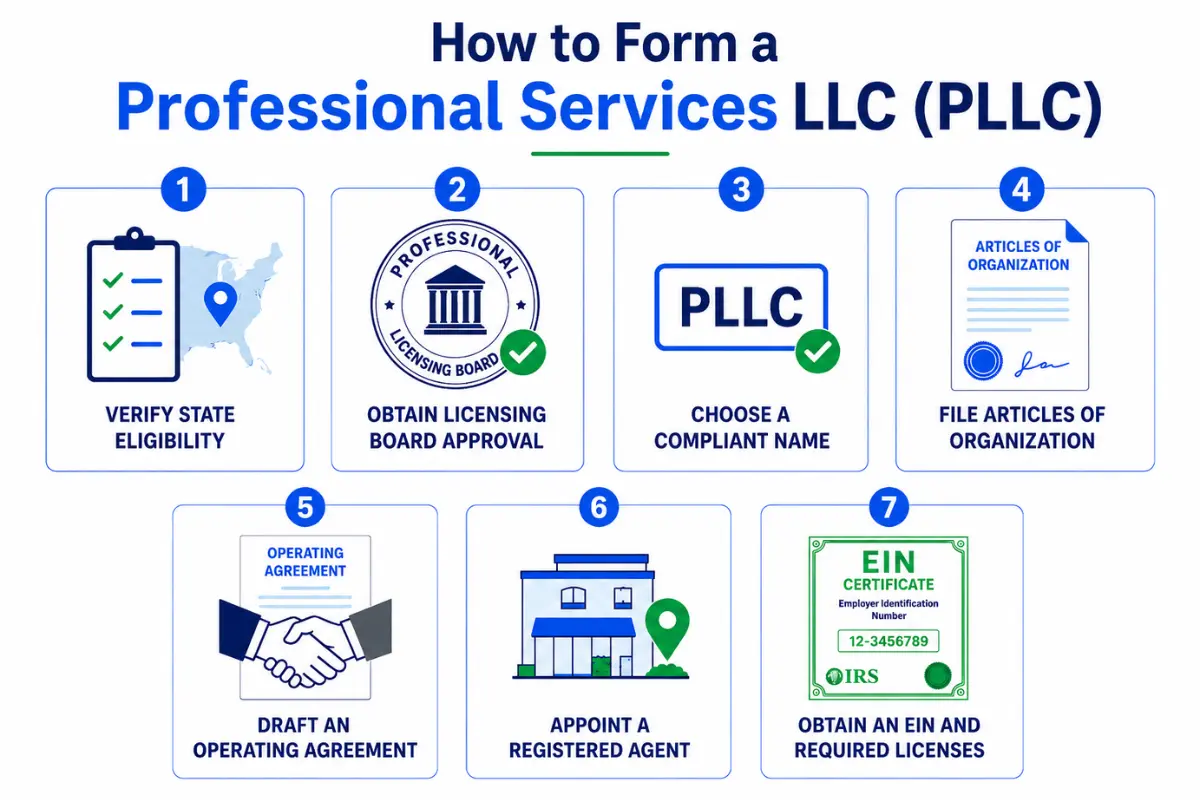
The PLLC formation process, or how to form a PLLC, follows the general outline of any LLC formation, with two added steps that account for the licensing dimension. What follows is the standard path. Specific requirements, fees, and timelines depend on the state and the profession.
Step 1: Verify State Eligibility
Confirm that the state permits PLLC formation for the specific profession. This information sits with the Secretary of State and the professional licensing board. When the state does not authorize a PLLC, the alternatives are typically a Professional Corporation or a Registered Limited Liability Partnership. Starting here avoids wasted drafting work.
Step 2: Obtain Licensing Board Approval
Many states require the relevant board (state bar, state medical board, or board of accountancy) to approve formation before the Secretary of State will process the filing. This step has no analog in standard LLC formation and adds time. Approval windows vary from a few days to several weeks depending on the board’s workload.
Step 3: Choose a Compliant Name
The PLLC’s legal name must include the required designator, usually "PLLC," "P.L.L.C.," or "Professional Limited Liability Company," and must be distinguishable from entities already on record. Several states impose additional constraints. Law firms in New York must include at least one member’s surname. Some states restrict terms implying medical specialization without matching credentials.
Step 4: File Articles of Organization
The core filing is the Articles of Organization, called a Certificate of Formation in some states. For a PLLC, the filing typically includes proof of professional licensure for all members. State fees range from roughly $50 to several hundred dollars. The InCorp LLC formation service handles preparation and filing for professionals who want the administrative work managed.
Step 5: Draft an Operating Agreement (PLLC operating agreement)
The PLLC operating agreement governs how the entity runs internally: ownership shares, profit distribution, decision rights, member admission, and what happens when a member leaves or loses their license. For multi-member practices, the last point matters most. If a physician loses their license, the agreement should already specify how that member’s interest is bought out, rather than leaving it to be negotiated under pressure. Drafting belongs with a qualified attorney. InCorp’s overview of whether you need an operating agreement for your LLC covers the same considerations that apply to PLLCs.
Step 6: Appoint a Registered Agent
Every PLLC must designate a registered agent with a physical address in the state of formation to receive service of process and official notices. For a practice operating across multiple states, the requirement applies in each one. The InCorp resources on what a registered agent does and how to choose a registered agent cover the role. A state compliance notice sent to an unattended address can trigger penalties, late fees, or administrative dissolution.
Step 7: Obtain an EIN and Required Licenses
Obtain a Federal Employer Identification Number from the IRS for tax filings, payroll, and business banking. Confirm whether additional state or local business licenses are required beyond the individual professional licenses held by members. A medical practice, for example, may need a separate state operating permit on top of each physician’s license.
Understanding Liability Protection in a PLLC (PLLC malpractice liability)
The PLLC malpractice liability question is the single most misunderstood feature of the structure. A PLLC can shield a member from a partner’s malpractice and from general business debts, but it cannot shield a member from their own professional negligence.
Protection from Partners’ Malpractice
A PLLC can help shield a member from personal liability arising from malpractice committed by another member. In a general partnership, every partner may share exposure to every other partner’s professional errors. The PLLC structure breaks that link. If one partner in a three-attorney PLLC commits malpractice, the other two may be insulated from personal liability for that claim. State law governs the extent of the protection, and a court that finds the entity was not properly maintained can pierce the shield.
No Protection from Your Own Malpractice
A PLLC does not shield a member from personal liability for their own professional negligence. A surgeon who makes a surgical error remains personally liable. A lawyer who misses a statute of limitations remains personally liable. No state allows a PLLC to sever the link between a licensed professional and their own conduct. This is the policy rationale behind the structure: if a PLLC could eliminate personal liability for malpractice, the state’s licensing system would lose its enforcement mechanism.
Protection from General Business Debts
A PLLC can help protect personal assets from general business debts unrelated to professional malpractice. Office leases, vendor invoices, equipment financing, and employment disputes generally fall within this category, assuming members have not personally guaranteed the debt and have maintained the entity properly.
Malpractice Insurance Considerations
Because the PLLC structure does not extend to a member’s own professional conduct, malpractice insurance does the work the entity cannot. Many states require PLLC members to carry professional liability coverage, often with minimum thresholds in the $100,000 to $1,000,000 range depending on the state and the profession. Some licensing boards publish these minimums as a condition of formation.
Tax Considerations for Professional Service LLCs
A PLLC’s tax treatment mirrors a standard LLC’s by default. The tax questions that matter most for professional practices involve whether to keep the default treatment, elect S corporation status, or avoid C corporation status entirely. A tax professional should run the numbers for a specific practice.
Default Pass-Through Taxation
A single-member PLLC is treated as a disregarded entity by default, with business income on the owner’s Schedule C. A multi-member PLLC is taxed as a partnership by default, with income on Form 1065 and passed through to members on Schedule K-1. In both cases, the entity pays no federal income tax. Profits flow to members’ personal returns and are taxed at individual rates.
S Corporation Election
A qualifying PLLC may file Form 2553 with the IRS to make an S corporation election. Under S corporation treatment, the member pays themselves a reasonable salary subject to employment taxes, and remaining profits are taken as distributions not subject to self-employment tax. Many high-earning professionals explore this once practice income reaches a level where savings outweigh added payroll administration. The IRS overview of S corporations covers eligibility.
Personal Service Corporation Caution
A professional entity that elects C corporation status and qualifies as a Personal Service Corporation faces a flat 21% corporate tax rate with no graduated brackets, on top of potential double taxation. This is why pass-through treatment is the default posture. The benefits of forming an LLC carry over to the PLLC variant.
Form Your Professional Services LLC with Confidence
Forming a Professional Services LLC involves more moving parts than a standard LLC. Licensing board approval, compliant naming, state-specific rules about permitted professions, and the liability boundaries that apply to professional practice all have to line up before the filing goes through. Keeping the entity in good standing then requires ongoing compliance with both state filings and professional licensing obligations.
InCorp supports licensed professionals through that process as an administrative partner. That support covers accurate preparation and filing of formation documents, registered agent coverage across states, managed annual reports and compliance filings, and deadline tracking through the EntityWatch® compliance monitoring system. Explore InCorp’s LLC formation to begin the process.
FAQ's
What is the difference between an LLC and a PLLC?
What professions require a PLLC?
Professions that typically require a PLLC include physicians, lawyers, CPAs, architects, engineers, dentists, and other state-licensed fields. The exact list is set by the Secretary of State or relevant licensing board.
Does a PLLC protect against malpractice?
A PLLC does not protect a member from personal liability for their own malpractice. It can shield members from another member's malpractice and from general business debts. Malpractice insurance handles the coverage the PLLC structure does not.
Are PLLCs available in all states?
PLLCs are not available in all states. Roughly 30 states authorize PLLCs. California is the most notable exception and requires licensed professionals to form a Professional Corporation instead. The PLLC vs LLP vs PC choice is set by each state's rules and which professions qualify under each structure.
Can a doctor and a lawyer form the same PLLC together?
In most states, no. PLLC members are typically required to hold the same type of professional license. A doctor and a lawyer would generally need to form separate PLLCs. A few states allow limited exceptions for related professions.
Can I convert my existing LLC to a PLLC?
In many states, yes. Conversion typically involves filing Articles of Amendment, obtaining licensing board approval, and updating the entity name to include the PLLC designator.
Is a PLLC more expensive to form than a standard LLC?
Formation costs are generally comparable. State filing fees are often the same. Additional costs come from licensing board application fees, mandatory malpractice coverage, and the extended timeline caused by board approval. The practical difference is time more than money.
What are the main advantages of choosing a PLLC over a Professional Corporation for a small practice?
For many small practices, a PLLC offers simpler governance than a Professional Corporation because it relies on an operating agreement instead of a full corporate structure with a board, officers, and formal meetings. Tax treatment is also more flexible by default, since a PLLC is generally taxed like a standard LLC with pass‑through taxation, and it can often elect S‑corporation status without taking on the added corporate formalities unless the state or licensing board specifically requires a PC.
Can a PLLC have non‑licensed owners, such as investors or a spouse?
In many states, PLLC ownership is restricted to individuals who hold the relevant professional license, and some jurisdictions require that all or a controlling percentage of members be licensed. A few states allow limited non‑licensed ownership, such as a minority stake by a spouse or certain types of investors, but those situations are tightly regulated, so professionals should confirm the ownership rules with their licensing board and Secretary of State before admitting any non‑licensed members.
Does forming a PLLC change my individual professional licensing obligations?
Forming a PLLC does not replace or reduce individual licensing requirements; each professional must still hold and maintain their own active license, complete required continuing education, and comply with ethical rules. In many states, the PLLC itself may also need to register with the licensing board or renew a firm‑level registration, so owners must track both entity‑level and individual‑level obligations to stay in good standing.
How does malpractice insurance interact with a PLLC structure?
A PLLC does not eliminate the need for malpractice insurance because it cannot shield a professional from liability arising from their own negligence. Instead, the PLLC helps separate general business liabilities from personal assets, while malpractice insurance is intended to cover claims tied directly to professional services, and many boards set minimum coverage amounts as a condition of practice or PLLC approval.
Can a PLLC operate in multiple states if my license is only in one state?
A PLLC can generally register to do business in multiple states if it meets each state's foreign registration and professional‑entity requirements, but the professionals providing services usually must be licensed in every state where patients or clients are served. This often means qualifying the PLLC in additional states, appointing registered agents in each, and ensuring at least one professional with the appropriate license is responsible for services delivered in that jurisdiction.
Disclaimer: This content is intended for general educational and informational purposes only and does not constitute legal, tax, or accounting advice. Every effort is made to keep the information current and accurate; however, laws, regulations, and guidance can change, and no representation or warranty is given that the content is complete, up to date, or suitable for any particular situation. You should not rely on this material as a substitute for advice from a qualified professional who can consider your specific facts and objectives before you make decisions or take action.