
The $10 Trillion Handoff: What Happens When Boomer Business Owners Are Ready to Sell, and Younger Buyers Aren't Prepared


Roughly 10,000 Baby Boomers turn 65 every single day. By 2030, the entire generation will have crossed into traditional retirement age.
That reality is colliding with another: Boomers control about 2.34 million small businesses in the United States, which collectively employ more than 25 million people and hold an estimated $10 trillion in assets. Those assets are expected to transfer over the next decade.
However, too few of these Boomer owners have successors.
More than 58% of these owners have no documented transition plan. And most have never obtained a professional valuation, even though their business often represents nearly all of their personal wealth. As the supply of sellers grows, the pool of ready buyers remains shallow, especially among younger generations reluctant to inherit the demands of ownership.
This disconnect has become one of the most overlooked economic transitions of our time, with generational wealth, millions of jobs, and the stability of local economies all hanging in the balance.

Why is this business transition wave different from past generations?
Baby Boomers control roughly 41 percent of privately owned businesses in the United States, a concentration unprecedented in American economic history. That sheer volume creates pressure across sectors and regions, beyond what smaller generations could generate.
And longevity has intensified the pressure. Many Boomers work past traditional retirement age, stacking up delayed exits and needing larger nest eggs. Yet many discover their businesses are worth less than they expected.
"America has never seen so many people reaching retirement age over a short period, and well over half of them will find it challenging to meet their needs through their retirements, let alone maintain their current standard of living," said Robert J. Shapiro, former Under Secretary of Commerce for Economic Affairs.
Passing the torch has also become harder. Many small businesses are built around the founder's personal systems, outdated technology, and hands-on relationships, which makes them more complex and harder to step into quickly. With so many owners retiring at once, there are not enough prepared successors to absorb them all.
Why aren't younger generations stepping in as expected?
Part of that shortage stems from lived experience. Many Gen Xers watched their Boomer parents sacrifice personal time and well-being to keep their businesses running, often working long hours into their seventies. Because of this, they learned to be wary of that kind of all-consuming ownership.
Millennials, on the other hand, are more optimistic: 61% believe owning a business offers more job security than working for someone else.
So why aren't more of them pursuing Boomer-owned companies? For many, it comes down to resources. Millennials carry substantial student loan debt and often lack the capital to buy an existing business.
They also gravitate toward tech startups and remote-first ventures rather than the retail, construction, and food-and-beverage firms many Boomers built.
There's also a cultural shift at play. Younger founders increasingly view business ownership as a flexible chapter, not a lifelong commitment. That leaves a growing mismatch between what Boomers hope to pass down and what next-gen buyers want.
"This isn't just a retirement wave. It's a structural economic transition. When millions of owner-led businesses change hands at once, the outcome affects jobs, local tax bases, and regional stability. The real risk isn't that owners want to exit; it's that too many exits are happening without a plan." -Yuliya Pearson, Director of Product at InCorp Services Inc.
The preparation gap: why so many owners are unready
Even when a sale feels inevitable, preparation often lags. For many Baby Boomers, the business is more than an asset; it reflects decades of work, reputation, and personal sacrifice, which makes planning emotionally difficult.
As consultant Julie Keyes told CNBC, "Boomers are the worst at this because their business is so ingrained in their identity." Letting go often feels premature, even as retirement approaches.
That attachment can distort expectations. Many owners overestimate what their companies are worth, especially if they delay formal valuations or rely on informal feedback. CNBC notes that few founders assign hard numbers until retirement is imminent, leaving little time to adjust.
Daily operational demands add to the inertia, especially in firms running on outdated systems that require constant owner oversight.
And despite the pressure, many still hold out hope for the perfect buyer. "You want someone who will continue your legacy and take care of your employees, your customers, and others," said Rajiv Jain, who sold his global firm in 2018. "But there are no certainties." That belief can lead to hesitation, as owners keep kicking the can down the road until their choices quietly disappear.
What happens when businesses fail to transition successfully?
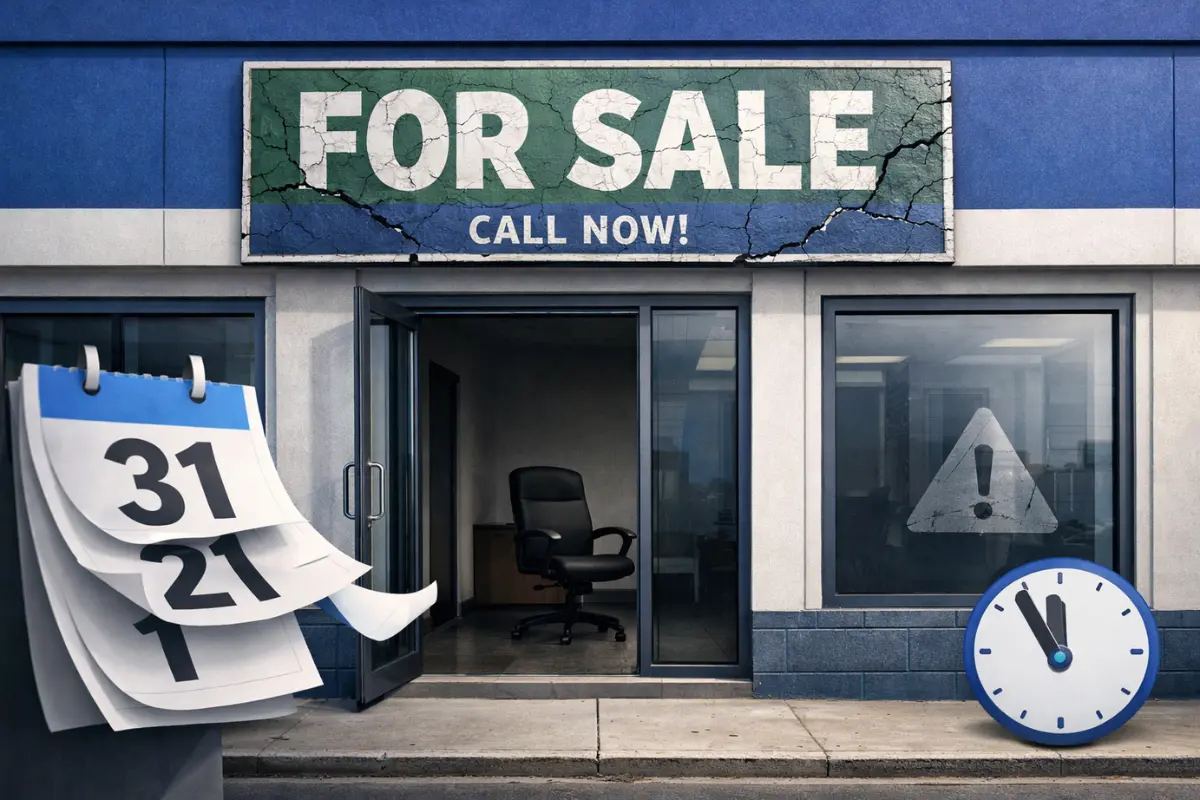
When transitions fall through, the impact reaches far beyond the owner. Some firms close altogether. Others sell under pressure at discounted prices, often to out-of-state buyers with little interest in preserving local jobs or operations.
And those exits compound over time. Jobs vanish. Institutional knowledge walks out the door. And communities lose tax revenue, services, and economic anchors that took decades to build.
In other cases, the company survives only on paper as private equity or corporate buyers consolidate locations and cut staff, reshaping once-local enterprises into distant portfolio assets.
Without a transition plan, the options narrow. And what could've been a successful handoff becomes a missed opportunity, both for the owner and the community left behind.
Why succession is more than a retirement issue
Succession is often framed as a private retirement decision, yet the stakes reach far beyond any single owner. Each successful handoff keeps teams employed, preserves expertise, and gives workers a clearer future, which makes succession a workforce stability issue as much as a leadership one.
In fact, those same handoffs also help neighborhoods keep their storefronts, services, and local tax base, so continuity quickly becomes a measure of community resilience. For founders whose net worth is inside the company, preparation can spell the difference between preserving family wealth and watching it erode during a rushed exit.
Scaled across millions of Boomer-led enterprises, those choices influence regional growth, public revenues, and wealth distribution, which is why more policymakers and investors now treat succession as a macroeconomic concern rather than a private milestone.
Forward-Looking Perspective
The coming decade marks a narrowing window for owners and communities to shape how the $10 trillion handoff unfolds.
If preparation gaps persist, many firms will face rushed exits, with fewer buyers and lower valuations. Others may shift to ownership models that were once uncommon, not by design but because time runs out to pursue traditional sales.
Analysts at the World Economic Forum note that this shift is creating room for new structures, including partial exits where founders retain some equity, internal transitions that elevate long-serving employees, and employee ownership strategies that keep companies rooted in their communities.
Each pathway alters who ultimately leads these businesses and how they continue contributing to local economies.
This transition goes far beyond a routine generational shift. It will shape workforce stability, regional strength, and how wealth moves through communities. Whether it becomes a success story or a cautionary tale will depend on how effectively stakeholders respond to the pressures surrounding it.
Disclaimer: This content is intended for general educational and informational purposes only and does not constitute legal, tax, or accounting advice. Every effort is made to keep the information current and accurate; however, laws, regulations, and guidance can change, and no representation or warranty is given that the content is complete, up to date, or suitable for any particular situation. You should not rely on this material as a substitute for advice from a qualified professional who can consider your specific facts and objectives before you make decisions or take action.
Share This Article:
Stay in the know!
Join our newsletter for special offers.