
The Side Hustle Tipping Point: When a Gig Becomes a Real Business, and What Happens If You Wait Too Long to Formalize


The nine-to-five is no longer the sole financial engine for millions of Americans. As living costs climb and job security feels less certain, side hustles have shifted from optional extras to essential income streams.
Even professionals with full-time roles are selling products online, consulting after hours, or building creator platforms to close the gap. And that shift is accelerating.
Platforms like Etsy, Amazon, Shopify, and TikTok Shop have normalized small‑scale commerce, while the creator economy has turned personal brands into revenue channels almost overnight.
"We're seeing a surge in people turning to side hustles as a way to build financial stability in these uncertain economic times," Kira Caban, flexible work expert and head of communications for Instawork, told FOX Business.
What starts as supplemental income often scales quickly, and so do the stakes.
The IRS now scrutinizes sponsorships, tips, affiliate revenue, and other gig income, even when no 1099 is issued. And while the 1099-K threshold returned to $20,000 and 200 transactions, creators and sellers still face rules that can quietly convert a casual hobby into a business. The tipping point isn't always obvious. But missing it can be costly.

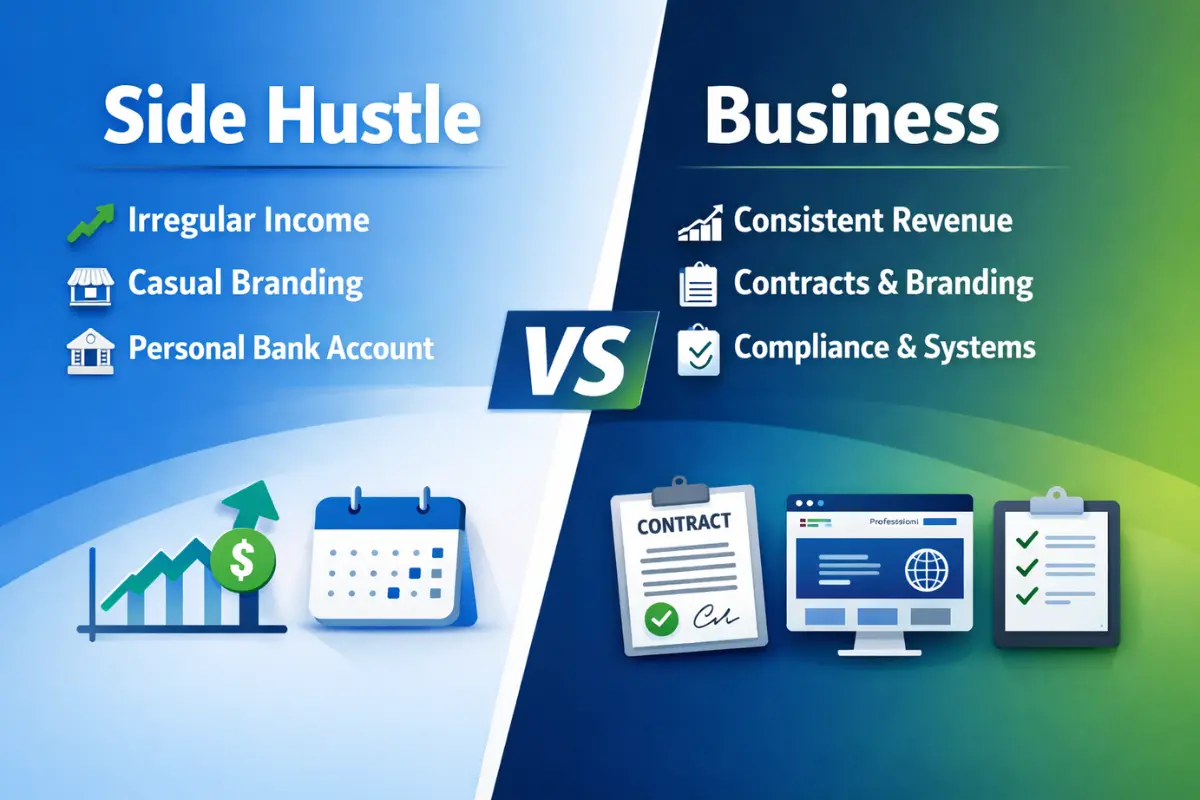
What defines the transition from "side hustle" to "business"?
The line separating casual income from commercial activity remains frustratingly unclear. No single moment marks the shift. Instead, it emerges gradually through operational changes that many only recognize in hindsight.
Revenue patterns offer the most visible indicator. "The first big sign your side hustle has turned into a legitimate business is when revenue starts to look less like 'extra' money and more like a paycheck," notes DBI Agency.
The second sign often follows quickly, as customers begin expecting consistency rather than availability, which forces deeper commitments.
Earnings that once covered personal expenses start flowing into inventory, tools, and marketing. Social posts turn into deliberate branding strategies supported by professional websites and paid campaigns. And verbal agreements harden into contracts with clients and vendors.
At that point, the IRS focuses on profit motive, assessing whether the activity reflects genuine business intent beyond casual activity or personal enjoyment. By the time all of that is in motion, many founders have already crossed into business territory long before the paperwork reflects it.
"Most side hustles don't cross into 'business' territory with a dramatic moment. The shift happens quietly, as revenue stabilizes, customer expectations rise, and money starts flowing back into operations. By the time many people realize they're running a business, the legal and tax obligations have already kicked in." -Yuliya Pearson, Director of Product at InCorp Services Inc.
What legal and tax triggers force the issue?
The IRS treats all income from self-employment as taxable, even if it begins casually. Once net earnings exceed $400, individuals are generally required to file taxes and pay self-employment tax, including Social Security and Medicare contributions.
Meanwhile, platform reporting is expanding. Form 1099-K is only issued when sellers exceed $20,000 in gross payments and 200 transactions. But that doesn't exempt income below those thresholds. "Social media income is taxable—no matter how casual the content," said the Head of Client Solutions at Clear Start Tax. "The IRS now receives 1099s from most creator platforms. If your return doesn't match what they see, you could get flagged."
Expense deductions introduce another layer of risk, particularly when losses are reported year after year, since that can call "profit motive" into question. At the state level, even small-scale product sales may create a sales tax nexus, requiring permits, local registration, or ongoing filings that many informal sellers overlook.
Why are enforcement and compliance pressures increasing now?
These triggers now activate faster than ever before due to fundamental changes in how income flows and gets tracked.
Platform-based commerce creates automatic digital records that replace the cash transactions and handshake deals that once kept side income invisible to tax authorities.
Payment processors like PayPal, Venmo, and Stripe operate within regulated financial systems that require reporting above certain thresholds, transforming informal arrangements into documented economic activity.
That documentation feeds directly into IRS data-matching systems that cross-reference reported income against platform-issued forms. "The IRS is using algorithms and AI to flag unreported digital income, and creators are getting caught off guard," notes the Head of Client Solutions at Clear Start Tax. "Even small streams of income can add up fast."
The shift represents infrastructure modernization rather than aggressive enforcement, as government agencies simply gained visibility into transactions that previously occurred beyond their view.
What changed wasn't the law itself but the technological capacity to enforce existing rules at scale across millions of casual earners who never viewed themselves as running businesses.
What risks come with operating informally for too long?
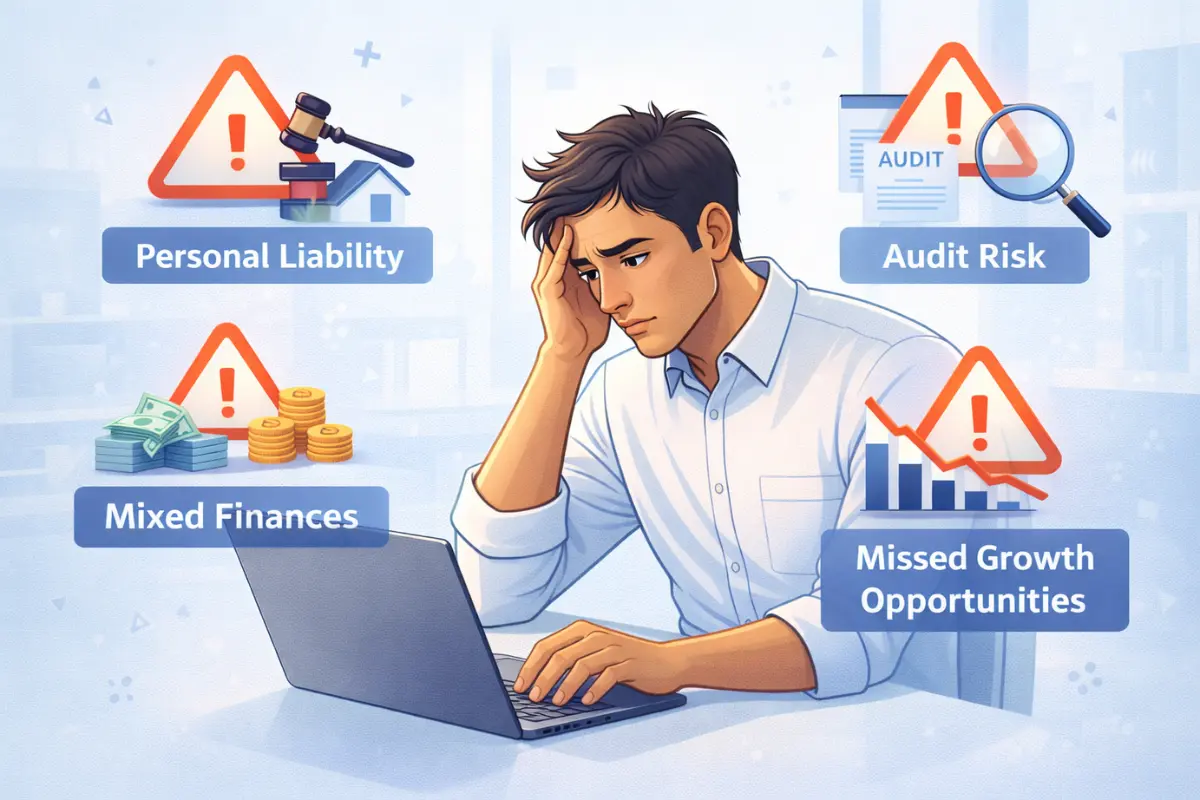
Personal liability stands as the most immediate exposure, as informal operators lack legal separation between business debts and personal assets. For example, a freelance designer accepting payments through personal accounts can be held personally responsible when sued, an outcome legal experts describe as preventable.
Then comes the financial tangle. Commingled funds make clean books impossible, which increases the odds of missed deductions, audit flags, and retroactive penalties.
"If your personal and business finances aren't separated, it can take hours to go through your checking account statements and see what was personal and what was business," says Kaylyn M. Houston, business banking client manager at U.S. Bank.
That confusion often leads to retroactive cleanup, requiring forensic accounting to untangle years of mixed transactions and triggering taxes on funds long spent. Those same gaps also limit scale.
For instance, a crafter who runs all Etsy revenue through a personal account may struggle to secure a small business loan or wholesale agreement because there is no formal structure or reliable financial history. For buyers, vendors, and banks, that's often a dealbreaker.
How the creator and platform economy have changed expectations
The creator economy, valued at roughly $205.25 billion in 2024, now imposes business infrastructure almost from the start.
Sellers and creators who are still testing ideas are pushed to manage inventory, marketing, tax compliance, and fulfillment with the discipline of small enterprises. As that operational weight builds, monetization stops being a distant milestone and becomes the default expectation.
On platforms like TikTok, Etsy, and YouTube offer tools for payouts, performance analytics, and tax reporting from day one, treating users less like hobbyists and more like operators of lean digital enterprises.
As The Successful Founder notes, "Technology has made the barrier to entry disappear," which means younger creators are professionalizing sooner, or being forced to, as audiences, brands, and platforms judge even modest gigs as real businesses.
Forward-Looking Perspective
The formalization pressures now reshaping creators and sellers signal a broader economic turn. Side hustles are no longer fringe pursuits but foundational income streams where traditional employment feels less secure.
The distinction between extra income and enterprise continues collapsing, pushing formalization into the core of entrepreneurial literacy.
In fact, surveys confirm 92% of workers expect side hustles to become the new normal, evidence that supplemental income has evolved into a pillar of household stability.
That shift lays the groundwork for businesses born structured rather than formalized by hindsight. The tipping point is no longer theoretical. It is shaping how modern work is built.
Disclaimer: This content is intended for general educational and informational purposes only and does not constitute legal, tax, or accounting advice. Every effort is made to keep the information current and accurate; however, laws, regulations, and guidance can change, and no representation or warranty is given that the content is complete, up to date, or suitable for any particular situation. You should not rely on this material as a substitute for advice from a qualified professional who can consider your specific facts and objectives before you make decisions or take action.
Share This Article:
Stay in the know!
Join our newsletter for special offers.