
DBA vs LLC: Which One Do You Need for Your Business?


An entrepreneur wants to expand her bakery into catering. A startup founder needs liability protection. A consultant wants to operate under a professional business name. All of these situations raise the question of "DBA vs LLC" and which option best supports each business goal. Understanding the differences between a DBA and an LLC for small businesses helps owners make informed decisions about business structure options. A DBA (Doing Business As) and a Limited Liability Company (LLC) serve different purposes and come with distinct implications for liability, taxation, and compliance.
This guide provides a factual comparison of DBAs and LLCs, including formation details and common use cases. InCorp is not a law firm and does not provide legal or financial advice. This information is educational only. Business owners should consult qualified legal professionals.
Key Takeaways
-
A DBA is simply a trade or fictitious name that lets a business operate under a different public name but does not create a separate legal entity or provide any personal liability protection.
-
An LLC is a formal business structure that exists as its own legal entity and generally shields owners’ personal assets from most business debts and lawsuits.
-
Choosing a DBA is usually faster and less expensive, with lighter registration and renewal requirements, while forming and maintaining an LLC involves higher state filing fees and ongoing compliance obligations.
-
A DBA does not change how a business is taxed, but an LLC offers tax flexibility, including default pass-through treatment and the ability to elect corporate taxation when eligible.
-
Many businesses use both: form an LLC for liability protection, then file one or more DBAs to support multiple brands or service lines under a single legal entity.
-
The right choice depends on your risk level, budget, branding needs, and long-term growth plans, and professional guidance can help align DBA or LLC registration with those business goals.
Understanding the Basics: What is a DBA?
A DBA, or “Doing Business As,” is a registered trade name that allows a business to operate under a name different from its legal name. Sometimes referred to as a fictitious name or assumed name, a DBA is not its own legal entity. The DBA registration process creates public notice that a company is operating under an alternate business name. Sole proprietors commonly use DBAs to operate under brand names instead of personal names, while LLCs and corporations often file DBAs to conduct business under names not listed in their formation documents.
A DBA does not create a separate legal entity, provide liability protection for business owners, or change the underlying business structure. The legal entity behind the DBA remains fully responsible for obligations and taxes. DBA registration requirements by state vary widely. Some states require filing with the Secretary of State, while others require county-level filing. The process typically includes checking name availability and submitting an application.
Understanding the Basics: What is an LLC?
A Limited Liability Company (LLC) is a formal business structure recognized as a separate legal entity. LLCs combine elements of corporations and partnerships, offering liability protection and management flexibility. The LLC formation process usually involves filing Articles of Organization with the state, appointing a registered agent, and creating an LLC operating agreement. This formally establishes the LLC as a separate legal entity from its owners (called members). This separation provides liability protection for business owners, creating a barrier between personal assets and business obligations. Generally, members are not personally responsible for business debts or lawsuits.
Business taxes and entity type rules apply differently to LLCs. By default, single-member LLCs are taxed as sole proprietorships, while multi-member LLCs are treated as partnerships. However, LLCs can elect to be taxed as corporations.
Key Differences Between a DBA and an LLC
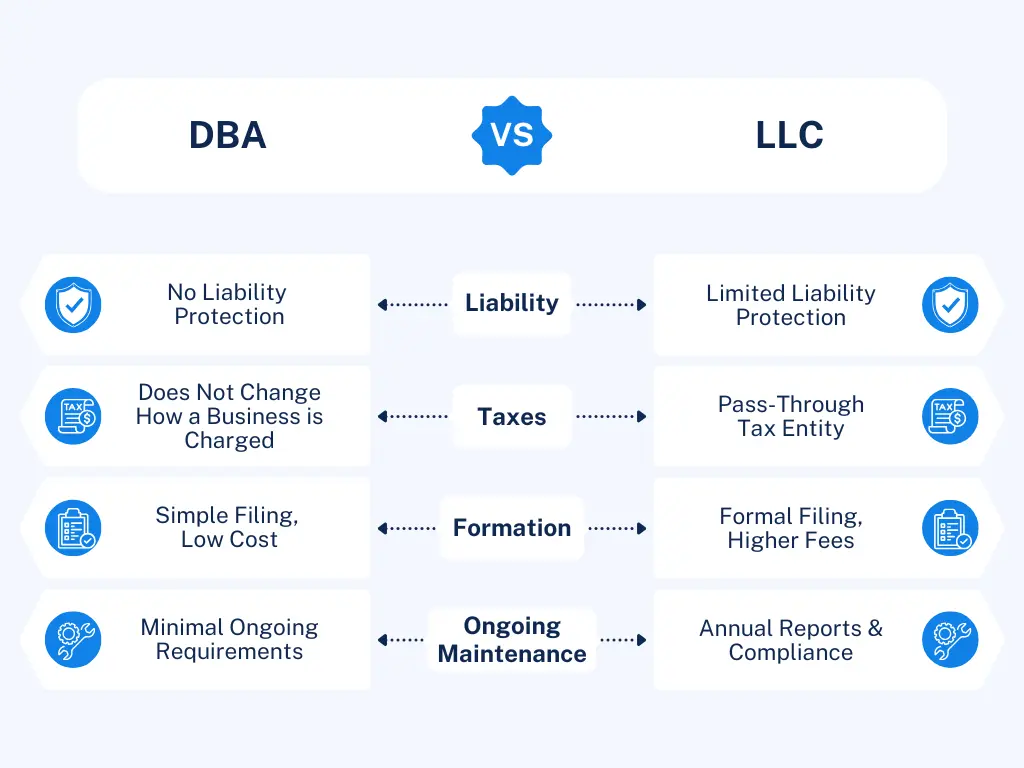
Business structure comparisons reveal that the "DBA vs LLC" analysis involves fundamental distinctions. The limited liability company vs DBA comparison shows that these are entirely distinct tools serving different purposes.
Legal Status and Liability
An LLC is a separate legal entity that provides liability protection for business owners by shielding personal assets from most business liabilities. Creditors typically can access only LLC assets, not an owner’s personal property. A DBA, on the other hand, is simply a registered business name. It provides no liability protection whatsoever. If a sole proprietor operates under a DBA, that individual remains personally liable. If an LLC uses a DBA, the LLC continues to provide protection—but the DBA itself does not.
Formation and Registration Requirements
The LLC formation process requires filing legal documents with the state, paying filing fees, appointing a registered agent services provider, and meeting business compliance requirements, such as filing periodic reports and paying annual fees. DBA registration requirements are generally lighter. State and local business filings for DBAs typically require verifying name availability, submitting an application, and paying fees. Some states or counties also require publishing a notice in a local newspaper.
Taxes and Financial Considerations
Business taxes and entity-type treatment vary by entity type. A DBA does not change how a business is taxed. Sole proprietors under a DBA still file on personal returns, and LLCs using DBAs retain their existing tax classification. LLCs provide added tax flexibility. Single-member LLCs default to disregarded entity taxation, while multi-member LLCs default to partnership taxation. LLCs may also elect S corporation or C corporation taxation when eligible.
Costs and Ongoing Maintenance
Business registration guidance shows that costs differ significantly between DBAs and LLCs. DBA filing fees generally range from a few dollars to several hundred dollars. Some states require periodic renewal. Ongoing compliance obligations are typically minimal beyond renewal requirements. Forming an LLC usually costs more due to state filing fees and registered agent fees. Ongoing costs may include annual or biennial report fees and, in some states, franchise taxes.
Common Reasons Businesses Choose a DBA
Businesses file DBAs for various practical purposes. Common DBA benefits include operating flexibility and simplified branding. Sole proprietors use DBAs to operate under professional business names rather than personal names. This allows business name registration under a brand identity while maintaining simplicity. Established entities use DBAs when expanding into new product lines. Rather than forming separate legal entities, a corporation or LLC can file a DBA to operate a division under a distinct name.
Businesses operating in multiple states may encounter situations where their legal name is unavailable. Filing a DBA in that state allows operations under an alternate name.
Common Reasons Businesses Choose an LLC
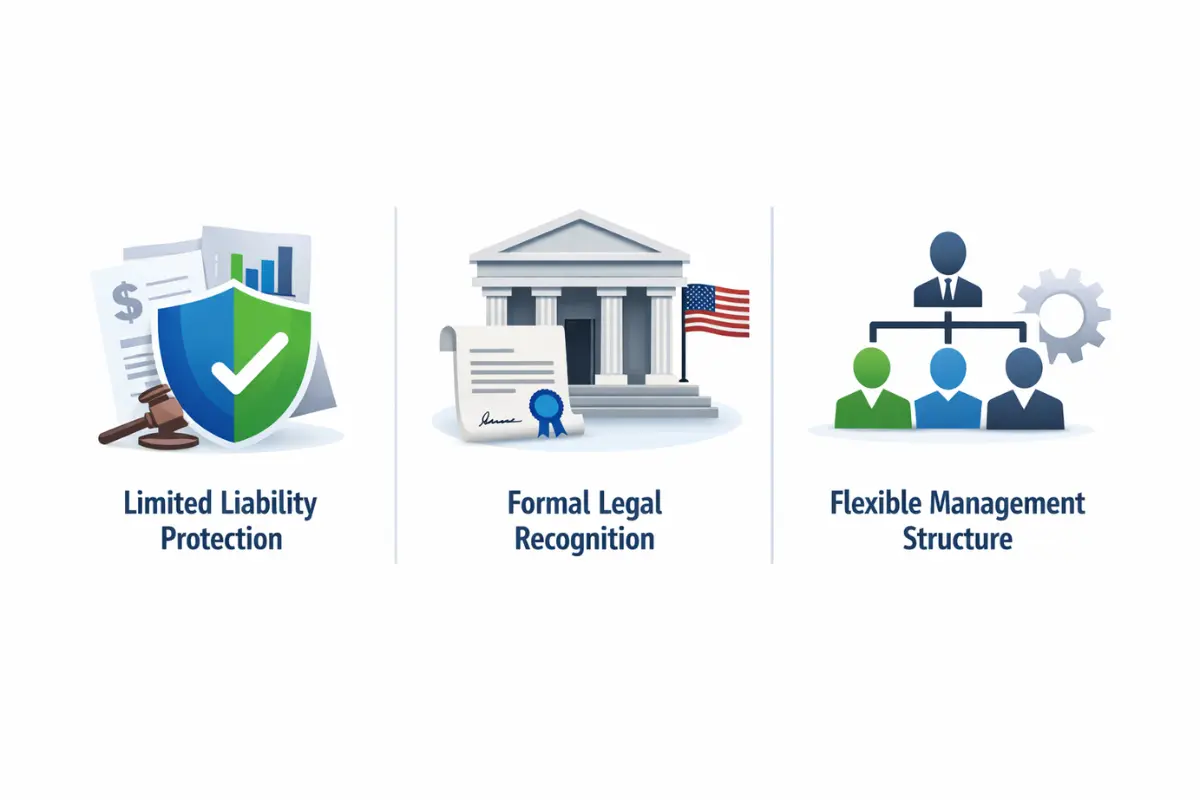
Businesses form LLCs primarily for liability protection for business owners. Because the LLC is a separate legal entity, it helps protect personal assets from most business debts and lawsuits. Legal entity formation as an LLC can also enhance credibility with clients, banks, and vendors. LLCs also appeal to business owners because of their flexible management structures and tax options. Additionally, LLCs provide state-level business name registration protection.
When Can a Business Use Both a DBA and an LLC?
Understanding "when to use a DBA instead of an LLC" and the "benefits of using a DBA with an LLC" helps clarify that these options are not mutually exclusive. Many LLCs also operate under one or more DBAs. Filing a DBA for an existing LLC is common for companies running multiple brands. For example, “Johnson Enterprises, LLC” may register DBAs for “Johnson Consulting,” “Johnson Training,” and “Johnson Technology” to run several divisions under a single LLC. This approach keeps the liability protection for business owners provided by the LLC while allowing marketing flexibility. A DBA adds branding options but does not create a separate legal entity.
How InCorp Supports Businesses With DBAs and LLCs
Professional services can streamline both DBA and LLC processes. InCorp supports business name registration, legal entity formation, and ongoing business compliance requirements. For DBAs, services include researching DBA registration requirements, checking name availability, filing required documents, and monitoring renewals. For LLCs, support includes researching state-specific LLC formation process rules, preparing Articles of Organization, arranging registered agent services, and managing business compliance requirements.
Professional compliance assistance helps ensure filings meet procedural requirements and maintain accuracy throughout the registration process. To learn more about converting your business structure, visit entity conversion procedures. For guidance on comparing different business types, see entity type comparisons.
Next Steps for Registering Your Business Name
Understanding "how to choose between a DBA and an LLC" requires considering liability needs, administrative requirements, tax implications, and long-term business goals. For business name registration under either option, the first step is confirming name availability. Businesses then submit the required filings to the appropriate state or local authority. Once approved, businesses receive the documentation needed for banking, contracts, and licensing. Professional filing services can simplify the process, reduce errors, and help meet deadlines.
Contact InCorp to learn how professional registration services can support DBA and LLC filings.
FAQs
Can a business have both a DBA and an LLC?
Yes. An LLC can operate under one or more DBAs while maintaining liability protection through the LLC structure. The DBA simply provides an alternate operating name.
Does filing a DBA protect my personal assets?
No. A DBA is only a name registration. It does not create liability protection. Forming an LLC or corporation is required to create legal separation.
Are there ongoing fees or renewals for a DBA or LLC?
Yes. DBAs often require renewals. LLCs typically require annual or biennial reports and associated state fees. Requirements vary by state.
How long does it take to file a DBA compared to forming an LLC?
Processing times vary, but DBAs typically process faster, often within days or weeks. LLC formation can take several weeks or longer, though expedited options may be available.
Do I need a DBA if I already have an LLC?
Only if your LLC operates under a different name than its legally registered name.
How do I decide between a DBA vs LLC for my business structure if I'm just starting out?
For very low risk businesses testing a concept, many sole proprietors start with a DBA to register a legal business name without creating a new legal entity. A Limited Liability Company, however, is usually the right business structure once you want limited liability protection, clearer separation of personal and business finances, and a more formal legal entity to support growth.
Does a DBA provide any legal barrier between my personal assets and business debts?
No. A DBA or fictitious business name is only a trade name and does not create a separate legal entity or provide liability protection. As a sole proprietor operating under a DBA, your owner's personal assets can still be reached for the company's debts and legal challenges.
When does forming an LLC make more sense than using only a DBA?
Forming an LLC often makes sense when your business activities carry meaningful risk, you want to protect personal assets from business liabilities, or you need to open a business bank account under a separate business entity. An LLC structure is also helpful when there are multiple owners, more significant business profits, or when you want tax flexibility, such as choosing between single member LLC and multi member LLC tax treatment.
Can an existing business that started as a sole proprietorship with a DBA later form an LLC?
Yes. An established business can form a new LLC and, in many cases, continue using the same business name as a trade name or fictitious business name if allowed by state rules. After business formation, the LLC becomes the distinct legal entity that owns the business assets, assumes business debts, and benefits from the LLC's liability protection going forward.
How do tax implications differ between operating only as a sole proprietor with a DBA vs forming an LLC?
A sole proprietor using a DBA reports business profits on personal tax returns with no change in tax status, because a DBA does not affect tax treatment. A single member LLC is also generally taxed on the owner's personal return by default, but the LLC structure can offer additional tax benefits and flexibility, including the option for different tax treatment as the business grows.
Disclaimer: This content is intended for general educational and informational purposes only and does not constitute legal, tax, or accounting advice. Every effort is made to keep the information current and accurate; however, laws, regulations, and guidance can change, and no representation or warranty is given that the content is complete, up to date, or suitable for any particular situation. You should not rely on this material as a substitute for advice from a qualified professional who can consider your specific facts and objectives before you make decisions or take action.
Share This Article:
Stay in the know!
Join our newsletter for special offers.