

Business owners frequently use the terms "copyright" and "trademark" interchangeably when discussing intellectual property protection. This confusion can lead to misapplied protection strategies and missed opportunities to secure appropriate legal safeguards for different types of business assets. Understanding “what is the difference between copyright and trademark” helps entrepreneurs and creatives apply for the correct form of protection based on the specific asset they wish to protect.
Copyright and trademark represent two distinct forms of intellectual property protection under U.S. law. Each serves different purposes, covers different types of assets, and operates under separate legal frameworks administered by different federal agencies. While both fall under the broader category of intellectual property rights, they are not interchangeable and do not replace one another.
This overview explains the general differences between copyright and trademark protection in neutral, factual terms. The explanations focus on what each type of protection typically covers, how it generally functions under U.S. law, and how businesses commonly use it across different asset categories.
InCorp is not a law firm and does not provide legal or financial advice. This information is educational. Readers should consult with qualified legal professionals for advice specific to their situations.
Key Takeaways
-
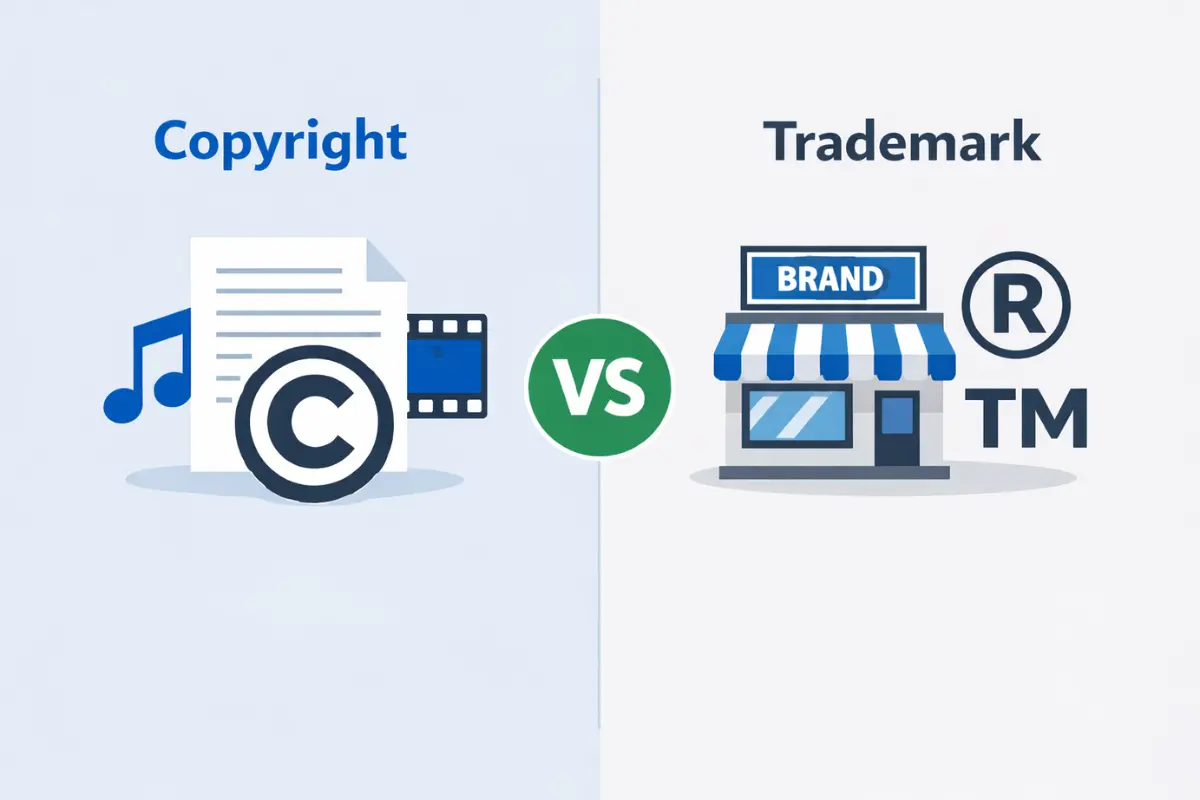
Copyright protects creative expression like written content, software code, photographs, videos, and artistic works, while trademarks identify commercial sources through brand names, logos, slogans, and other business identifiers.
-
Copyright protection arises automatically when an original work is created and fixed in tangible form, though registration with the U.S. Copyright Office provides legal advantages for enforcement in federal court.
-
Trademark rights develop through commercial use, with common law rights limited to geographic areas of use, while federal registration with the USPTO provides nationwide protection and additional legal presumptions.
-
Copyright lasts for a fixed period (typically the author's life plus 70 years), whereas trademark protection can continue indefinitely as long as the mark remains in commercial use and required maintenance filings are submitted.
-
Business names and slogans cannot be copyrighted but may qualify for trademark protection when used to identify goods or services, while the creative content in marketing materials falls under copyright protection.
-
Many businesses need both protections for different assets—copyright for website content, product descriptions, and creative materials, and trademarks for company names, product names, and logos that serve as brand identifiers.
What Is Copyright?
Copyright is a form of legal protection that generally applies to original works of authorship fixed in tangible form. Under U.S. copyright law, this protection typically covers creative and artistic works, including written content, visual artwork, music compositions, videos, software code, photographs, dramatic works, and architectural designs.
Copyright law principles establish that protection generally exists automatically once a qualifying work is created and fixed in a tangible medium. "Fixed in a tangible medium" means the work exists in a form that can be perceived, reproduced, or communicated, such as written on paper, saved to a computer file, recorded on audio or video, or rendered in physical form. Copyright typically protects the original expression embodied in a work, rather than underlying ideas, concepts, or methods. For example, copyright might protect the specific text of a business article but not the general business concepts discussed within it. The copyright symbol (©) is commonly used to indicate copyright claims, though its use is not required for protection to exist under current U.S. law.
The duration of copyright protection vs trademark renewal differs significantly. For works created by individual authors, copyright protection generally lasts for the life of the author plus 70 years. Different rules apply to works made for hire, corporate authorship, and works created before certain legislative changes.
Copyright registration with the U.S. Copyright Office, part of the Library of Congress, is not required for protection to exist. However, registration is generally required before filing infringement lawsuits in federal court and may affect the remedies available in such proceedings. Copyright registration creates a public record of the copyright claim and provides certain legal advantages in enforcement actions.
What Is a Trademark?
A trademark is a word, name, symbol, design, or combination of these elements that is used in commerce to identify and distinguish the source of goods or services. Trademarks serve as brand name identifiers that help consumers recognize the origin of products or services in the marketplace. Common examples include business names, product names, logos, slogans, and in some cases, distinctive colors, sounds, or product packaging that identify commercial sources and build brand recognition.
Under trademark law, rights generally arise from use of a mark in commerce. Common law trademark rights vs federal registration represent an important distinction in understanding trademark protection. Common law rights typically develop through actual use of a mark, even without registration. These rights are generally limited to the geographic areas where the mark has been used and the specific goods or services with which it has been associated.
Federal registration with the US Patent and Trademark Office vs US Copyright Office provides different types of benefits compared to common law rights. The US Patent and Trademark Office administers federal trademark registrations, while the U.S. Copyright Office handles copyrights. Registered trademarks receive certain legal presumptions and advantages under federal law, including a legal presumption of ownership, nationwide priority, and the ability to bring infringement actions in federal court.
Trademark law requires periodic maintenance filings to keep registrations active. Registered trademarks require Declarations of Continued Use between the fifth and sixth year after registration. Between the ninth and tenth year, and every ten years thereafter, owners must file combined Declarations of Use and Applications for Renewal to maintain their registrations.
Key Differences Between Copyright and Trademark
Copyright and trademark serve fundamentally different purposes under intellectual property rights law and apply to different categories of business assets.
Purpose of Protection
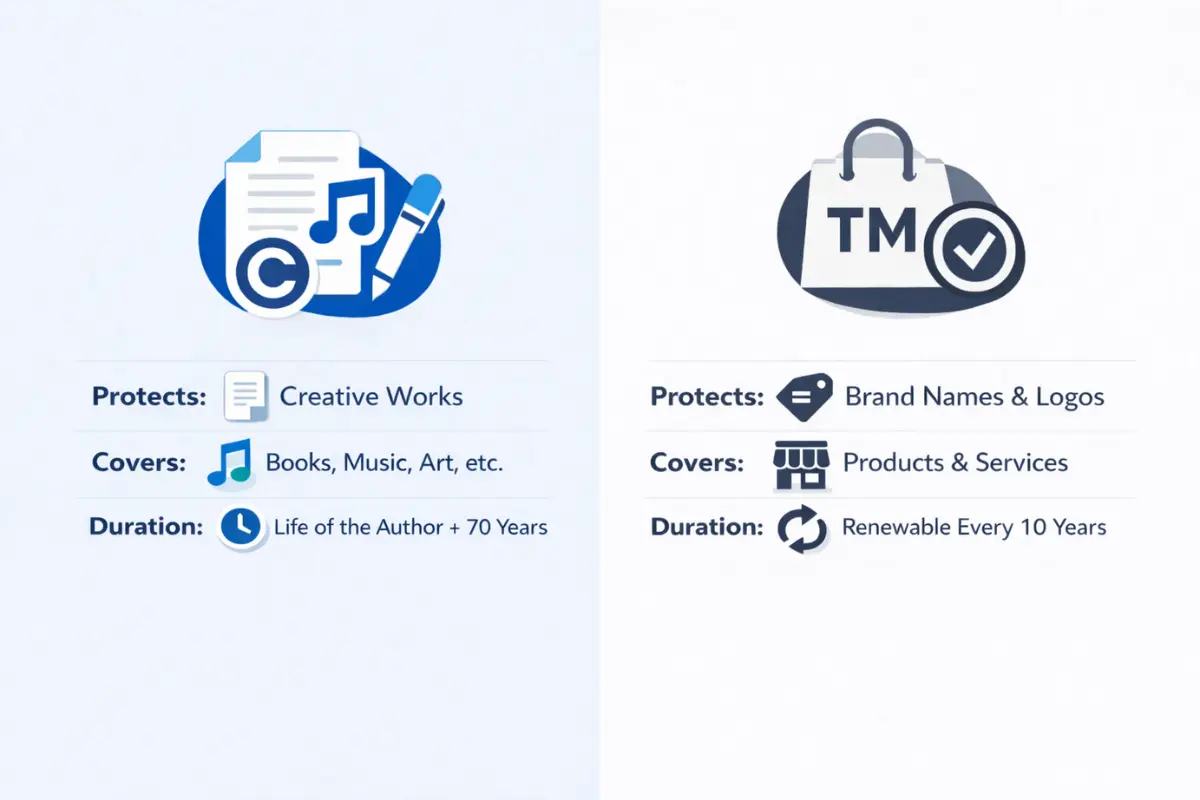
Copyright generally protects original creative expression captured in tangible works. The purpose is typically to grant creators exclusive rights to reproduce, distribute, display, and perform their works.
A trademark generally identifies and distinguishes the commercial source of goods or services. The purpose is typically to prevent consumer confusion about the origin of products or services and to protect business goodwill.
Types of Assets Covered
Copyright typically applies to creative and artistic works, including books, articles, blog posts, photographs, illustrations, graphic designs, music, videos, software code, architectural works, and dramatic performances. These works must be original and fixed in tangible form to qualify for copyright protection.
Trademarks typically apply to identifiers used in commerce, including business names, product names, slogans, logos, and other distinctive elements that identify the source of goods or services. Under trademark vs copyright for business names and slogans, business names and slogans generally fall under trademark protection when used to identify commercial sources, while the creative expression in advertising copy or marketing materials might fall under copyright protection.
How Protection Is Established
Copyright protection under U.S. law typically arises automatically when an original work is created and fixed in tangible form. Registration with the U.S. Copyright Office is not required for protection to exist, but is generally required before filing infringement lawsuits.
Trademark rights can arise through use in commerce, creating common law trademark rights vs federal registration protections. Common law rights develop through actual use and are generally limited geographically. Federal registration with the USPTO provides additional benefits, including nationwide priority and legal presumptions.
Duration of Protection
The duration of copyright protection vs trademark renewal differs significantly in structure and requirements. Copyright protection generally lasts for a fixed period determined by law. For works created by individual authors, this typically means the life of the author plus 70 years. For works made for hire, corporate authorship, and anonymous or pseudonymous works, different durations apply under federal copyright law.
Trademark protection can potentially continue indefinitely as long as the mark remains in use in commerce and required maintenance filings are submitted to the USPTO. Registered trademarks require declarations in the fifth and sixth years after registration, in the ninth and tenth years, and every ten years thereafter. Failure to file these maintenance documents results in cancellation of the registration.
Common Business Use Cases
Businesses commonly use copyright to protect marketing materials, website content, product descriptions, training materials, software, photographs, videos, and other creative works.
Businesses commonly use trademarks to protect brand names, product names, service names, slogans, logos, and other identifiers that distinguish their goods or services. A single business might rely on both for different assets.
Governing Authorities and Oversight
Copyright is administered by the U.S. Copyright Office, part of the Library of Congress. Trademarks fall under the US Patent and Trademark Office, part of the U.S. Department of Commerce.
How Copyright and Trademark Are Used in Business
Businesses typically rely on both copyright and trademark protection, each applying to different categories of assets. According to USPTO intellectual property guidance, business assets fall into distinct protection categories.
Protecting Creative Works
Copyright is commonly used to protect original creative materials produced by businesses, including written content, visual content, software code, and website designs.
The question “Do I need a copyright or trademark for a website?” often arises. Website content, including text, images, and code, generally qualifies for copyright protection as original works of authorship. The domain name and logos displayed on it are typically protected by trademark law when used to identify the business.
Identifying Brands and Sources of Goods or Services
A trademark is commonly used to protect brand identifiers that distinguish a business's goods or services. Company names, product names, logos, taglines, and slogans generally qualify as trademarks when used in connection with goods or services.
The question of “protecting a logo with copyright and trademark” reflects common confusion. A logo's artistic design elements might qualify for copyright protection as a graphic work, while its use as a brand identifier may be eligible for trademark protection.
Using Both Protections for Different Business Assets
A single business commonly holds both copyrights and trademarks for different assets. A software company might hold copyrights in its software code and documentation while simultaneously holding trademarks in its company name and product names.
An advertising agency might hold copyrights in creative advertisements while holding trademarks in its agency name. A retail business might hold copyrights in product photography while holding trademarks in its store name.
Why Copyright and Trademark Are Not Interchangeable
Copyright and trademark serve distinct legal functions and do not substitute for one another. Copyright generally does not protect names, titles, slogans, or short phrases. These elements typically fall under trademark law when used to identify commercial sources. A business name cannot be copyrighted.
Conversely, a trademark generally does not protect the full creative content of artistic or literary works. The confusion between trademark vs copyright for business names and slogans often stems from this distinction.
Common Misunderstandings
Several misconceptions about copyright and trademark appear frequently. One common misunderstanding is that copyright can protect business names or slogans. Copyright law generally does not extend to names, titles, or short phrases. These elements typically fall under trademark protection. Another common misconception is that trademark protection covers creative content. While a logo's design might receive copyright protection as artwork, trademark protection specifically addresses its function as a brand identifier.
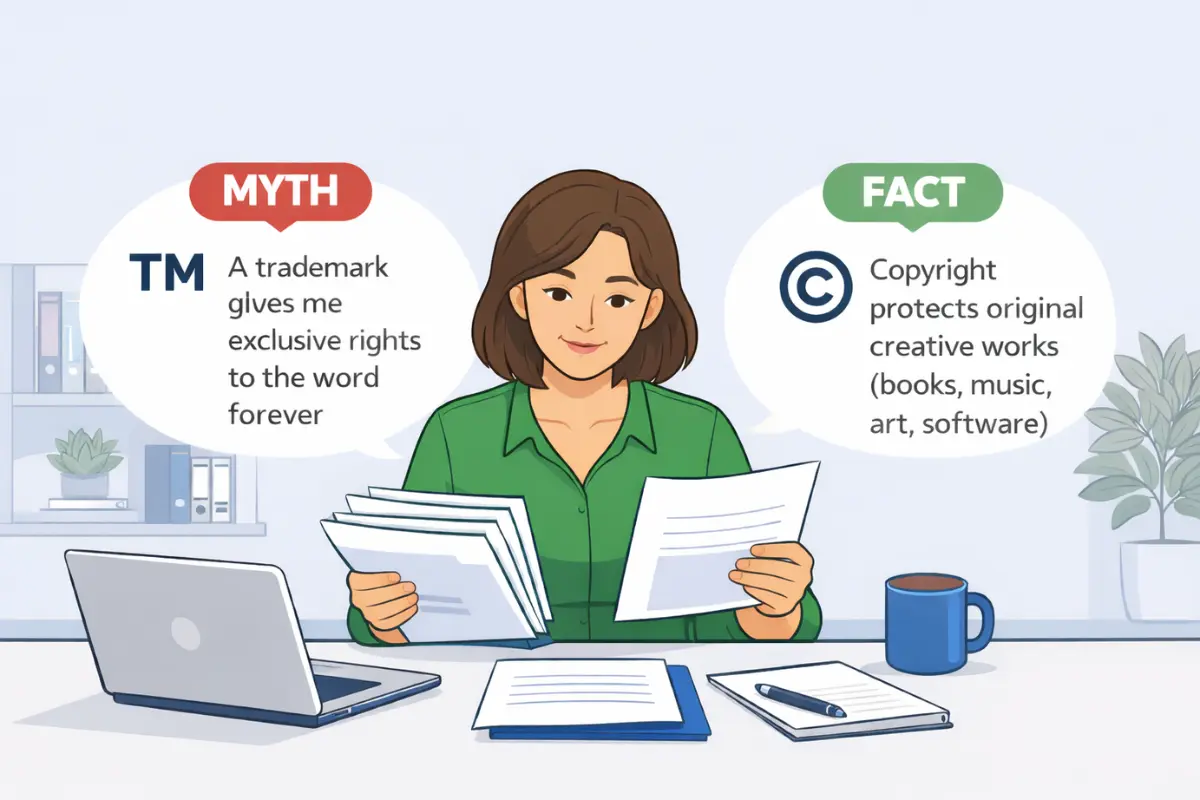
Some business owners believe that using a ™ symbol provides the same level of protection as federal registration. The ™ symbol may be used with any mark claimed as a trademark. The ® symbol is reserved for marks with active federal registrations and may be used only after registration is granted.
The question of whether intellectual property rights require formal registration often arises. Copyright protection generally exists automatically upon creation. Trademark rights can develop through use without registration. However, registration provides additional benefits for enforcement.
Registration and Professional Guidance
Both copyright and trademark registration involve formal processes with specific requirements. The processes differ based on the type of protection sought. Copyright registration is handled by the U.S. Copyright Office. The process generally involves completing forms, paying fees, and submitting deposit copies. Federal trademark registration is handled by the US Patent and Trademark Office. The process typically involves conducting searches, preparing applications, responding to examining attorney actions, and maintaining registrations through required filings.
Licensed legal professionals specializing in intellectual property law are the appropriate source for individualized legal advice regarding which protections apply to specific situations.
Protect Your Brand and Your Work Today
Copyright protects original creative expression fixed in tangible form, while trademark identifies the commercial source of goods or services. These protections serve distinct purposes and operate under separate legal frameworks. Understanding these distinctions helps businesses manage their intellectual property rights appropriately. For businesses seeking to protect creative works and brand identifiers, professional services can help navigate registration processes. InCorp offers both copyright and trademark registration services, working to support businesses in managing intellectual property protection requirements.
For comprehensive guidance on managing business compliance, see compliance officer responsibilities and questions to ask before hiring a registered agent for entity management support. For information on professional service comparisons, see service provider comparisons.
Contact InCorp to learn more about copyright and trademark registration services.
FAQs
Does copyright or trademark apply internationally?
National laws govern copyright and trademark protections. While international agreements exist, protection is generally enforced on a country-by-country basis. Rights recognized under U.S. law do not automatically apply worldwide. Businesses operating internationally typically need to pursue protection in each country where they seek coverage.
Can the same asset be protected by both copyright and trademark?
In some cases, different aspects of the same asset may be subject to different protections. A logo's artistic design elements might qualify for copyright protection as a creative work, while its use as a brand identifier might be protected under trademark law. These protections serve different purposes.
Do copyrights and trademarks require public disclosure?
Copyright protection typically arises upon creation and fixation, without requiring public disclosure. Works can be protected whether published or unpublished. Registration creates a public record but is not required for protection to exist.
Trademark protection is inherently tied to the use of a mark in commerce, which involves public identification of the source. Federal registration creates a public record in the USPTO database.
Are copyright and trademark enforced in the same way?
Enforcement processes differ significantly. Copyright enforcement typically involves demonstrating ownership and showing unauthorized copying. Trademark infringement enforcement typically involves demonstrating rights in a mark and showing that someone's use creates a likelihood of confusion.
The legal standards, procedures, and available remedies differ based on whether the dispute involves copyright or trademark.
How do copyright and trademark laws affect brand identity development?
Brand identity development typically involves creating multiple types of intellectual property that receive different forms of legal protection. The visual elements of a brand—such as logos, color schemes, and design layouts—may qualify for copyright protection as artistic works when they demonstrate sufficient originality and creativity. Meanwhile, the identifying function of these same elements when used to distinguish goods or services in commerce falls under trademark law. Brand names, slogans, and other identifiers that help consumers recognize your company's brand identity are generally protected through trademark rights rather than copyright. Understanding these distinctions helps businesses pursue trademark protection for source identifiers while simultaneously protecting creative works through copyright registration. This dual approach ensures comprehensive intellectual property protection for different aspects of your brand.
Can I register a trademark and copyright for the same creative work?
Different aspects of the same creative work may qualify for both trademark and copyright protection, though each protects different elements. An artistic work like a logo design receives copyright protection for its original expression and creative elements fixed in a tangible form. This copyright protects against unauthorized reproduction of the artwork itself. The same logo, when used to identify and distinguish your goods or services from competitors, functions as a brand identifier eligible for federal trademark registration through the United States Patent and Trademark Office. Registered trademarks protect the logo's role in preventing consumer confusion about commercial sources, while copyright protects the artistic creation. Many businesses hold both forms of intellectual property protection for their logos—copyright covering the creative design and trademark covering its identifying function in commerce.
What exclusive rights do copyright and trademark provide to owners?
Copyright and trademark law grant different types of exclusive rights based on their distinct purposes. Copyright owners generally receive exclusive rights to reproduce the protected work, create derivative works, distribute copies, and publicly display or perform the work. These rights typically last for the author's life plus 70 years for individual creators. Copyright law protects the original expression in creative works like software code, website content, and artistic works from unauthorized copying. Trademark holders receive different rights focused on preventing consumer confusion—primarily the exclusive right to use similar marks in connection with related goods or services. Registered trademarks provide legal standing to prevent competitors from using confusingly similar brand names or identifiers that might confuse consumers about commercial sources. Unlike copyright's fixed duration, trademark rights can continue indefinitely through ongoing use and proper maintenance filings with the Trademark Office.
How does the copyright registration process differ from pursuing federal trademark registration?
The copyright registration process and federal trademark registration follow distinctly different procedures administered by separate federal government agencies. Copyright registration through the Copyright Office generally involves submitting an application, paying a filing fee, and depositing copies of the work. Registration creates a public record and provides certain legal advantages, though copyright protection exists automatically once original works of authorship are fixed in a tangible medium—registration is not required for protection to exist. Federal trademark registration through the Patent and Trademark Office requires a more complex process including a trademark search to identify similar marks, filing an application demonstrating use in commerce, responding to examining attorney objections, and maintaining the registration through periodic filings. Unlike copyright's automatic protection, trademark rights are tied to commercial use. Registration provides nationwide protection and legal standing to take legal action in federal court, while common law trademarks offer more limited geographic protection.
What happens if I use someone's copyrighted material or registered trademark without permission?
Unauthorized use of copyrighted material or registered trademarks can result in different types of legal action depending on the intellectual property involved. Copyright infringement typically occurs when someone reproduces, distributes, or creates derivative works from a protected work—such as computer programs, sound recordings, or other creative works—without the copyright owner's permission. Enforcement may involve a cease and desist letter demanding you stop using the material, followed by federal court litigation seeking damages and injunctions. Trademark infringement occurs when unauthorized use of similar marks creates consumer confusion about the source of goods or services or attempts to capitalize on another company's brand identity. Trademark holders may pursue legal action to prevent competitors from using confusingly similar brand identifiers. Both copyright and trademark law provide rights holders with legal remedies including injunctions, monetary damages, and in some cases attorney's fees. The specific consequences depend on factors like whether the use was commercial, the degree of similarity, and whether it causes actual market confusion or dilutes brand recognition.
Disclaimer: This content is intended for general educational and informational purposes only and does not constitute legal, tax, or accounting advice. Every effort is made to keep the information current and accurate; however, laws, regulations, and guidance can change, and no representation or warranty is given that the content is complete, up to date, or suitable for any particular situation. You should not rely on this material as a substitute for advice from a qualified professional who can consider your specific facts and objectives before you make decisions or take action.