

Is your current business structure holding you back? As companies evolve, the legal framework that once served them can become a constraint. Understanding how to change your business structure is essential for unlocking better tax treatment, stronger liability protection, and clearer paths for growth and investment. This process, known as business restructuring, is a strategic move for scaling companies. According to a 2024 survey, approximately 23% of small businesses reported changing their legal structure within their first five years. While necessary, this transition involves navigating a complex web of legal filings, significant tax implications, and critical operational updates. A misstep can lead to personal liability, tax penalties, or broken contracts.
This guide provides a clear, actionable, step-by-step path to ensure your business structure transition is safe, compliant, and strategically sound. We will walk you through evaluating your current setup, selecting the correct new entity, and managing all the details of this legal business change. For businesses managing this complexity, a service provider like InCorp can offer support with key administrative tasks, such as maintaining a registered agent.
Key Takeaways
-
Changing your business structure is a strategic move that can improve liability protection, tax efficiency, and your ability to raise capital—but doing it improperly can trigger penalties, contract issues, and personal exposure.
-
A safe transition starts with a thorough evaluation of your current entity, including legal documents, tax treatment, and growth constraints, so you know exactly what problems the new structure must solve.
-
Working with qualified legal and tax professionals is critical to navigate state-specific conversion rules, manage asset and liability transfers, and plan for EIN, filing, and long-term tax consequences.
-
Successful restructuring requires precise execution: forming the new entity, dissolving or converting the old one, updating licenses, accounts, contracts, and notifying all stakeholders to keep operations and credit intact.
-
After the change, ongoing compliance—annual reports, tax filings, corporate formalities, and reliable registered agent coverage—plus organized entity management tools help maintain good standing and protect your new structure over time.
Step 1 – Evaluate Your Current Business Structure
Before charting a new course, you need to thoroughly and honestly assess your starting point.
Begin by documenting your current entity type. Are you operating as a sole proprietorship, a general partnership, an LLC, or a corporation? Each has distinct legal and tax characteristics. Pull out your foundational documents: your Operating Agreement for an LLC, your Articles of Incorporation and bylaws for a corporation, or a partnership agreement. What do they say about ownership, management, and profit distribution?
Next, conduct a financial and tax audit of your current structure. How is your business income reported on your personal tax return (pass-through taxation) or on a separate corporate return? What are your current tax obligations for self-employment, payroll, and state franchise taxes? Quantify the administrative burden and cost of your current tax filing requirements.
Finally, assess operational and strategic limitations. Does your structure restrict your ability to raise capital from outside investors? Are you personally exposed to business debts and lawsuits? Are there restrictions on transferring ownership or bringing in new partners? Are you expanding into new states or countries that your current entity can't efficiently manage? Documenting these specific pain points will crystallize why you need to change and provide clear goals for your new structure.
Step 2 – Choose the Right Business Structure
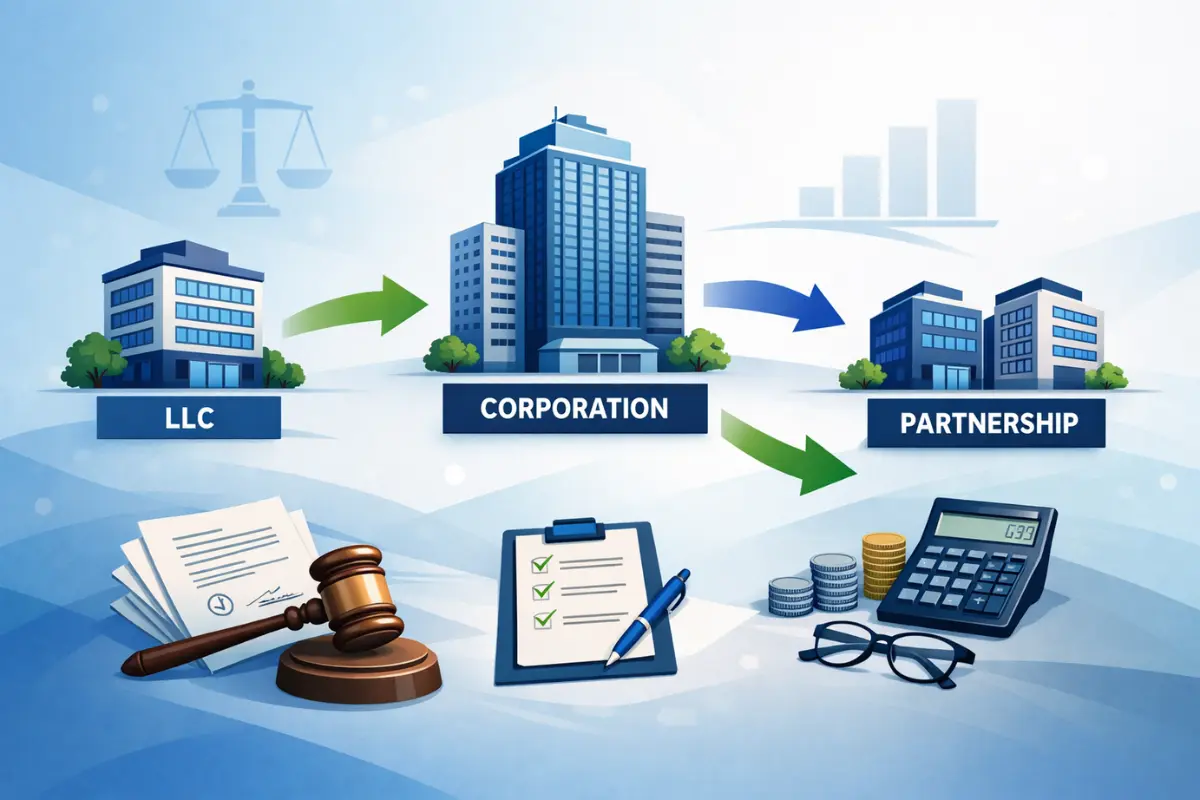
Selecting your new structure is not an administrative task; it is a core strategic decision that aligns your legal framework with your long-term vision. You are choosing among different entity types, each with distinct rules for liability, taxation, and governance.
Here is a detailed comparison of the primary entity types:
-
Sole Proprietorship: The default for a single-owner business; no formal filing required. It offers simplicity and complete owner control but provides no personal liability protection. All business debts and legal judgments are the owner's personal responsibility. It also limits growth options, as you cannot bring in equity partners.
-
General Partnership: Formed automatically when two or more people go into business together to share profits. A formal partnership agreement is strongly recommended to outline roles and profit-sharing. Like a sole proprietorship, it offers no liability shield—each partner can be personally liable for the partnership's debts and the actions of the other partners.
-
Limited Liability Company b(LLC): A common sole proprietorship to LLC conversion involves forming a Limited Liability Company (LLC), the most popular choice for small- to mid-sized businesses seeking flexibility. It provides a strong "corporate veil" protecting members' personal assets from business liabilities. It offers pass-through taxation by default (profits/losses flow through to members' personal returns), but members can elect to be taxed as a corporation.
-
Corporation (C-Corp or S-Corp): For businesses considering a transition from an LLC to a corporation, this structure offers the strongest liability protection by creating a separate legal entity from its owners (shareholders). It entails more complex governance, including a board of directors, officers, and formal shareholder meetings.
-
C-Corporation: Subject to double taxation—the corporation pays income tax on its profits, and shareholders pay tax again on dividends. This is often the required or preferred structure for attracting venture capital, going public, or offering complex employee stock option plans.
-
S-Corporation: A special tax election that allows profits and losses to pass through to shareholders' personal tax returns (avoiding double taxation), while still providing corporate liability protection. It has strict eligibility rules (e.g., limited to 100 shareholders, who must be U.S. citizens/residents).
-
Your choice should balance five key factors:
-
Liability Protection
-
Tax Efficiency
-
Administrative Burden
-
Funding Goals, and
-
Future Exit Plans
Researching the fundamental differences between business structures from authoritative sources is a vital part of this step. Ask yourself: Do I plan to seek venture capital? A C-Corporation is often required or strongly preferred. Do I prioritize simplicity and pass-through taxes with strong liability protection? An LLC is likely ideal.
Step 3 – Consult Legal and Financial Professionals
This is an important step in the process. It's highly advisable to consult with expert counsel before proceeding. Changing your business structure has profound legal and financial consequences that are easy to misunderstand but costly to fix. Professional guidance supports the stability and legality of your business.
First, consult a business attorney who specializes in entity formation and restructuring. They will:
-
Explain the specific requirements and procedures under your state law for both dissolving the old entity and forming the new one.
-
Advise on the most appropriate method for the change (e.g., statutory conversion, merger, formation of a new entity, or asset transfer).
-
Draft all necessary legal documents to ensure compliance and protect your interests.
-
Review all existing contracts to determine how the change affects them and plan for assignments or novations.
-
Help you understand and maintain your corporate veil to preserve liability protection.
Simultaneously, meet with a qualified accountant or tax advisor. They will:
-
Explain the detailed tax implications of dissolving your old entity and forming the new one. This includes potential taxes on asset transfers, recognition of gains, and treatment of prior losses.
-
Advice on obtaining a new Employer Identification Number (EIN) from the IRS. Generally, a new EIN is needed if you change to a corporation or partnership, or if you are a sole proprietor forming an LLC.
-
Plan for the tax year transition, ensuring all final and initial returns are filed correctly to avoid penalties.
-
Model the long-term tax consequences of the new entity type to ensure it aligns with your financial goals.
Step 4 – File Required Legal Documents
This step is the core legal action that formalizes your changing business entity with government authorities. This process requires accuracy and timeliness throughout. A single error or missed filing can invalidate the transition, leave you non-compliant, and expose you to penalties.
Your state law and the type of change dictate the specific documents and process. You will primarily interact with your state's Secretary of State office.
-
Forming the New Entity: For a new LLC, you file Articles of Organization. For a new corporation, you file Articles of Incorporation. These documents include key details such as the business name, principal address, registered agent, and, in some cases, the names of members/directors.
-
Formal Conversions or Mergers: Many states permit a "statutory conversion" or "statutory merger," which is often the cleanest way to change structure. This involves filing a specific conversion/merger document that legally transforms the old entity into the new one in a single step, automatically transferring assets and liabilities.
-
Dissolving the Old Entity: If you are not converting, you must formally dissolve or cancel your old business entity. This usually involves filing "Articles of Dissolution" or "Certificate of Cancellation" with the state, and often requires settling all debts and taxes and notifying creditors.
Key actions within this step include:
-
Appointing or Confirming Your Registered Agent: Every state requires a registered agent with a physical in-state address to receive legal and tax documents. You must ensure your agent is appointed for the new entity. You can learn more about this process in our guide on how to appoint a registered agent.
-
Obtaining a New EIN: As advised by your accountant, apply for a new Employer Identification Number from the IRS if required.
-
Updating Licenses and Permits: All your business licenses, professional licenses, and local permits must be updated or reapplied for under the new entity's name and EIN.
-
Publishing Notice: Some states require publishing a notice of the dissolution or formation in a local newspaper.
As highlighted, using a detailed business structure change filing guide or checklist is essential.
Step 5 – Update Financial Accounts and Records
With the new legal entity officially formed, your entire financial infrastructure must be rebuilt under its name and EIN. This step ensures your banking, credit, accounting, and asset ownership reflect the new legal reality, preventing confusion during tax season or an audit.
Execute the following financial updates methodically:
-
Business Banking: Contact your bank to either update your existing account information or, more commonly, open brand new business bank accounts under the new entity's name and EIN. Close old accounts only after all outstanding transactions have cleared.
-
Accounting System: Update or reconfigure your accounting software (e.g., QuickBooks, Xero). Create a new company file or update all master records to reflect the new legal name and EIN.
-
Asset Transfer: Formally transfer all business assets—including intellectual property (trademarks, patents, copyrights), real estate, vehicles, equipment, and inventory—from the old entity to the new one. This may require deeds, bills of sale, or assignment agreements drafted by your attorney.
-
Debt and Credit: Notify all lenders (banks, credit card companies, SBA loan servicers) of the entity change. Loans may need to be formally assumed or reissued under the new entity.
-
Tax Authority Notification: File final federal and state income, payroll, and sales tax returns for the old entity. Then, file initial "new business" registrations with the IRS and state tax agencies for the new entity.
Meticulous record-keeping throughout this financial transition is essential. Maintain a dedicated file with all correspondence, closing statements, transfer documents, and confirmation letters.
Step 6 – Revise Contracts and Agreements
Your new business entity is a separate legal "person" in the eyes of the law. Therefore, contracts signed by the old entity are not automatically binding on the new one. This step involves a meticulous review and revision of every legal business document to ensure continuity and avoid breach-of-contract claims.
This process covers three main areas:
-
External Business Contracts: Examine every client contract, vendor/supplier agreement, software license, lease, loan document, and insurance policy. Most will contain an "assignment clause." You will typically need the other party's consent to assign the contract to the new entity. This often requires sending a formal "Assignment and Assumption Agreement" or re-signing an amended contract.
-
Internal Governing Documents: Draft and adopt the new entity's foundational documents. For an LLC, this is a new Operating Agreement that outlines member roles, profit distribution, and management rules. For a corporation, its corporate bylaws and initial board resolutions.
-
Employee and Partner Agreements: Update any employment, independent contractor, non-disclosure (NDA), and non-compete agreements to reflect the new employing entity. If you have partners or shareholders, any existing buy-sell agreements or equity incentive plans must be reviewed and, if necessary, re-established for the new entity.
Step 7 – Notify Stakeholders
A structural change can create uncertainty. Clear, proactive, and professional communication is the antidote. It maintains trust, prevents operational confusion, and reinforces your business's stability during the transition.
Develop a tiered communication plan. Notify stakeholders in this logical order:
-
Employees (Internal Team): Hold a meeting or send a clear memo explaining the change, the business reasons behind it, and most importantly, how it affects them. Address key concerns about paychecks, benefits, and new employment agreements. Reassure them that their jobs and the company's operations are secure.
-
Clients/Customers (Revenue Source): Send a formal, positive notification. Frame it as an upgrade that allows you to serve them better. Clearly state the new legal name that will appear on future invoices, contracts, and communications. Provide updated W-9 forms if requested.
-
Vendors and Strategic Partners (Operational Network): Notify all critical suppliers, service providers, and partners. Update accounts payable/receivable information and provide a new W-9.
-
Investors and Lenders (Financial Backers): Provide a formal briefing outlining the rationale, steps taken, and any impact on ownership shares, equity structure, or loan covenants.
Craft a consistent message for all groups, emphasizing the benefits of the change and the steps you're taking to ensure a seamless transition. Update your website, email signatures, and social media profiles to reflect the new legal name.
Step 8 – Monitor and Maintain Compliance
The final steps to update LLC or corporation structure involve ongoing compliance after the filings are done and the emails are sent. Your new structure comes with its own, often different, set of ongoing compliance duties. Falling out of good standing with the state can jeopardize your liability protection and result in fines.
Establish a system immediately to track and meet these new recurring requirements:
-
State Filings: Most entities must file an Annual Report (or Biennial Statement) with the Secretary of State and pay an associated fee. Miss this, and your entity can be administratively dissolved.
-
Tax Filings: Understand the new tax calendar. This includes annual income tax returns (federal and state), quarterly estimated tax payments, payroll tax filings (if you have employees), and sales tax filings.
-
Registered Agent: Maintain an active and reliable registered agent service in every state where you are registered.
-
Internal Formalities: Especially for corporations and multi-member LLCs, maintain corporate formalities. Hold and document annual member/board meetings, keep minutes, and issue ownership certificates.
Make it a practice to review your business structure annually. As your business scales, enters new markets, or changes its capital strategy, the "right" structure can evolve. For broader insights into the long-term legal issues that arise from scaling a business, external resources such as this guide to legal issues for business scaling can provide valuable context.
How InCorp Helps During a Business Structure Change
Navigating a business structure transition involves a maze of state-specific paperwork, shifting deadlines, and document management. It's easy for a critical filing to be missed in the shuffle. InCorp provides specialized, non-legal services designed to help businesses manage the administrative burdens accurately and on time, reducing risk and owner stress.
While InCorp does not provide legal or tax advice, its tools are built to support the procedural backbone of your transition. Its nationwide registered agent services for changing business entity ensure your business has a reliable, professional point of contact in every state where you're registered to receive crucial legal and tax documents. This requirement becomes even more important during an entity change when state correspondence is frequent.
Furthermore, leveraging an Entity Management System for business transitions is invaluable for managing state filings during a business restructure. Such a system acts as a central command center. It can provide automated reminders for critical filing deadlines (such as annual reports or statements of information), help you track the status of multiple state filings simultaneously, and securely store key documents, such as your old and new Articles of Organization. This organizational support makes it significantly easier for business owners and their professional advisors to manage the transition smoothly and maintain good standing.
Ready to Transform? Start Your Smooth Transition Today!
Changing your business structure is a significant undertaking that mirrors a major organizational reboot. When done correctly, it provides a solid, optimized legal and financial foundation for your next phase of growth. By following these steps, you learn how to change business structure without legal issues—moving from introspective evaluation to strategic choice, through meticulous filing, updating, and communication—to execute a transition that minimizes risk and maximizes future opportunity.
The process demands careful planning, professional help, and attention to detail, but the payoff in enhanced protection, tax efficiency, and operational flexibility is substantial. It is a clear signal to yourself, your team, and the market that your business is maturing and planning for a bigger future.
Take the first step today by honestly evaluating your current structure against your three- to five-year goals.
Ready to navigate your business structure change with confidence? Explore InCorp's services for support with registered agent services and entity management tools designed to help you maintain compliance every step of the way.
FAQs
Can I switch back to my old business structure later?
Yes, you can change your business structure again if your original choice proves less optimal than expected. However, switching back involves the same legal filings, potential tax obligations, updated contracts, and stakeholder notifications as the original change. Each restructuring incurs state filing fees, professional service costs, and administrative time. Before changing your structure, carefully evaluate your long-term goals to minimize the need for future reversals.
How long does it usually take to change a business structure?
There is no universal timeline; it varies significantly by state, the complexity of the change, and your level of preparedness. A simple filing for a single-state LLC conversion might receive state approval in 2-4 weeks. Forming a new entity and transferring assets while dissolving an old one could take 6-8 weeks. If the change is complex (involving multiple states, many assets, or significant debt), requires specific regulatory approvals, or if you encounter requests for additional information from the state, the process can easily extend to 3-6 months.
Will changing my business structure affect my existing business credit?
It can, and you should plan for an impact. Your business credit history is tied to your old entity's EIN and legal name. While some business credit bureaus may allow you to link the old history to the new entity, many creditors (banks, credit card companies) will require you to re-establish credit under the new entity's name and EIN. This means you may start with a thinner credit file. It is crucial to proactively notify all lenders, credit card issuers, and business credit bureaus (Dun & Bradstreet, Experian Business) of the change to preserve as much continuity as possible.
Do I need to inform my customers about the change?
While not always a strict legal requirement (unless specified in a contract), transparent communication is a critical business best practice. Proactively informing customers prevents confusion, delays, and frustration with invoices, contracts, warranty claims, and official communications. It demonstrates professionalism and stability, thereby maintaining trust and ensuring business continuity.
What are the main legal and tax reasons to move from a sole proprietorship to an LLC or corporation?
Many owners change structures to reduce personal liability for business debts, separate business assets from personal assets, and access more favorable income tax treatment or future tax elections.
How does changing my business structure affect my Employer Identification Number (EIN) and tax filings?
If you change your business entity (for example, from a sole proprietorship to an LLC taxed as a partnership or corporation), you often need a new EIN and must file final returns for the old structure and new returns for the new entity.
Do I need a new business bank account when I change my business structure?
Yes, most businesses should open a new business bank account under the new legal entity's name and EIN to keep customer payments, day-to-day operations, and accounting clearly separated from the old structure and from personal income.
How can I choose the right business structure to balance liability protection and tax advantages?
Evaluating personal liability tolerance, how you want to pay taxes, your plans for raising capital, and how complex your day-to-day management can be will help you decide between structures such as LLCs, S corporations, and C corporations.
What role does a tax professional play in safely changing my business structure?
A qualified tax professional can model tax consequences, advise on self-employment taxes versus corporate taxes, plan for capital gains or recapture issues, and help align your new tax structure with your long-term business plan.
Disclaimer: This content is intended for general educational and informational purposes only and does not constitute legal, tax, or accounting advice. Every effort is made to keep the information current and accurate; however, laws, regulations, and guidance can change, and no representation or warranty is given that the content is complete, up to date, or suitable for any particular situation. You should not rely on this material as a substitute for advice from a qualified professional who can consider your specific facts and objectives before you make decisions or take action.