
How to Get an Apostille for Business Documents: A Step-by-Step Guide


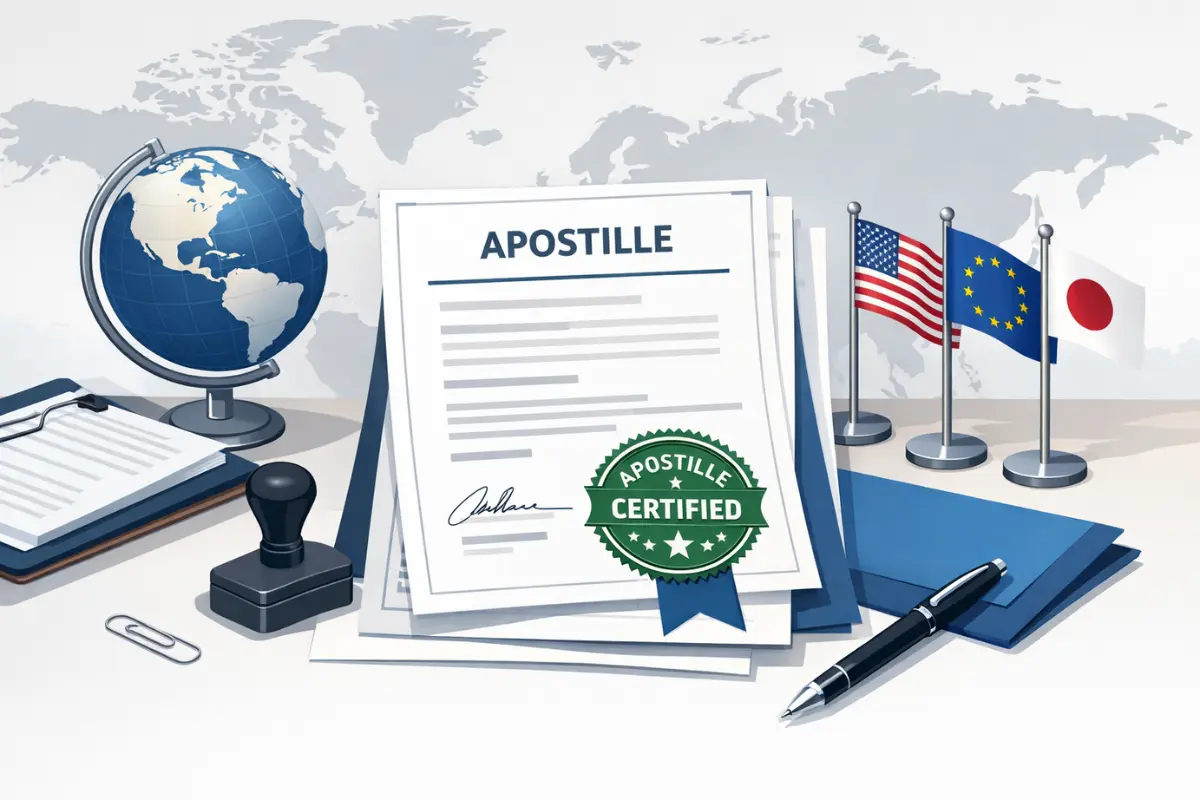
International business expansion requires more than ambition and capital. When establishing a foreign branch, signing contracts abroad, or engaging in cross-border transactions, foreign governments demand proof that your U.S. business documents are legitimate. A photocopy of your Articles of Incorporation won't satisfy a German bank or an Italian court. They need official verification that the document is genuine and issued by a recognized authority. This verification comes through an apostille, a specialized certificate that authenticates documents for use in countries that are members of the 1961 Hague Convention.
Understanding how to get an apostille prevents costly delays when time-sensitive international transactions depend on properly authenticated paperwork. The process applies to various business documents, including corporate formation records, Powers of attorney, contracts, and regulatory certifications. The apostille process follows specific procedural requirements that vary based on document type and jurisdiction. Following the correct sequence prevents rejection and ensures your business operations proceed without bureaucratic obstacles. Whether authenticating state-issued corporate documents or federal regulatory certifications, each document type requires specific handling through designated authenticating offices.
Key Takeaways
-
An apostille is a specialized certificate that verifies U.S. public and business documents for use in Hague Convention countries, allowing foreign banks, courts, and agencies to trust that the document is genuine and properly issued.
-
The process you follow depends on jurisdiction: state-issued documents (like Articles of Incorporation and Certificates of Good Standing) go through the appropriate Secretary of State, while federally issued documents (like FBI checks or federal certificates) go through the U.S. Department of State.
-
Before requesting an apostille, you must confirm whether the destination country is a Hague Convention member; non‑member countries require multi‑step “authentication/legalization” through state, federal, and embassy channels instead of a single apostille.
-
Successful filings rely on technical details: use original or certified copies, meet any age/recency requirements, and ensure private documents are properly notarized with complete wording, a clear seal, and an active notary commission.
-
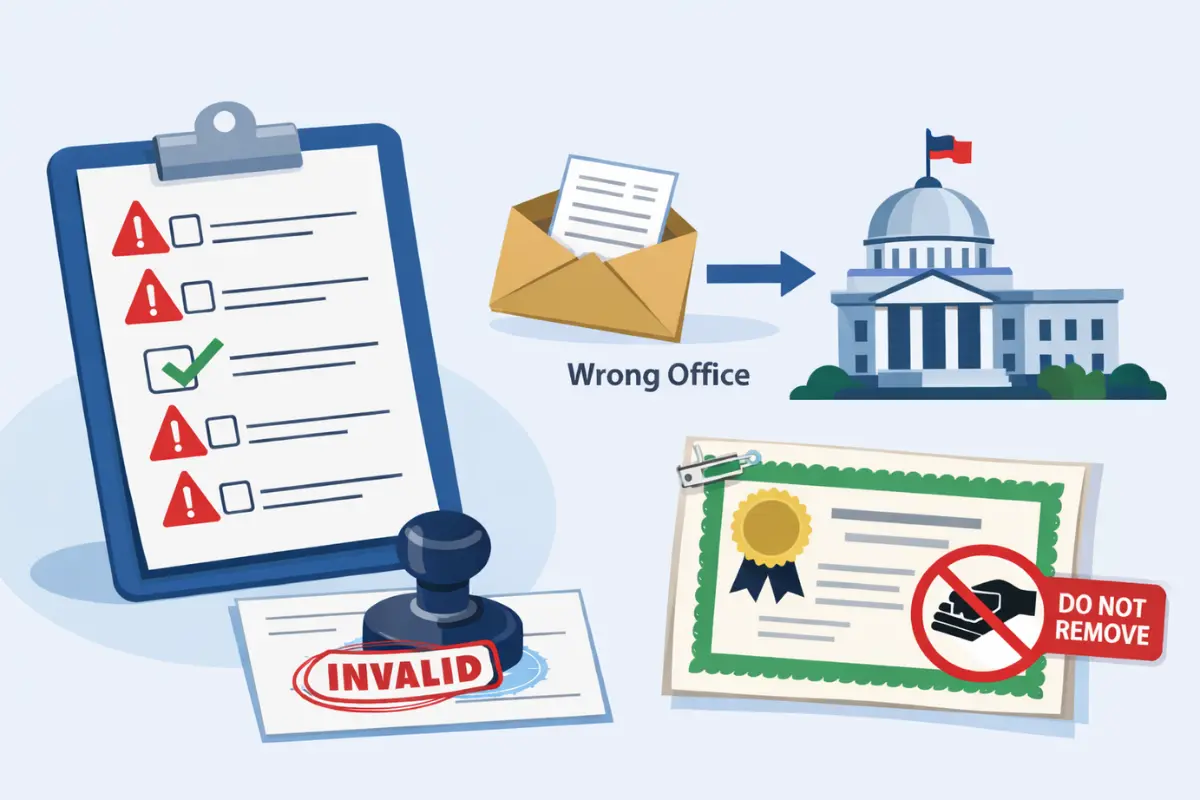
Common reasons for rejection include improper notarization, sending federal documents to a state office (or vice versa), skipping required county certification in certain states, and detaching the apostille from the document after issuance.
-
Fees, processing times, payment methods, and availability of expedited service vary by state and between state and federal offices, so planning ahead is critical for time‑sensitive international transactions.
-
Professional apostille services, including providers like InCorp, can coordinate state and federal submissions, manage multi‑document packages, and reduce errors for businesses handling frequent or multi‑jurisdictional international document needs.
15 Simple Steps to Get An Apostille
Obtaining an apostille requires precision at each stage. The following fifteen steps provide a comprehensive roadmap through the authentication process, from initial verification through final receipt of the certified document. International document authentication guidance shows that understanding the complete process before beginning helps avoid common errors that delay approval and waste filing fees.
Determine the Document's Destination
Before requesting an apostille, verify that the destination country is a member of the 1961 Hague Apostille Convention. More than 110 countries are parties to this treaty, including the United States, the United Kingdom, Germany, Italy, France, Greece, Spain, Ireland, and many others. Member countries accept apostilles as sufficient authentication without requiring additional embassy legalization.
If the destination country is not a Hague Convention member, the document requires a different process called authentication or legalization, which involves multiple steps, including state certification, U.S. Department of State certification, and final authentication by the destination country's embassy. This multi-step process adds significant time and cost compared to the streamlined apostille procedure for Hague Convention countries.
Identify the Issuing Authority (Jurisdiction)
Documents fall into two categories based on their issuing authority: state-issued or federally-issued. This distinction determines where the authentication request must be submitted. State-issued documents include Certificates of Good Standing, apostilles for articles of incorporation, business licenses, state-certified business records, and documents notarized within a specific state. These originate from state-level government agencies or state-commissioned notaries.
Federally-issued documents include FBI background checks (Criminal Record Check), FDA certificates, patents, trademarks issued by federal agencies, and other public documents created by federal government entities. These require federal vs state apostille processing through different channels.
Confirm the Authenticating Office
The issuing authority determines the authenticating office. State-issued documents must be submitted to the Secretary of State's office in the state where the document originated. For example, a California Certificate of Good Standing is issued by the California Secretary of State, while Delaware Articles of Incorporation are filed with the Delaware Secretary of State.
Federally-issued documents must be submitted to the U.S. Department of State's Office of Authentications in Washington, D.C. Submitting a federal document to a state office results in automatic rejection, as does the reverse.
Check Recency Requirements
Some receiving countries or institutions impose recency requirements on certain document types. A foreign bank may reject a Certificate of Good Standing issued more than 90 days ago, even with a valid apostille. Background checks often must be dated within three to six months of submission. Before obtaining the document, verify whether the receiving party requires recent issuance. This prevents the expense of apostilling a document that will be rejected for age rather than authenticity.
Obtain the Required Copy Type
Apostille offices require original documents or officially certified copies issued directly by the originating agency. Standard photocopies, scanned copies, or notarized photocopies are not accepted. For an apostille for articles of incorporation, request a certified copy directly from the state where the business was formed. The certification typically includes raised seals, original signatures, and specific language stating the copy is true and correct. These elements allow the authenticating office to verify the document's legitimacy.
Schedule Notarization (for Private Documents)
Public documents issued by government agencies generally do not require notarization before apostille, as the issuing agency's signature is already official. However, private business documents like contracts, Powers of attorney, board resolutions, and corporate agreements must be notarized before submission.
The process to notarize a document for apostille requires the signer to appear in person before a commissioned Notary Public. The notary verifies the signer's identity through government-issued identification and witnesses the signature. Remote online notarization acceptance varies by state and destination country, so verify requirements before proceeding with electronic notarization services.
Ensure Proper Notarization
Improper notarization represents the most common cause of apostille rejection. The notarized document must include complete notarial wording that identifies the signer, states the notarial act performed, and includes the notary's commission expiration date.
The notary must apply a clear, legible seal or stamp showing their commission number and jurisdiction. The signature must exactly match the name on file with the state's Notary Public Section. Variations in signature style or missing elements result in rejection. The notary's commission must be current on the date of notarization. Documents notarized by an expired commission cannot be apostilled and must be re-notarized.
Obtain County Certification (If Required)
Some states require an intermediate authentication step before the Secretary of State will issue an apostille. In these jurisdictions, the County Clerk's office must first certify the notary's signature and seal before the document proceeds to the state level. This requirement varies by state. California, for example, generally does not require county certification, while some counties in other states do. Verify state-specific requirements to avoid submission delays.
Download the Request Form
Each authenticating office provides specific forms for apostille requests. State Secretary of State offices typically offer downloadable PDF request forms on their websites. The U.S. Department of State uses Form DS-4194 for federal document authentication. Complete the form accurately, providing all requested information, including contact details, document description, destination country, and requested processing time options. Incomplete forms delay processing or result in rejection.
Specify the Destination Country
The authentication request form requires the destination country to be specified. This information may affect processing procedures and help the authenticating office maintain records of international document flow. Provide the exact country name as it appears on official lists. Vague descriptions like "Europe" or regional designations are insufficient.
Calculate the Correct Filing Fee
The secretary of state apostille fee varies significantly by state, ranging from $5 to over $100 per document. Federal apostilles through the U.S. Department of State cost eight dollars per document. These fees cover the administrative cost of verifying the authenticating signature and attaching the official apostille certificate.
Many states accept only money orders or certified checks. Some offer credit card payment options through online portals. Personal checks are often rejected due to processing delays and potential payment issues. Verify accepted payment methods and exact fee amounts before submission, as incorrect payment delays processing or results in package return.
Some offices offer expedited processing for an additional fee, reducing standard processing time from several weeks to as little as one to three business days. Businesses with urgent international deadlines often benefit from expedited services despite higher costs.
Prepare the Return Shipping
Most authenticating offices require applicants to provide prepaid return shipping. Standard mail is often insufficient, particularly for valuable business documents. Many offices require traceable shipping methods such as FedEx, UPS, or USPS Priority Mail with tracking. Include a prepaid shipping label or envelope with sufficient postage and tracking capability. Failure to provide proper return shipping results in documents being held until correct shipping is arranged.
Assemble the Complete Package
Gather all required components: the original or certified document, the completed authentication request form, payment in the accepted format, and the prepaid return envelope. Review the package against the office's checklist to ensure nothing is missing. Do not bind or permanently attach multiple documents together unless specifically instructed. Each document typically requires a separate apostille and a separate fee.
Submit to the Correct Office
Submit the complete package to the appropriate authenticating office based on document type. State documents are submitted to the relevant state's Secretary of State office, either by mail or in person, where accepted. Federal documents go to the U.S. Department of State in Washington, D.C. Processing time varies significantly. Some states process online submissions within 24 hours, while mail submissions may require several weeks. Federal processing typically takes two to four weeks for standard service.
Verify the Completed Apostille
Upon return, carefully examine the document. The apostille appears as an official certificate permanently attached to the document through staples, grommets, or official binding. The certificate includes specific information: the country of origin, the signature being authenticated, the signer's capacity, seal details, the place and date of certification, and a unique reference number. Confirm all information is correct and legible. Never remove the apostille from the document. Detaching the certificate breaks the chain of custody and invalidates the entire certification, requiring the expensive process to begin again.
Common Pitfalls (What Goes Wrong)
Understanding frequent errors helps business administrators avoid costly mistakes that delay international transactions.
The most common cause of rejection is improper notarization. Missing statutory wording, expired notary commissions, or illegible stamps trigger automatic rejection. The notarized document must meet all technical requirements exactly. When the notary's seal is faint or their signature deviates from the name registered with the state's Notary Public Section, the authenticating office cannot verify the notary's authority and must reject the submission.
Jurisdictional confusion represents another critical error. Submitting federally issued documents, such as FBI background checks, to a state Secretary of State rather than the U.S. Department of State guarantees rejection. Understanding federal vs state apostille requirements prevents this mistake. Similarly, submitting documents to the wrong state office—such as sending Nevada Articles of Incorporation to California when the business operates there—results in rejection.
The final permanent error involves detaching the apostille from the document. Once the certificate is attached, removing staples or grommets breaks the legal chain of custody and instantly invalidates the certification. The document must be resubmitted with new fees for a replacement apostille. According to professional apostille service guidance, maintaining document integrity throughout the authentication process and subsequent use protects the substantial investment in time and fees.
Get Your Business Apostille Now
The apostille process follows a logical bureaucratic path. Each step builds on the previous one, creating a verifiable chain from document creation through international authentication. Following these procedures precisely prevents the delays that stall business expansion or derail time-sensitive international transactions. Understanding the distinction between state and federal authentication channels, maintaining proper notarization standards, and submitting complete packages with correct fees are essential to successful processing.
Professional apostille services can help manage these technical requirements, particularly for businesses handling multiple international documents or operating across various jurisdictions. InCorp's apostille service helps navigate state-specific procedures and federal requirements, reducing errors that lead to rejection and delays. Experienced service providers understand the nuances of state requirements and can expedite processing by familiarizing themselves with each office's specific procedures.
For businesses maintaining extensive international operations, systematic document management becomes essential. Review business record-keeping practices to ensure that Recordable documents remain accessible when international authentication is required. Understanding document retention guidelines helps determine which records should be maintained in forms suitable for future apostilles.
When preparing corporate documents for potential international use, consider advance planning. Ensuring that legal business documents include proper signatures, seals, and notarization from the outset reduces the time required when an apostille is needed unexpectedly. Maintaining current Certificates of Good Standing ensures these frequently apostilled documents are ready for authentication without delays.
Contact InCorp to obtain apostille services for your international business documents and ensure proper authentication for use in Hague Convention countries.
FAQs
Can I get an apostille for a document in a foreign language?
Yes, with specific conditions. Most states allow apostilling documents written in foreign languages, provided the notarial certificate—the section the notary signs—appears in English. For example, a Spanish-language power of attorney can be apostilled if the notary's certificate is in English.
However, some federal agencies and certain states require a certified English translation attached to the foreign-language document before issuing the apostille. The destination country may also require translation. Verify both the authenticating office's requirements and the receiving country's language requirements before proceeding.
Does an apostille expire?
The apostille certificate itself has no expiration date. The certification remains valid indefinitely as proof that the document was authentic on the date of issuance.
However, the underlying document may have practical limitations. Foreign banks, courts, or government agencies often reject documents that are older than 6 months, regardless of valid apostilles. A Certificate of Good Standing or background check older than three, six, or twelve months may be rejected despite proper authentication. Always verify the receiving party's recency requirements for the specific document type.
Can I apostille a digital document (e-Apostille)?
Availability varies by jurisdiction. Some states, including Montana, Utah, and California, have implemented e-Apostille programs that allow the digital submission and issuance of electronic documents with digital signatures.
However, the U.S. Department of State for federal documents still requires physical paper documents with original wet-ink signatures. Many states have not implemented e-Apostille systems. The destination country must also accept electronic apostilles, which not all Hague Convention members do currently.
Verify that both the issuing office and the receiving country accept e-Apostilles before pursuing digital authentication.
What happens if my apostille request is rejected?
When an authentication request is rejected, the office returns the documents with an explanation letter detailing the specific deficiency. Common reasons for rejection include improper notarization, incorrect jurisdiction (submitting federal documents to state offices), expired notary commissions, or documents that exceed age requirements.
The deficiency must be corrected before resubmission. This often requires obtaining a new notarized document, securing a more recent certified copy, or redirecting the submission to the correct authenticating office. A new filing fee is required with resubmission.
Review rejection notices carefully and address every cited deficiency to prevent repeated rejections.
What is the difference between "Apostille" and "Authentication"?
The difference reflects apostille vs. authentication processing for different international agreements. An apostille is a streamlined, single-step certification for countries that are members of the 1961 Hague Convention. The apostille certificate issued by the Secretary of State or the U.S. Department of State completes the authentication process.
Authentication, also called legalization, is a multi-step process for countries that are not parties to the Hague Convention, such as China, Canada, and Vietnam. This process requires state certification, then U.S. Department of State certification, and finally authentication by the destination country's embassy or consulate in the United States. Each step incurs separate fees and processing time.
Countries requiring authentication rather than an apostille add substantial time and expense to international document preparation.
Do I need to notarize my corporate documents before starting the apostille process?
Many important documents apostilled for international use must be notarized first, including corporate bylaws, powers of attorney, and many internal corporate documents, because the designated authority only authenticates recognized official or notarized signatures. In most cases, public documents such as state-issued Certificates of Good Standing, Articles of Incorporation, and certain court documents do not require a new notary acknowledgment because the signature of the issuing government agency is already considered official.
How do I know whether to send my apostille request to a state agency or the U.S. Department of State?
The correct office depends on where the original document was issued: documents originating from a state authority (like a Secretary of State, county clerk, or vital records office) are handled by that state's office, while federal documents issued by a U.S. government agency must go through the U.S. Department of State. If a foreign country or receiving party requires authentication for non-Hague Convention use, you may also need to involve an embassy or local consulate after the state or federal authentication certificate is issued.
What should I include when I submit documents for apostille certification using a courier service or mail?
Most authorities require the original document or a certified copy, a completed request form or cover letter identifying the destination country and person requesting the service, the correct fees, and a prepaid return envelope. Planning ahead by using a reliable courier service and tracking, and clearly labeling your package for the appropriate state agency or federal department, helps save time and avoid processing delays.
Can I get an apostille on vital records and court documents for use in another country?
Yes, many foreign countries routinely require apostilled vital records such as birth certificates and certain court documents, including adoption orders or corporate litigation records, before recognizing them for official purposes. Typically, these records must be certified copies issued by the appropriate state agency, clerk of court, or vital records office, and then submitted to the designated authority for an apostille certificate or, if required, full authentication and legalization.
How far in advance should I plan when I need an apostille for international business use?
Processing times for apostille requests vary widely by office, volume, and whether you request standard or expedited services, so it is best to plan several weeks in advance, especially when the documents will support time-sensitive international transactions. Because each state and the federal Department of State have their own rules, fees, and specific requirements, building in extra time for rejected paperwork, updated certified copies, or additional authentication steps helps ensure your apostilled documents are valid when the receiving party needs them.
Disclaimer: This content is intended for general educational and informational purposes only and does not constitute legal, tax, or accounting advice. Every effort is made to keep the information current and accurate; however, laws, regulations, and guidance can change, and no representation or warranty is given that the content is complete, up to date, or suitable for any particular situation. You should not rely on this material as a substitute for advice from a qualified professional who can consider your specific facts and objectives before you make decisions or take action.
Share This Article:
Stay in the know!
Join our newsletter for special offers.