
Business Terms Every New Entrepreneur Must Understand


Every entrepreneur remembers their first business meeting where industry jargon flew across the table like a foreign language. Terms like "burn rate," "EIN," and "conversion rate" can intimidate even the most confident startup founders. The difference between understanding these concepts and feeling lost often determines whether entrepreneurs make informed decisions or costly mistakes during the most vulnerable stages of their ventures. Learning common business terms for entrepreneurs provides the foundation for confident business management.
Launching a business involves navigating unfamiliar territory filled with specialized language. Many aspiring entrepreneurs feel overwhelmed when they encounter terms like "burn rate," "registered agent," or "conversion rate" during meetings with advisors or investors. Understanding foundational business terms helps new business owners make informed decisions, communicate effectively, and avoid costly mistakes.
This guide demystifies startup terminology across legal structures, finances, marketing, and operations. InCorp is not a law firm and does not provide legal or financial advice. This information is educational. Readers should consult with qualified legal professionals.

Key Takeaways
-
Understanding core legal, financial, marketing, and operations terms helps new entrepreneurs make informed decisions, negotiate confidently, and avoid costly mistakes.
-
Choosing the right structure (LLC, corporation, sole proprietorship) and using tools like DBAs, registered agents, and EINs correctly protects personal assets and keeps your company in good standing.
-
Knowing the difference between revenue and profit, tracking cash flow and burn rate, and monitoring basic balance sheet items (assets, liabilities, equity) is essential for sustainable growth.
-
Clear definitions of target market, brand, conversion rate, and customer acquisition cost (CAC) help you focus your marketing and measure whether campaigns are actually working.
-
Maintaining compliance as you grow—through proper filings, contracts, terms of service, and separate business finances—reduces risk and supports long‑term scalability.
Why Understanding Business Terms Matters
Mastering business terminology for startups directly impacts your ability to run a successful company. When you understand the language of business, you can evaluate opportunities more effectively, negotiate better deals, and make strategic decisions based on clear information. Entrepreneurs who grasp fundamental concepts can identify red flags in contracts, spot opportunities others miss, and adapt quickly to changing market conditions.
Professional communication improves when you speak the same language as investors, bankers, attorneys, and accountants. Using correct terminology builds credibility and demonstrates professionalism. Partners and vendors respond more favorably to entrepreneurs who understand basic concepts and can discuss operations intelligently. Knowledge of common business legal terms also helps you recognize unfavorable contract provisions and ask informed questions when reviewing agreements.
Understanding business vocabulary helps you avoid expensive mistakes. Misunderstanding the difference between revenue and profit might lead to overspending based on inflated projections. Confusing entity types could leave you personally liable for business debts. Taking time to learn these terms pays dividends through better decisions, stronger relationships, and fewer costly errors that could threaten your venture's survival.
Key Legal and Structural Business Terms
Legal entity types and structural decisions form the foundation of every business. These choices affect taxation, personal liability, and operational flexibility.
LLC, Corporation, and Sole Proprietorship
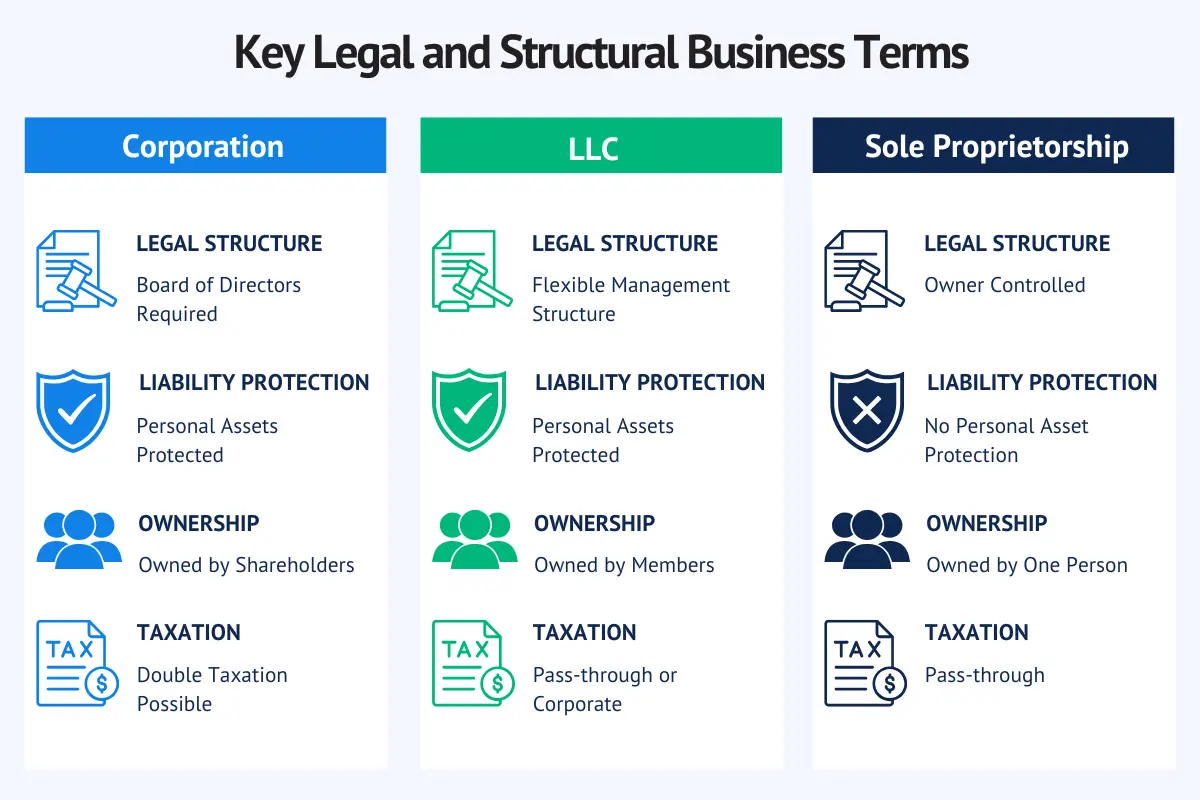
Three primary business structures dominate small-business formation. A limited liability company creates legal separation between the business and its owners, protecting personal assets from business liabilities. LLCs offer operational flexibility and a range of tax options while maintaining relatively simple compliance requirements. Single-member LLCs work well for solo entrepreneurs, while multi-member configurations accommodate partnerships.
Corporations provide the strongest liability protection and are best suited for businesses seeking substantial investment or planning for eventual public offerings. C corporations pay corporate income tax on profits, then shareholders pay taxes on dividends, creating double taxation. S corporations avoid this by passing income through to shareholders, though eligibility restrictions apply. For detailed comparisons, reviewing LLC, S corporation, and C corporation differences clarifies which option best serves specific needs.
Sole proprietorships represent the simplest structure, requiring no formal registration beyond basic licenses. The owner and the business exist as a single legal entity, meaning the owner assumes full personal liability for all obligations. This structure suits low-risk ventures and allows immediate operation, but offers no asset protection if the business is sued or cannot pay its debts.
Registered Agent
Every LLC and corporation must designate a registered agent, an individual or entity authorized to receive legal documents on behalf of the business. The registered agent maintains a physical address in the state where the business is formed and remains available during business hours.
Failing to maintain a registered agent can result in administrative dissolution and missed legal deadlines. Many entrepreneurs initially serve as their own registered agents, though professional registered agent services offer privacy benefits and ensure consistent availability.
DBA (Doing Business As) / Fictitious Business Name
A DBA, or "doing business as" name, allows businesses to operate under a name different from their legal entity name. Also called fictitious business names, DBAs serve branding purposes and allow a single legal entity to conduct business under multiple names.
Company registration terms, such as DBA, can confuse entrepreneurs who mistake them for separate legal entities. However, DBAs provide no liability protection. Registration requirements vary by jurisdiction. For more information on DBA registration and usage, entrepreneurs should research local requirements.
EIN (Employer Identification Number)
An Employer Identification Number functions as a Social Security number for businesses. The IRS issues EINs to identify businesses for tax purposes. Any business with employees must obtain an EIN, as must partnerships and corporations.
Banks typically require an EIN to open business accounts and separate personal and business finances. The EIN application process remains straightforward, with the IRS providing immediate confirmation for online applications.
Essential Financial and Accounting Terms
Financial terms form the language of business performance measurement. Understanding these concepts and accounting terms for small businesses helps entrepreneurs track progress and communicate effectively with investors.
Revenue vs. Profit
Revenue represents total income generated through business operations before expenses. A business selling $100,000 in products generates $100,000 in revenue regardless of costs. Profit is the amount remaining after expenses are deducted. The same business spending $70,000 earns $30,000 in profit.
This distinction matters because businesses can generate substantial revenue while losing money. Many startups focus on revenue growth during early stages. For deeper exploration of revenue versus profit metrics, entrepreneurs should examine how both figures affect business health.
Assets, Liabilities, and Equity
Assets include everything a business owns with monetary value, such as cash, inventory, equipment, and intellectual property. Liabilities represent what the business owes: loans, accounts payable, and wages due. Equity equals assets minus liabilities, representing the net value owners hold.
This relationship, expressed as Assets = Liabilities + Equity, underpins balance sheet accounting. Understanding how business activities affect each category helps entrepreneurs evaluate financial health.
Cash Flow and Burn Rate
Cash flow management tracks money moving into and out of a business over specific periods, typically monthly. Positive cash flow means more money enters than leaves, while negative cash flow indicates spending exceeds income. Many profitable businesses fail due to poor cash flow management when customer payments arrive too slowly to cover immediate expenses like payroll, rent, and supplier invoices.
Burn rate measures how quickly a business spends money, particularly relevant for startups operating at a loss while developing products or building customer bases. Gross burn rate represents total monthly spending on all expenses, while net burn rate accounts for incoming revenue and reflects actual cash depletion. Dividing available cash by the monthly net burn rate calculates the runway, the number of months a business can operate before depleting funds. Entrepreneurs must monitor burn rate closely to ensure sufficient time to reach profitability or secure additional funding before resources run out.
Marketing and Customer-Related Terms
Marketing vocabulary helps entrepreneurs develop strategies and measure results. These marketing terms for entrepreneurs appear frequently in planning discussions.
Target Market and Audience
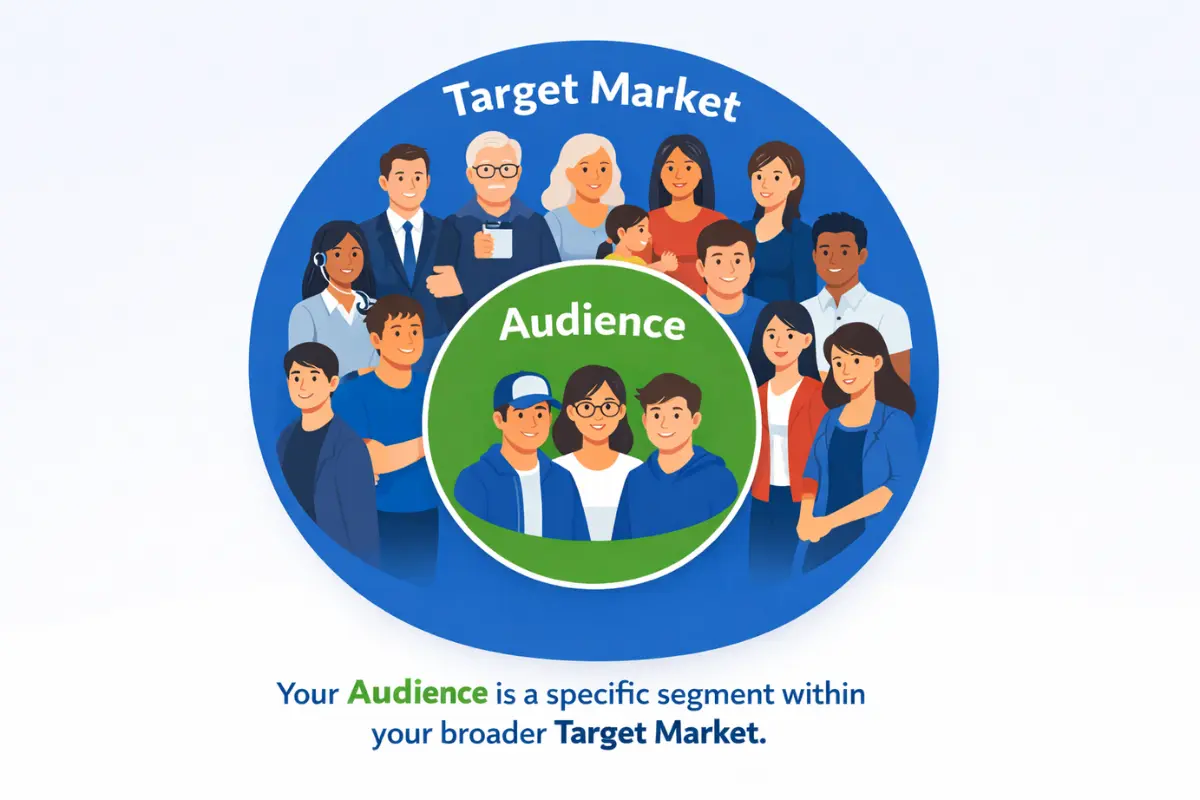
A target market encompasses the broad group of consumers most likely to purchase your product. Target markets get defined by demographics, location, income, and behaviors. Within that target market, specific audiences represent narrower segments you address with particular campaigns.
Understanding these distinctions helps allocate marketing metrics efficiently. A fitness equipment company might target health-conscious adults in general but run campaigns for busy professionals, parents, or seniors.
Brand, Trademark, and Trade Dress
Brand identity extends beyond logos to encompass the complete customer perception of your business. It includes visual elements, messaging, service quality, and reputation. Strong brands command loyalty and justify premium pricing.
Trademarks provide legal protection for names and logos. Trade dress protects distinctive visual appearances. Both prevent competitors from using confusingly similar identifiers. Registering trademarks and protecting intellectual property helps businesses maintain competitive advantages.
Conversion Rate and Customer Acquisition Cost (CAC)
Conversion rate measures the percentage of prospects who complete a desired action: making a purchase, signing up, or requesting a quote. A website receiving 1,000 visitors and generating 50 sales achieves a 5% conversion rate. Higher conversion rates indicate more effective marketing.
Customer Acquisition Cost (CAC) is calculated by dividing total marketing expenses by the number of customers acquired. Spending $10,000 to acquire 100 customers yields a $100 CAC. This metric helps evaluate marketing efficiency. CAC must remain substantially below customer lifetime value to ensure profitability.
Operations and Management Terms
Operational terminology helps entrepreneurs measure performance and maintain business compliance standards.
KPI (Key Performance Indicator)
Key performance indicators (KPIs) are measurable metrics that demonstrate how effectively businesses achieve their objectives. Different business types track different KPIs. Sales teams monitor revenue and new customers, while customer service tracks response times and satisfaction.
Selecting appropriate KPIs requires understanding which metrics most directly indicate progress. For comprehensive guidance on identifying and implementing effective KPIs, businesses should evaluate metrics providing actionable insights.
Supply Chain and Vendor Agreements
Supply chains encompass all processes involved in producing and delivering products, from raw materials through manufacturing to the end customer. Managing supply chains effectively ensures product availability, controls costs, and maintains quality.
Vendor agreements formalize relationships with suppliers, specifying prices, delivery terms, and quality standards. Well-drafted agreements protect both parties and minimize disputes.
Terms of Service and Contracts
Terms of service establish rules governing how customers can use products or services. They outline responsibilities, limit liability, and define dispute resolution. Contracts create legally binding agreements specifying obligations, deliverables, and compensation.
Both documents provide legal protection and establish clear expectations. Understanding why terms of service matter helps entrepreneurs avoid liability issues.
Common Mistakes Entrepreneurs Make With Business Terms
Misunderstanding business terminology leads to preventable errors. New entrepreneurs often confuse business structures, believing a DBA creates the same liability protection as an LLC. This misconception leaves personal assets vulnerable.
Another common mistake involves mixing personal and business finances. Entrepreneurs operating LLCs must maintain separate accounts. Failing to do so can eliminate liability protection. Failure to meet compliance deadlines for annual reports can result in administrative dissolution.
Many entrepreneurs also misinterpret revenue and profit figures, celebrating high sales while ignoring losses. Sustainable businesses require eventual profitability.
Staying Compliant as Your Business Grows
Business compliance requirements evolve as companies expand. Annual reports, registered agent obligations, tax payments, and license renewals all require attention. Failure to meet these requirements triggers penalties and potential loss of good standing.
Compliance becomes more complex when businesses operate across multiple jurisdictions. Each state imposes its own requirements for foreign qualification and annual reports.
InCorp helps businesses maintain good standing through comprehensive compliance services and registered agent representation. Professional support helps entrepreneurs meet deadlines without diverting attention from core business activities. Contact InCorp to learn how we can help your business stay compliant as it grows.
FAQs
Why is it important for new entrepreneurs to understand business terms?
Knowing key business terms helps entrepreneurs make informed decisions, avoid legal mistakes, and manage finances effectively. It ensures clarity in contracts, taxes, and business operations while building credibility with investors, partners, and advisors.
What is the difference between an LLC and a sole proprietorship?
An LLC provides a legal separation between personal and business assets and offers liability protection, whereas a sole proprietorship does not. LLCs often have more complex formation and tax options compared to sole proprietorships, which remain the simplest business structure.
What is a DBA, and when should a business use one?
A DBA ("Doing Business As") allows a business to operate under a name different from its legal entity. Businesses use DBAs to brand, market, or manage multiple ventures under a single entity without creating separate legal structures.
Why do I need an EIN for my business?
An Employer Identification Number separates your personal and business taxes, allows you to hire employees, and enables you to open a business bank account. It remains important for legal and financial management, particularly as businesses grow.
What are the key financial terms every entrepreneur should know?
Terms like revenue, profit, assets, liabilities, equity, cash flow, and burn rate help entrepreneurs track performance, plan budgets, and measure growth effectively. Understanding these concepts proves fundamental to making sound financial decisions.
How do customer acquisition cost (CAC) and customer lifetime value (CLV) affect my business model?
Customer acquisition cost measures how much your business spends on sales and marketing to gain one new customer, including advertising, sales expenses, and related tools. Customer lifetime value estimates the total revenue a typical customer group generates over their relationship with your business, and a sustainable business model usually requires CLV to be several times higher than CAC to support growth and profit margins.
What is the difference between a business‑to‑business (B2B) and business‑to‑consumer (B2C) business model?
A business‑to‑business (B2B) model sells products or services to other businesses, often with longer sales cycles, higher contract values, and a heavy focus on relationships and industry trends. A business‑to‑consumer (B2C) model sells directly to individual customers, typically relying more on content marketing, search engine optimization, and a streamlined sales funnel to convert high volumes of potential customers.
How do funding options like angel investors, venture capital, and debt financing differ?
Angel investors are individuals who invest their own personal savings in early‑stage startups in exchange for an ownership stake, often providing mentorship and industry connections. Venture capital and private equity funds invest larger amounts in businesses showing rapid growth potential, usually across multiple investment rounds, while debt financing involves borrowing money that must be repaid with interest, allowing founders to retain equity but adding financial obligations to meet over time.
Why are financial statements like the balance sheet and income statement so important for new businesses?
An income statement shows a company's revenue, total sales, and expenses over a period, helping entrepreneurs see whether the business earns a profit or loss and how sales expenses and other costs affect net income. A balance sheet provides a snapshot of what the business owns (assets), what it owes (liabilities), and owners' equity at a specific point in time, helping founders and investors evaluate cash flow health, the ability to meet financial obligations, and overall long‑term sustainability.
Disclaimer: This content is intended for general educational and informational purposes only and does not constitute legal, tax, or accounting advice. Every effort is made to keep the information current and accurate; however, laws, regulations, and guidance can change, and no representation or warranty is given that the content is complete, up to date, or suitable for any particular situation. You should not rely on this material as a substitute for advice from a qualified professional who can consider your specific facts and objectives before you make decisions or take action.
Share This Article:
Stay in the know!
Join our newsletter for special offers.