

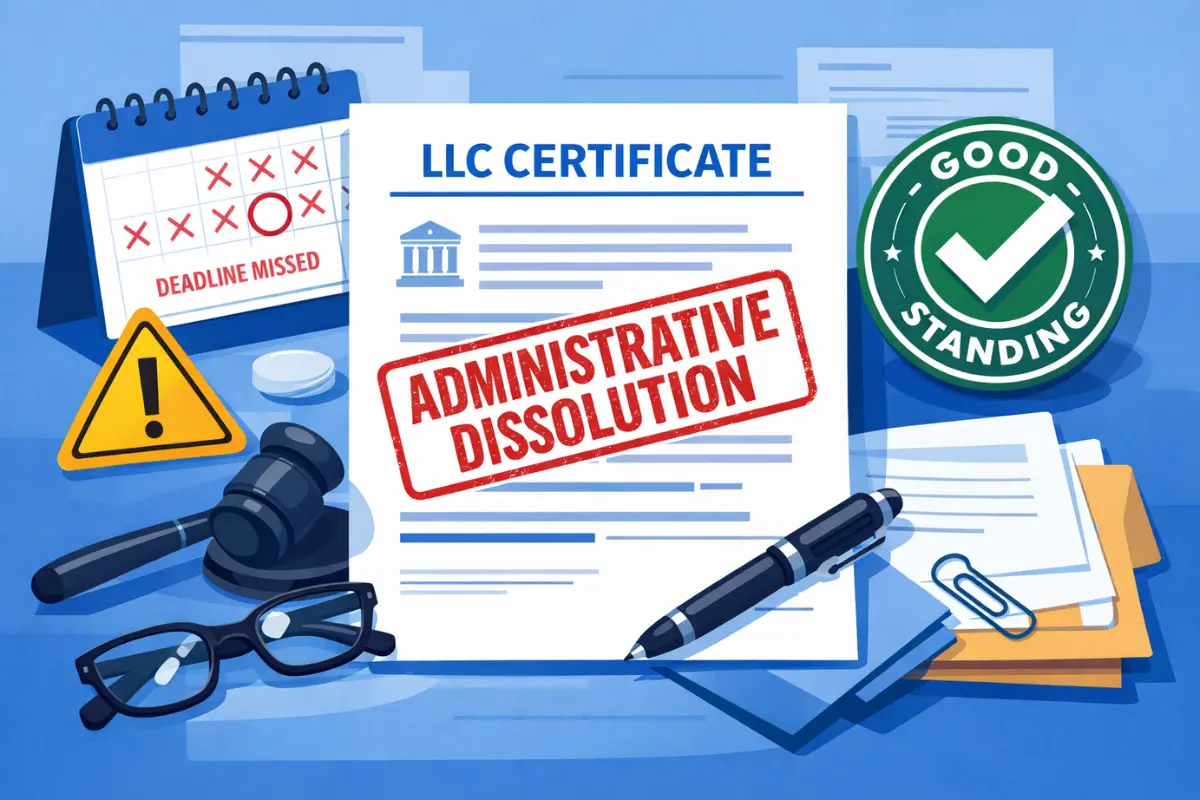
A business owner opens the mail to find an official notice from the Secretary of State. The headline reads: "Notice of Intent to Dissolve." The company failed to file last year's annual report. The state now threatens to terminate the LLC's legal existence within 60 days. This scenario plays out thousands of times annually across the United States. Administrative Dissolution is the involuntary termination of a business entity's legal authority by the state due to failure to meet mandatory compliance requirements. This differs from voluntary dissolution, where owners deliberately wind up operations. With administrative dissolution, the state takes action without the owner's consent.
The consequences of administrative dissolution for an LLC or corporation extend beyond administrative penalties. Dissolution terminates good standing status, forfeits the exclusive right to the company name, and can expose owners to personal liability. Understanding triggers and implementing proactive measures helps maintain liability protection.
Key Takeaways
-
Administrative dissolution is an involuntary state action that ends your company’s good standing and legal authority to operate when core compliance obligations are missed.
-
The three primary triggers are failing to file annual or periodic reports, failing to maintain a valid registered agent, and failing to file or pay required franchise/privilege taxes.
-
Once dissolved, your business can lose its exclusive name rights, face frozen or restricted bank activity, and risk owners being held personally liable for obligations incurred after dissolution.
-
Prevention is far less costly than reinstatement: a compliance calendar, internal review checks, prompt contact updates, and professional registered agent/compliance services significantly reduce dissolution risk.
-
If dissolution occurs, reinstatement usually requires curing every deficiency, paying back fees, taxes, interest, and penalties, and in some states paying extra for expedited processing before full good standing is restored.
The Three Main Reasons for Involuntary Dissolution
State agencies administratively dissolve thousands of business entities annually. Most dissolutions stem from three specific compliance failures that are entirely preventable through proper monitoring and timely action.
Failure to File Annual Reports
Almost all states require business entities to file periodic reports with the state agency responsible for business registrations. These reports, commonly called Annual Reports, Biennial Reports, or Statements of Information, update the government on current ownership, management, and contact information.
Annual report requirements represent one of the most common compliance failures, with failure to file an annual report consequences leading to involuntary dissolution.
The reports typically require the entity's principal address, the names of officers or managers, and confirmation of the registered agent. Many states charge filing fees ranging from twenty to several hundred dollars. Failure to submit the report and fee by the deadline initiates dissolution proceedings.
Failure to Maintain a Registered Agent
State laws require every business entity to continuously maintain a registered agent with a physical street address in the state. The registered agent receives legal documents on behalf of the entity, including service of process for lawsuits, official tax notices, and compliance correspondence.
Maintaining a registered agent to avoid dissolution is critical as the state cannot legally deliver crucial documents if the agent is missing or the address is outdated. When a registered agent resigns, and the entity fails to appoint a replacement within the required timeframe, dissolution proceedings typically follow.
The registered agent must maintain a physical street address where the entity is registered. Post office boxes generally do not satisfy this requirement. Loss of registered agent status represents grounds for dissolution in most jurisdictions.
Failure to Pay Franchise or Privilege Taxes
Many states, including California, Texas, and Delaware, impose annual franchise taxes or privilege taxes on business entities. These taxes are assessed for the privilege of operating as an LLC or corporation, separate from income taxes on profits.
The tax filing requirement often exists even when no tax payment is due. States require entities to file tax returns with the state tax authority, separate from the office that handles entity registrations. Failure to file required tax returns or pay assessed taxes within the deadline triggers state agency enforcement actions that can suspend or dissolve the entity's registration. These actions often require coordination between tax authorities and the Secretary of State to effectuate dissolution.
Steps to Proactively Avoid Administrative Dissolution
Dissolution prevention guidance indicates that implementing systematic compliance procedures significantly reduces the risk of involuntary dissolution.
Centralize All Compliance Deadlines
Create a master compliance calendar that tracks specific due dates for all annual reports and franchise taxes in every state where the business maintains registration. Entities operating in multiple states through foreign qualification face varying deadlines, fee structures, and reporting requirements. The calendar should include the exact due date, grace period, the filing office where documents must be submitted, required fees, and contact information. Digital calendar systems with automated reminders help ensure deadlines are not missed.
Verify Registered Agent Status Quarterly
Conduct regular reviews to confirm that the registered agent's name and address remain accurate on the state agency public record. Verify the agent is actively receiving mail and forwarding documents appropriately. If using a commercial registered agent service, confirm the service agreement remains active. Agent resignations due to unpaid fees represent a common cause of compliance failures.
Establish an Internal Review Process
Before submitting annual reports or tax filings, implement a second-person review to ensure all required fields are complete and accurate. Common errors include missing signatures, incorrect fees, outdated addresses, and omitted management information.
The reviewer should verify that payment methods are acceptable. Some states require certified checks or money orders, while others offer online filing with credit card payment.
Pay State Taxes and Fees Separately
When possible, submit annual report fees and franchise taxes separately to the respective agencies. The Secretary of State typically handles corporate registration, while a separate tax authority administers franchise taxes. Separating payments prevents confusion about which obligation has been satisfied and ensures each agency receives correct documentation.
Maintain Documentation of Filing
Keep detailed records of every successful filing, including confirmation numbers, receipts, and copies of submitted documents. For paper filings, maintain proof of mailing. For electronic submissions, save confirmation emails. This documentation proves timely compliance if disputes arise about whether filings were received. States can take weeks to update public records.
Update Contact Information Immediately
Notify the state agency immediately when the principal business address, phone number, registered agent, or management changes. Many states allow updates through annual reports, but interim changes often require separate notification. Maintaining current contact information ensures the business receives critical notices about compliance deficiencies requiring a response.
Utilize Professional Monitoring Services
Professional registered agent and compliance management services provide automated alerts before statutory deadlines. These services track requirements across multiple jurisdictions. Professional services maintain current knowledge of changing state requirements and fee schedules. They can prepare and submit filings on behalf of the entity, ensuring accuracy and timeliness.
The Financial Risk: Reinstatement vs. Prevention
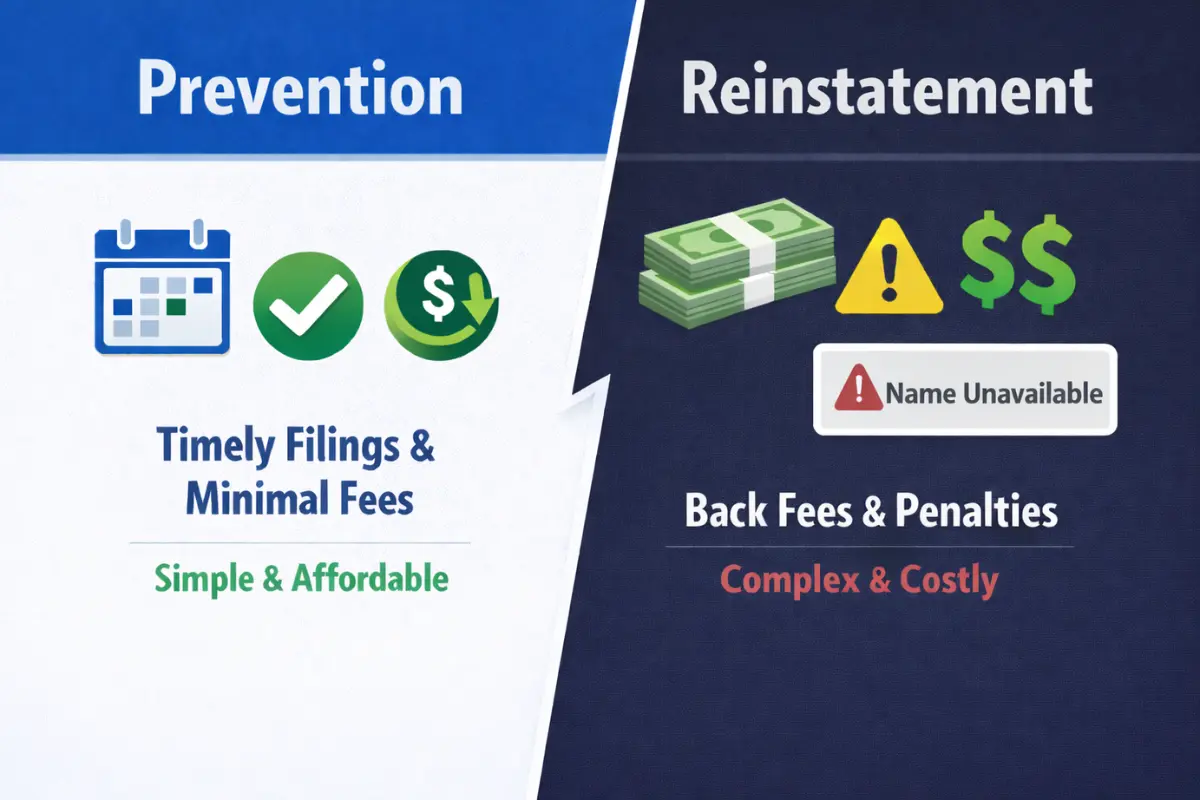
Understanding the reinstatement process vs avoiding dissolution reveals the substantial cost difference between proactive compliance and reactive remediation. Prevention through timely compliance typically involves predictable costs: annual report fees typically ranging from $20 to $300 per state, franchise taxes as required, and registered agent fees if using professional services.
Reinstatement after administrative dissolution incurs significantly higher costs. States typically require payment of all past-due annual report fees, accumulated franchise taxes, interest on unpaid taxes, late-filing penalties, and a separate reinstatement fee. The total can easily exceed several thousand dollars for entities dissolved for multiple years.
According to state filing cost data, Virginia charges a base dissolution filing fee of twenty-five dollars for standard processing. However, entities requiring expedited reinstatement incur additional costs: $100 for next-day processing or $200 for same-day processing.
Beyond direct costs, “what happens if my company loses good standing” includes operational disruptions. Banks may freeze accounts or deny loans. Customers may refuse to transact with entities not in good standing. The entity cannot bring lawsuits or defend against legal actions. Business licenses may be revoked.
Most significantly, the entity's exclusive right to its name may be lost. During dissolution, the name returns to available status. Another entity can form using that name, forcing the original business to rebrand entirely upon reinstatement.
Safeguard Your Business Structure Today
Business owners form LLCs and corporations primarily to protect personal assets from business liabilities through limited liability protection. Administrative Dissolution terminates this protection, exposing owners to personal liability for obligations incurred after dissolution. Understanding how to prevent loss of good standing status through consistent compliance preserves the liability shield.
The annual filing checklist to avoid state dissolution begins with knowing exactly what each state requires, when filings are due, and which agency administers each requirement. For entities registered in multiple states, maintaining accurate tracking systems helps prevent oversights that could trigger enforcement actions.
Professional compliance services can help manage these requirements across jurisdictions. InCorp offers registered agent services and compliance management support that help businesses maintain good standing through systematic monitoring of state requirements and timely filing of mandatory reports.
Maintaining proper corporate governance practices supports compliance and regulatory compliance. Regular board or member meetings, documented resolutions, and updated entity records ensure the information reported to states reflects the current reality. For guidance on maintaining comprehensive business records, see “Business Record-keeping Practices.”
Entrepreneurs building new businesses often overlook ongoing compliance obligations in favor of operational priorities. Understanding common pitfalls helps prevent costly mistakes. For information on frequent compliance errors, see “Legal Mistakes Entrepreneurs Make."
If administrative dissolution has already occurred, understanding the reinstatement process is critical. Requirements vary significantly by state, but generally involve curing all underlying deficiencies and paying accumulated fees. For detailed guidance on this process, see “How to Reinstate a Dissolved Business.”
Business owners considering voluntary closure should understand the distinction between administrative and voluntary dissolution. Properly dissolving an entity through voluntary procedures protects against ongoing liability and tax obligations. For information on voluntary dissolution procedures, see “How to Dissolve a Business Properly.”
Contact InCorp to learn how registered agent services can help maintain your entity's good standing and avoid administrative dissolution.
FAQs
What specific penalty is issued before the final dissolution?
Most states issue a Notice of Delinquency or Notice of Intent to Dissolve before final administrative dissolution. This notice serves as a mandatory warning, typically providing sixty to ninety days to correct the compliance issue. The notice specifies the deficiency, such as filing an overdue annual report or paying unpaid franchise taxes, and explains the deadline to cure the violation. Failure to respond by the deadline results in the state agency filing a Certificate of Dissolution that officially terminates the entity's legal authority. The notice period provides an opportunity to avoid dissolution through prompt remedial action.
What happens to the company's bank accounts after dissolution?
Banks generally do not automatically freeze accounts upon administrative dissolution. However, many financial institutions restrict significant transactions when they verify that an entity is not in good standing with the Secretary of State. The bank may prohibit loan applications, signatory changes, or large transfers. The dissolution suspends the entity's legal authority to conduct business, creating liability concerns for banks that facilitate unauthorized transactions. Some banks require periodic verification of good standing status and may freeze accounts if dissolution is discovered. Maintaining a good standing status prevents these banking complications.
Can the owners be held personally liable after dissolution?
Yes, personal liability represents the most significant risk of administrative dissolution. When the state dissolves an entity, courts may find that the owners failed to maintain the corporate veil. Consequences of administrative dissolution for an LLC include potential personal liability for obligations incurred after the dissolution date. Creditors may pierce the corporate veil and pursue owners' personal assets when liability protection has ceased to exist. This risk particularly affects contracts signed, debts incurred, or torts committed after dissolution. The liability exposure continues until the entity is reinstated and regains good standing status.
Does being dissolved mean my EIN is cancelled?
No. The state agency, typically the Secretary of State, dissolves the entity's legal status at the state level. The Employer Identification Number (EIN) remains registered with the Internal Revenue Service (IRS) at the federal level. State dissolution does not automatically cancel the EIN. However, the business should notify the IRS if all operations cease permanently. The EIN generally cannot be reused or transferred. If the entity reinstates with the state, the same EIN remains valid for federal tax purposes. A separate notification to the IRS is required to close tax accounts or file final returns.
How can business owners avoid administrative dissolution and maintain good standing?
Business owners can avoid administrative dissolution by tracking state filing deadlines, timely filing annual reports, and paying all required franchise taxes and fees for each business entity. Ongoing compliance obligations also include maintaining a valid registered agent, updating state records when ownership or address changes, and promptly responding to any legal notices from government agencies.
What happens to a business entity's rights and operations when it is administratively dissolved?
When administrative dissolution occurs, the corporation's legal existence or LLC's legal status is limited to winding up affairs, and the entity generally loses the right to conduct business or enforce contracts except as allowed by state law. The administratively dissolved entity may also lose licenses, face restricted access to financial institutions, and experience legal complications if it continues conducting business as though it were in good standing.
How does administrative dissolution affect personal liability and limited liability protection?
If a business entity fails to satisfy ongoing compliance obligations and is administratively dissolved, courts may find that limited liability protection has been compromised for obligations incurred after dissolution. In those circumstances, owners, members, or a sole shareholder can be found personally liable for outstanding debts, future liabilities, or creditor claims if they continue to conduct business without correcting the compliance failures.
How is voluntary dissolution different from administrative or involuntary dissolution?
Voluntary dissolution is a formal dissolution process initiated by business owners under the operating agreement or bylaws, including filing articles of dissolution, paying debts, and distributing remaining assets according to proper dissolution procedures. Unlike administrative dissolution or judicial dissolution, voluntary dissolution allows the entity to plan for tax obligations, file final tax returns, obtain a tax clearance certificate when required, and avoid future liabilities by properly winding down business operations.
What is the reinstatement process after an entity has been administratively dissolved?
The reinstatement process typically requires curing each compliance failure, such as filing delinquent annual reports, paying franchise taxes and outstanding taxes, and satisfying any financial obligations like penalties or interest. Many states impose a grace period or specific dissolution period for reinstatement, and may require applications, state law forms, and fees before restoring the entity's powers, legal standing, and ability to maintain good standing going forward.
Disclaimer: This content is intended for general educational and informational purposes only and does not constitute legal, tax, or accounting advice. Every effort is made to keep the information current and accurate; however, laws, regulations, and guidance can change, and no representation or warranty is given that the content is complete, up to date, or suitable for any particular situation. You should not rely on this material as a substitute for advice from a qualified professional who can consider your specific facts and objectives before you make decisions or take action.