

An entrepreneur launches a unique brand and wants to protect the name. A startup develops a distinctive company name and needs nationwide rights. A growing business plans expansion and requires exclusive use of its brand. Each scenario raises the question of how to trademark a business name. Understanding how to trademark a business name helps business owners protect brand identity and prevent unauthorized use. The trademark registration process involves specific steps, documentation, and strategic decisions. This guide provides a step-by-step overview of how to register a business name as a trademark, including search procedures and application requirements.
InCorp is not a law firm and does not provide legal or financial advice. This information is educational. Readers should consult with qualified legal professionals for more information.

Key Takeaways
-
Trademark registration transforms your business name into a legal asset: A registered trademark gives you exclusive nationwide rights to use your business name, preventing competitors from creating confusion in the marketplace and diluting the brand identity you've worked hard to build.
-
Federal protection beats state registration every time: Federal trademark registration through the USPTO provides nationwide rights and legal advantages that state-level registration can't match, especially if you plan to expand beyond your local market or engage in interstate commerce.
-
The trademark search step prevents expensive mistakes: Conducting thorough searches through the USPTO database, state registries, and common-law sources before filing identifies conflicts that could derail your application or trigger costly legal disputes after you've already invested in branding.
-
Proper classification determines your protection scope: The 45-class system categorizes goods and services, and selecting the correct classes ensures your trademark protects what you actually offer—getting this wrong can leave gaps in your protection or waste money on unnecessary classes.
-
The process takes time and precision: Expect 8 to 12 months from application to registration, with specific requirements at each stage including specimen submission, responding to office actions, and publication periods where others can oppose your mark.
-
Maintenance keeps your trademark alive: Registered trademarks last indefinitely but require declarations of use between years five and six, renewals between years nine and ten, and subsequent renewals every ten years—missing these deadlines can cost you the protection you've built.
-
Professional guidance increases approval odds: The USPTO trademark filing process involves technical legal requirements and strategic decisions that trademark attorneys and experts can navigate efficiently, reducing errors and addressing potential issues before they become roadblocks.
Why Trademark Your Business Name?
Registering a trademark provides legal advantages that support business growth and brand name legal protection.
Legal Protection
A registered trademark gives the business exclusive rights to use the name for goods or services listed in the registration. Intellectual property protection through trademark registration allows owners to prevent competitors from using confusingly similar names.
This exclusive-use right reduces the risk of brand dilution and provides legal grounds to address unauthorized use. The registration creates a public record of ownership, strengthening the business's position in infringement prevention actions.
Federal trademark vs state trademark registrations differ significantly in scope. Federal registration provides nationwide rights, while state registration typically offers protection only within that state.
Brand Recognition
A trademark helps customers identify and differentiate the business in the market. A recognizable name builds trust and strengthens marketing efforts by reinforcing a consistent brand identity.
Business branding strategy considerations include selecting names that consumers can easily remember and associate with specific quality levels. The trademark becomes a valuable business asset representing accumulated goodwill.
Nationwide Rights
Federal trademark registration protects a business name nationwide, not just in the state where the business operates. This nationwide rights protection is crucial for companies planning to expand beyond local markets.
Federal trademark vs state trademark registrations determine whether protection extends across state lines or remains limited to specific geographic areas. Businesses engaged in interstate commerce benefit substantially from federal registration.
Step-by-Step Process to Trademark a Business Name
The trademark process involves multiple stages, from initial searches through final registration. Understanding each step helps businesses prepare applications effectively.
Step 1 – Conduct a Trademark Search
Trademark search tips begin with examining the USPTO database for existing trademarks. The Trademark Electronic Search System (TESS) provides free access to federal trademark records. Searching for identical and similar names in the same industry helps identify potential conflicts. The search should include spelling variations and similar-sounding names.
Beyond the USPTO database, comprehensive searches examine state trademark registries, business name databases, and domain registrations. These additional searches identify common-law trademark uses that may not appear in federal records but could create conflicts. Avoiding trademark conflicts prevents application rejection and reduces the risk of costly legal disputes. Professional trademark search tips recommend examining marks that could create a likelihood of confusion.
Step 2 – Determine the Trademark Class
Trademark classes categorize goods and services into 45 international classes. Selecting the correct class for the business's offerings ensures the proper scope of protection. The classification system divides goods (classes 1-34) from services (classes 35-45). Each class covers specific types of products or services, and trademarks are registered for particular classes.
Businesses offering multiple types of goods or services may need to register in multiple classes. The application fee structure typically charges per class, making class selection an important financial consideration in the USPTO trademark filing process.
Step 3 – Prepare and File Your Application
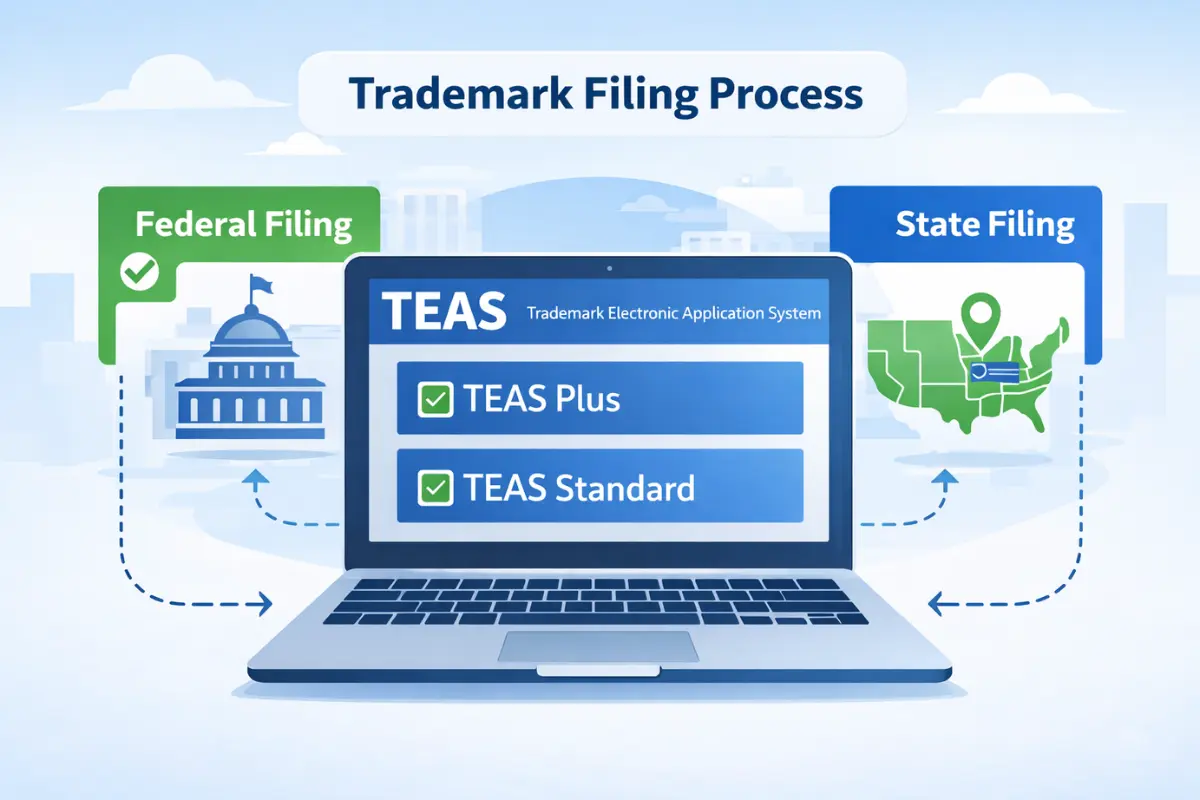
Trademark application steps begin with gathering required information and selecting the appropriate filing method. The Trademark Electronic Application System (TEAS) provides the primary portal for submitting federal applications.
The USPTO trademark filing system offers two main application types: TEAS Plus and TEAS Standard. TEAS Plus has lower filing fees but requires meeting specific requirements and restrictions. TEAS Standard offers more flexibility in application details but charges higher fees. Required information includes owner details, business name or mark, description of goods or services, trademark classes, basis for filing (use in commerce or intent to use), and filing fees. Applications based on current commercial use must include specimens showing how the mark appears in actual business operations.
The federal vs state trademark decision affects the location of application filing. Most businesses seeking substantial protection file federally with the USPTO for nationwide rights. State trademark registration provides more limited geographic protection but may suffice for businesses operating only within one state.
How to register a business name federally requires demonstrating use in interstate commerce or filing based on an intent-to-use statement, with plans to begin use within a specified timeframe.
Step 4 – Respond to USPTO Correspondence
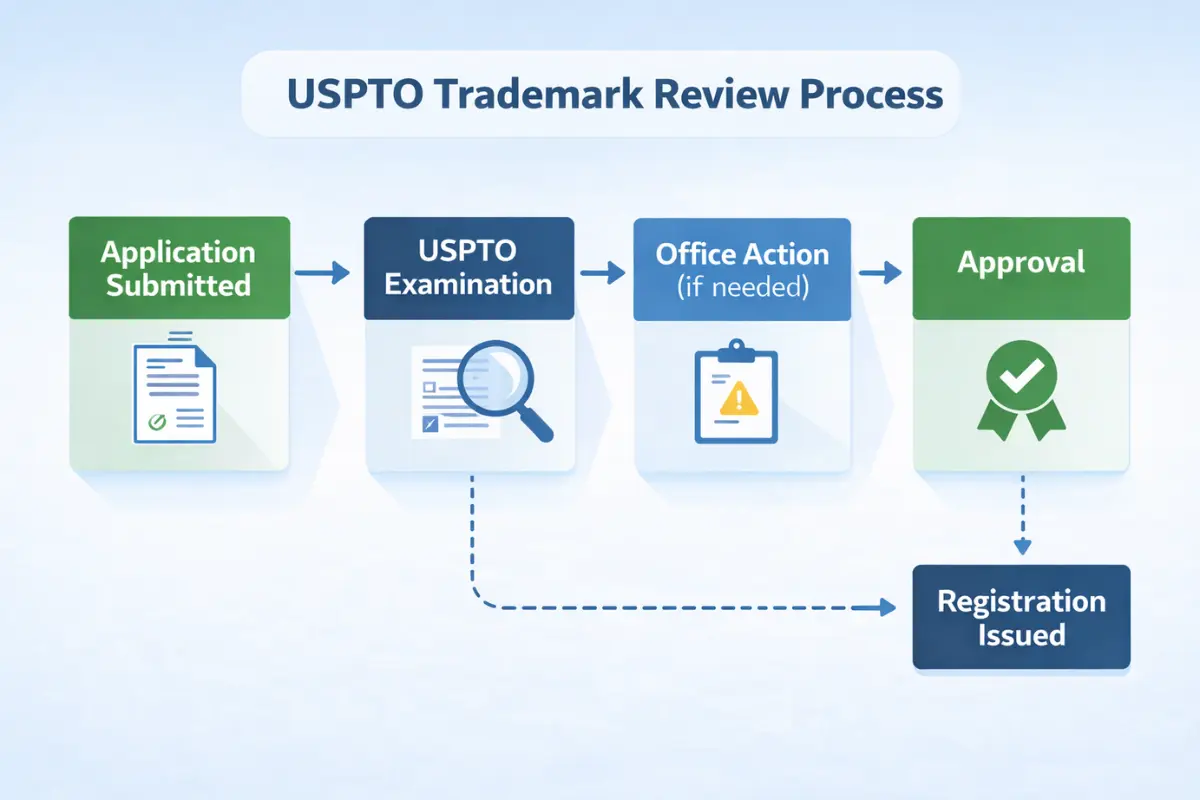
After filing, a USPTO examining attorney reviews the application. USPTO considerations include whether the mark meets distinctiveness requirements, conflicts with existing marks, and complies with filing requirements. If the examiner identifies issues, the USPTO issues an "office action" detailing objections or requirements. Common reasons include the likelihood of confusion with existing marks, descriptiveness concerns, or incomplete application information.
Applicants typically have six months to respond to office actions. Timely, accurate responses address the examiner's concerns and keep the application proceeding. Failure to respond results in application abandonment. The response may require amending the application, providing additional information, or arguing why the examiner's concerns do not apply.
Step 5 – Receive Registration
Once the USPTO approves the application and no oppositions are filed during the publication period, the trademark registration process concludes with official registration. The USPTO issues a registration certificate confirming the registered trademark status.
Registration allows the business to use the ® symbol with the mark, signaling federal registration status. This symbol provides notice to competitors that the mark is federally registered and the owner has exclusive rights.
Brand-name legal protection through registration includes the right to sue for trademark infringement in federal court and the presumption of ownership and exclusive rights nationwide. The registration creates a public record that appears in trademark searches conducted by others.
What Happens After You Apply for Trademark Protection
After submitting a USPTO trademark filing, the application enters a queue for examination by a reviewing attorney. Processing times typically range from several months to over a year, depending on application volume. The examining attorney reviews the application for compliance with trademark law requirements. If approved, the mark is published in the USPTO's Official Gazette, initiating a 30-day opposition period during which third parties may file objections.
Professional trademark services help businesses navigate the application process, respond to office actions, and address opposition proceedings.
Maintaining Your Trademark
Maintaining trademark registrations requires timely renewals and proper use in commerce. Federal trademarks do not expire as long as the mark remains in use and the required maintenance documents are filed. The first maintenance filing occurs between the fifth and sixth year after registration. Renewal filings are required between the ninth and tenth year, and every ten years thereafter.
Maintaining a trademark includes monitoring for potential infringement and taking action when others use confusingly similar marks. The USPTO registers trademarks but does not police for infringement. Trademark owners bear responsibility for protecting their marks by monitoring the marketplace and taking appropriate action against infringers.
Reasons the USPTO Might Reject Your Trademark Application
Several common issues lead to application rejection during the examination process.
Not Registered for Business Purposes
Trademarks filed for personal rather than commercial use receive automatic rejection. The trademark process requires legitimate business use of the mark in commerce or bona fide intent to use the mark in commerce.
Generic or Descriptive Names
Common words, overly generic terms, or merely descriptive names typically cannot receive trademark protection. The mark must be distinctive enough to identify the source rather than simply describing the goods.
Generic terms name the product itself. Descriptive terms directly describe characteristics or features. Both categories face significant registration obstacles.
Business branding strategy should prioritize distinctive names that can be trademarked rather than generic or descriptive terms.
Likely to Cause Consumer Confusion
Trademarks similar to existing registered marks in the same or related industries may be rejected on the basis of likelihood of confusion. The USPTO cannot allow registrations that would confuse consumers about the source of goods or services. Infringement prevention begins at the application stage by selecting marks sufficiently distinct from existing registered marks.
Protect Your Brand with Expert Trademark Guidance
Professional guidance helps entrepreneurs navigate the trademark registration process efficiently, from initial searches through filing and maintenance. Expert assistance ensures businesses avoid common mistakes and secure long-term protection.
InCorp helps businesses with trademark procedures, including conducting searches, preparing applications, and managing maintenance requirements. Professional support increases the likelihood of approval by addressing potential issues before rejection. Intellectual property protection strategies extend beyond trademarks to include comprehensive approaches for protecting business assets.
Contact InCorp to learn how professional trademark services can support your brand name legal protection strategy.
FAQs
What is the difference between a business name and a trademark?
A business name identifies a company legally for formation purposes, while a trademark protects brand identity, including names, logos, or slogans, giving exclusive rights in commerce. Business names are registered with state agencies during entity formation. Trademarks are registered with the USPTO to protect the use of names or symbols in connection with specific goods or services.
Can I trademark my business name if someone else is already using it?
You cannot register a trademark if it is confusingly similar to an existing registered trademark in the same or related industry. Conducting thorough trademark search tips procedures helps identify conflicts before filing. Even if a name is not federally registered, common law trademark rights may prevent registration if another business already uses a similar name in commerce.
How long does it take to get a registered trademark?
The USPTO trademark filing process generally takes 8 to 12 months from application to registration. Factors affecting processing time include application completeness and whether office actions require responses. Simple applications proceed faster, while applications requiring amendments take longer.
Do I need a lawyer to file a trademark?
You can file independently, but working with a trademark attorney or experts helps ensure proper selection of trademark classes, reduces errors, and increases the likelihood of approval. Professional assistance proves valuable for complex applications and responding to office actions. The trademark registration process involves technical legal requirements that professionals can address efficiently.
How long does a trademark last?
Registered trademark protection lasts indefinitely as long as the mark continues to be used in commerce and required maintenance documents are filed with the USPTO. Maintaining trademark registrations requires declarations of use between the fifth and sixth year, renewal between the ninth and tenth year, and renewals every ten years thereafter. Trademarks can remain valid for decades with proper maintenance.
What is the difference between a trademark and a service mark, and does it change the trademark registration process?
A trademark identifies and protects a brand name, logo, or symbol used with tangible goods, while a service mark protects branding used to promote services. The United States Patent and Trademark Office treats trademarks and service marks under the same trademark application process, so the filing steps, review process, and registration certificate requirements are essentially the same for both.
How detailed should my description of goods or services be in a trademark application?
A description must be specific enough for the USPTO examining attorney to clearly understand what you sell, but not so narrow that it limits future business growth. Vague descriptions or incorrect classification can lead to office actions, potential legal disputes, or application rejection, so applicants often use the USPTO's Acceptable Identification of Goods and Services Manual or consult an experienced attorney to ensure compliance.
Why is a comprehensive trademark search important before filing with the USPTO?
A thorough search of the USPTO database, state records, domain names, and common-law uses helps identify existing trademarks that are confusingly similar to your desired trademark. Skipping or rushing this clearance search can result in costly mistakes, such as investing in branding that later triggers legal action, opposition in the Trademark Official Gazette, or refusal during examination.
What happens if my mark is published in the USPTO's Official Gazette and someone files an opposition?
When a mark is approved and published in the USPTO's Official Gazette, any party who believes it will be harmed by the registration may file a formal opposition within the opposition period. If an opposition is filed, the case goes before the Trademark Trial and Appeal Board, and trademark owners may need a legal team or trademark attorney to defend their rights, negotiate a settlement, or decide whether to abandon or amend the application.
How long do my trademark rights last after final registration, and what must I do to keep them?
Federal trademarks can last indefinitely as long as the mark remains in use in commerce and the owner files renewals and required maintenance documents on time. Trademark owners must submit a declaration of continued use and, later, combined declarations and renewals at specific intervals; failure to file renewals or show continued use can result in cancellation, weakening brand protection and legal standing.
Disclaimer: This content is intended for general educational and informational purposes only and does not constitute legal, tax, or accounting advice. Every effort is made to keep the information current and accurate; however, laws, regulations, and guidance can change, and no representation or warranty is given that the content is complete, up to date, or suitable for any particular situation. You should not rely on this material as a substitute for advice from a qualified professional who can consider your specific facts and objectives before you make decisions or take action.