
Top LLC Benefits Every New Business Owner Should Know


A software developer preparing to launch her first product faced an important decision: operate as a sole proprietor or form an LLC. Without understanding LLC Benefits, she initially chose a sole proprietorship for simplicity. Six months later, a client lawsuit over alleged software defects threatened her personal savings and home. She learned too late that the limited liability company's advantages could have protected her personal assets from business claims.
LLC Benefits include liability protection, tax flexibility, management options, and operational simplicity. Limited Liability Companies (LLCs) in the U.S. has grown significantly from around 200,000 in 1993 to 21.6 million active LLCs by 2025, with 4.1 million new formations in 2025 alone, and new business owners continue to favor LLCs for their liability protection, tax flexibility, and operational simplicity
Understanding key LLC advantages helps entrepreneurs with business planning by clarifying how this business structure option protects owners while providing operational flexibility. LLC formation through InCorp streamlines the establishment process.
Key Takeaways
-
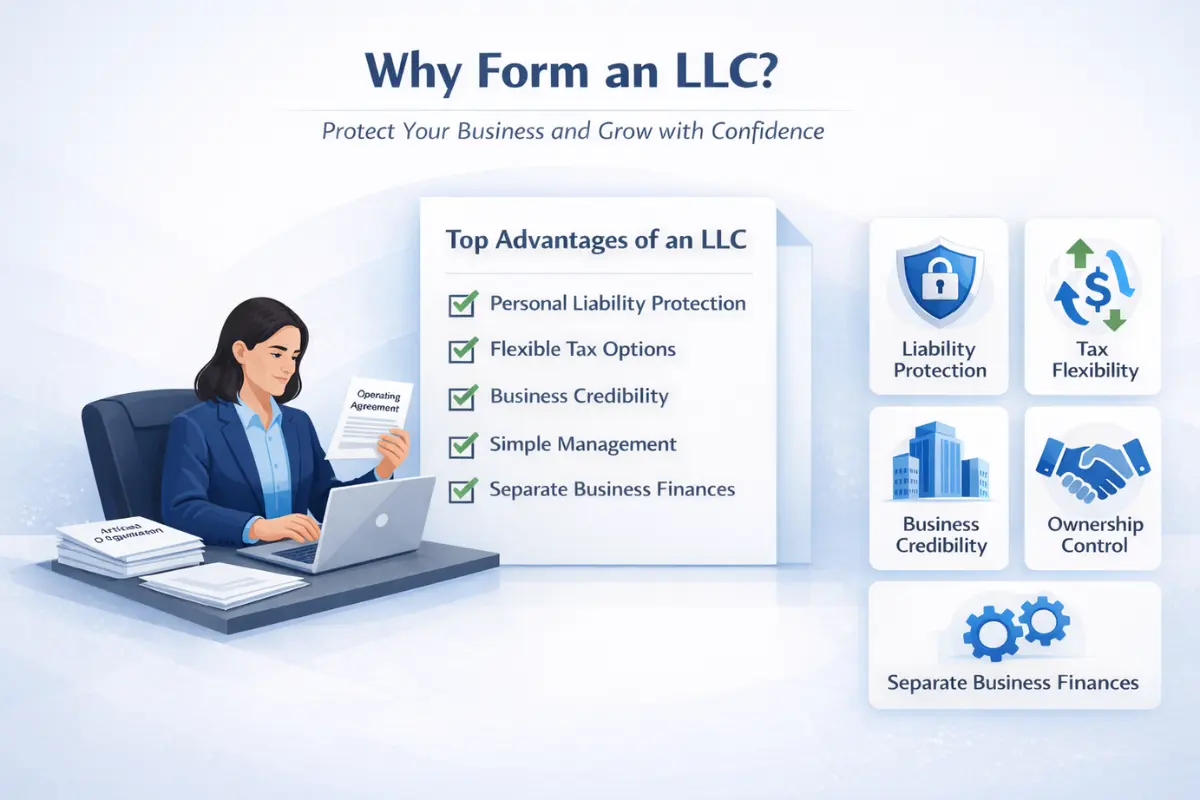
An LLC creates a separate legal entity, helping shield your personal savings, home, and other assets from most business debts and lawsuits.
-
LLCs generally offer limited liability protection that sole proprietorships and general partnerships do not, reducing your personal risk exposure.
-
By default, LLCs use pass-through taxation, so profits and losses flow to the owners’ personal tax returns and can avoid double taxation.
-
Owners can choose how the LLC is taxed (disregarded entity, partnership, S-corp, or C-corp), allowing flexibility to optimize for changing income levels and growth.
-
LLCs support flexible management structures, letting owners choose member-managed or manager-managed setups that match how they actually run the business.
-
Formation and ongoing compliance are typically simpler and involve less paperwork than corporations, which helps new business owners stay in good standing with fewer formalities.
-
Perpetual existence and clear succession options help keep the business running smoothly through ownership changes, retirements, or inheritances.
-
LLC status and having “LLC” in your business name can enhance credibility with customers, vendors, lenders, and potential partners.
-
LLCs allow customized profit distributions that don’t have to strictly follow ownership percentages, which can reflect differences in capital, effort, or expertise.
-
LLC owners may access a wide range of ordinary business tax deductions (such as operating expenses, home office, travel, and equipment), which can reduce taxable income when properly documented.
Separate Legal Identity
LLCs exist as legally distinct entities separate from their owners. LLC formation benefits include the ability for businesses to own property, enter into contracts, and incur liabilities independently. This separation means that third parties doing business with LLCs must look to the company rather than to individual members to satisfy obligations.
Legal separation enables LLCs to file lawsuits in their own names and be sued as entities. The company can buy, own, and use real or personal property independently. LLCs can make contracts, guarantee obligations, lend money, and invest funds as separate entities. NYC Bar explains that a separate legal identity forms the foundation for liability protection and operational independence.
Small business legal protection begins with this fundamental separation between owner and entity. Personal and business affairs remain distinct, allowing companies to conduct operations without directly involving owners in every transaction. This independence facilitates professional business relationships and establishes clear boundaries between personal and business obligations.
Property ownership through LLCs rather than individuals provides additional protection and organizational clarity. Real estate, equipment, intellectual property, and other assets held in LLC names belong to the entity. This ownership structure simplifies asset management and supports liability separation.
Perpetual Existence
LLCs continue to exist even when ownership changes occur. Member departures, retirements, deaths, or sales of interests don't automatically trigger dissolution. State LLC regulations typically require specific events or member consent for dissolution, rather than automatically terminating upon ownership changes.
Operating agreements can specify continuity provisions ensuring businesses survive ownership transitions. Most states presume perpetual existence unless articles of organization state otherwise. This stability supports long-term planning, contractual commitments, and business development across multiple years or decades.
LLC formation benefits include succession planning flexibility. Businesses can establish procedures for handling ownership transfers without disrupting operations. Articles of amendment allow updating organizational documents as circumstances change while maintaining entity continuity.
Perpetual existence proves particularly valuable for businesses building long-term customer relationships, maintaining vendor contracts, or developing intellectual property over extended periods. Customers and partners gain confidence knowing ownership changes won't disrupt service or terminate agreements. This continuity supports brand building and relationship development.
Free Transferability of Financial Interests
LLC members can transfer financial interests without dissolving the company. While management rights typically require the consent of other members to transfer, financial rights are personal property that can be freely assigned under most state laws. Operating agreements may modify default transfer rules to suit specific business needs.
Membership interests include both financial components and management rights. Financial rights encompass profit sharing, loss allocation, and distribution receipt. These economic interests can be transferred independently of management participation rights. This separation allows investors to exit financially while preserving operational continuity.
Multi-member LLC management remains stable when financial interests change hands. New financial interest holders receive economic benefits without automatically gaining management authority. This separation facilitates investment while protecting operational control and preventing unwanted management interference.
Charging order protection further enhances transferability benefits. When members face personal creditors, charging orders typically allow creditors to receive distributions but prevent them from obtaining management rights or forcing LLC dissolution. This protection shields both the business and other members from individual members' personal financial difficulties.
Limited Personal Liability Protection
LLC liability protection advantages shield members' personal assets from business debts and lawsuits. Members risk only their LLC investments, not their personal savings, homes, or other assets. Delaware Business Litigation discusses how LLCs provide substantially greater protection than sole proprietorships.
Liability shield for business owners prevents creditors from pursuing personal assets to satisfy business obligations. Courts generally maintain separation between LLC debts and member property. This protection is particularly valuable for businesses that involve inherent risks, such as manufacturing, consulting, or service provision.
LLC vs sole proprietorship benefits become apparent during legal disputes. Sole proprietors face unlimited personal liability while LLC members enjoy statutory protection. Common situations that demonstrate the importance of liability include contract disputes, customer injury claims, and vendor payment disagreements.
Flexible Management Structure
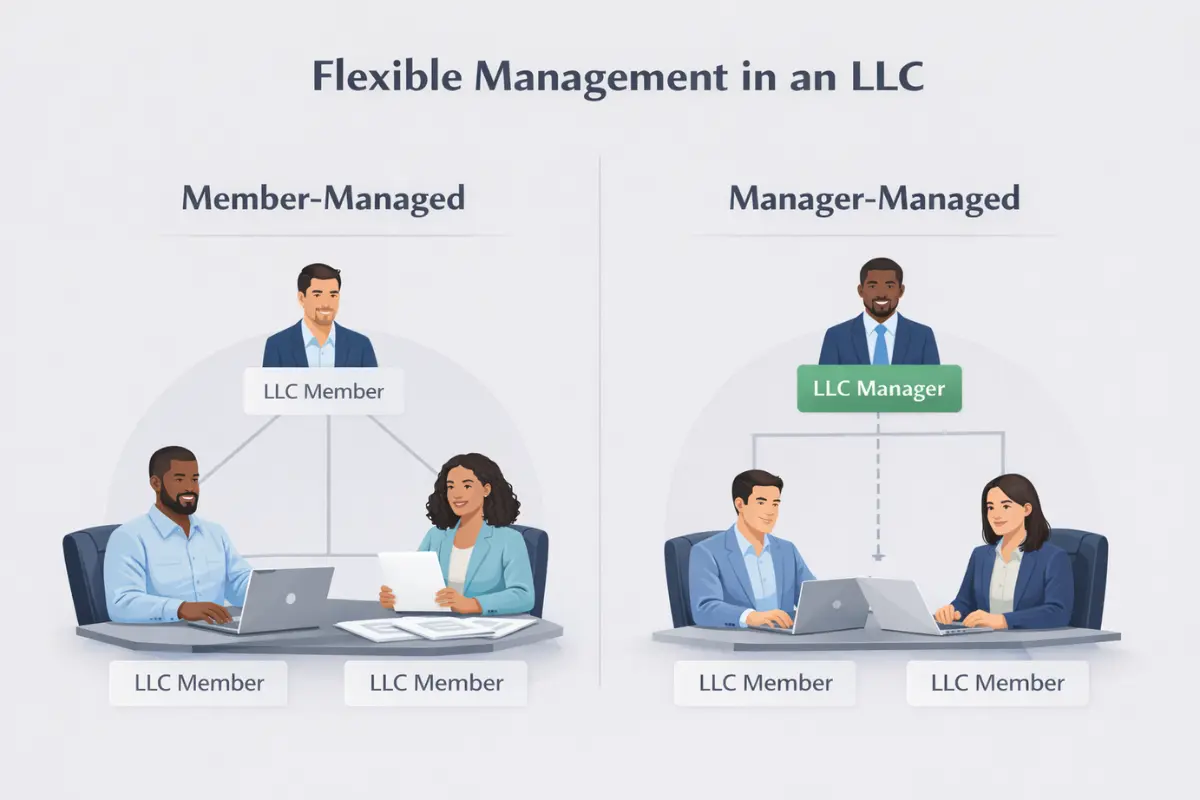
LLCs offer more flexible management structures than corporations' rigid structures. Single-member LLCs are owned by one person who makes all decisions. Multi-member LLCs can choose member-managed or manager-managed structures.
Operating flexibility in LLC structures allows members to customize decision-making processes. Member-managed LLCs give all owners management authority. Manager-managed LLCs designate specific individuals to handle daily operations while other members remain passive investors.
Multi-member LLC benefits include the ability to choose management approaches that match members' involvement levels and expertise. Operating agreements specify voting rights, approval thresholds, and the distribution of authority. This flexibility accommodates various business models and ownership preferences.
Pass-Through Taxation
Pass-through taxation for LLCs means business income flows directly to members' personal tax returns. The IRS doesn't tax LLCs at the entity level by default. Instead, members report their profit shares on individual returns, avoiding corporate double taxation.
Tax advantages of LLCs for small businesses include the ability to choose a tax structure. Single-member LLCs default to sole proprietorship taxation. Multi-member LLCs default to partnership taxation. LLCs can elect S-corporation or C-corporation taxation if beneficial.
Why choose an LLC for your startup often relates to tax flexibility. Startups can begin with pass-through taxation and elect corporate treatment as circumstances change. Tax implications vary based on business income levels and member tax situations.
Ease of Formation and Compliance
LLC compliance requirements prove simpler than corporate formalities. LLCs avoid mandatory annual shareholder meetings, board of directors meetings, and extensive corporate minutes. LLC vs Corporation comparison reveals significantly reduced administrative burdens for LLC operations.
Formation involves filing articles of organization with state agencies and paying filing fees. Most states require minimal information: business name, registered agent, member names, and business purpose. Processing typically takes days to weeks, depending on state procedures.
Ongoing compliance includes annual reports in most states, maintaining good standing, and keeping operating agreements current. Benefits of forming an LLC for new business owners include avoiding complex corporate governance requirements while maintaining a professional structure.
Credibility With Customers and Partners
LLC designation enhances business credibility and professionalism. Having "LLC" in a company name signals a formal business structure to customers, vendors, and potential partners. This perception proves valuable when negotiating contracts, establishing vendor relationships, or seeking investment opportunities.
Financial institutions and suppliers often prefer working with formal entities rather than sole proprietorships. LLCs demonstrate commitment and organization that sole proprietorships lack. Banks view LLCs as more stable when considering business loans or credit lines. Professional credibility facilitates relationship-building and access to opportunities across multiple business contexts.
Limited liability company advantages extend beyond legal protection to marketplace perception. Customers associate LLCs with established, serious businesses. This credibility supports marketing efforts and competitive positioning, particularly when competing against larger, established companies.
Government contracts, corporate partnerships, and wholesale relationships frequently require formal business structures. Many organizations restrict vendor relationships to incorporated or LLC entities. Forming an LLC opens doors to opportunities unavailable to sole proprietors, expanding potential revenue sources and growth pathways.

Flexible Profit Distribution
LLCs can distribute profits disproportionate to ownership percentages. Operating agreements specify allocation methods matching member contributions, roles, or other factors. Capital contributions don't necessarily determine distribution ratios.
Multi-member LLC benefits include the ability to reward active members differently from passive investors. Businesses can structure distributions to recognize different forms of contribution: capital, labor, expertise, or relationships. This flexibility accommodates complex ownership arrangements.
Customized profit sharing through operating agreements allows for adaptation to changing circumstances. Members can adjust distributions as roles evolve or business needs shift. Flexibility prevents rigid allocation structures from limiting business development.
Potential Tax Deductions and Benefits
Tax deductions for LLCs include ordinary business expenses, reducing taxable income. Common deductions encompass home office expenses, vehicle use, business equipment, supplies, professional services, insurance premiums, and employee wages.
Tax deductions for LLCs extend to travel expenses, marketing costs, education related to business operations, and retirement plan contributions. Proper documentation and expense categorization maximize the benefits of deductions. Forbes discusses protecting business interests through proper documentation.
Benefits of forming an LLC for new business owners include accessing business tax treatment unavailable to non-entity operations. Professional tax guidance helps identify all applicable deductions and optimize tax strategies. Systematic expense tracking ensures deduction substantiation.
How InCorp Can Help With LLC Formation and Compliance
InCorp simplifies the realization of LLC formation benefits through comprehensive formation services, ongoing compliance support, and professional guidance. Registered agent services ensure businesses receive important state correspondence reliably.
Formation assistance includes preparing and filing articles of organization, obtaining employer identification numbers, and creating operating agreements. Professional support reduces errors that cause processing delays or compliance problems. Systematic approaches ensure completeness and accuracy.
Modern entrepreneurs benefit from streamlined formation processes and ongoing compliance management. Contact InCorp to explore LLC formation and compliance services supporting your business goals.
FAQ's
What is an LLC, and how does it differ from a sole proprietorship?
An LLC, or Limited Liability Company, is a business structure that provides personal liability protection to owners (members). Unlike a sole proprietorship, members' personal assets are generally protected from business debts and legal claims. LLCs also offer tax flexibility and enhanced credibility.
Do I have to pay separate taxes as an LLC?
LLCs offer flexibility in taxation. By default, single-member LLCs are taxed like sole proprietorships, and multi-member LLCs like partnerships. You can also elect to be taxed as a corporation (S-Corp or C-Corp) to optimize tax benefits based on your situation.
How does forming an LLC protect my personal assets?
LLCs legally separate your business from your personal finances. This means that creditors can pursue the business's assets, but in most cases, your personal savings, home, and other personal property remain protected from business liabilities.
Can an LLC have multiple owners?
Yes. LLCs can have one owner (single-member LLC) or multiple owners (multi-member LLC), making it suitable for solo entrepreneurs and partnerships alike. Multi-member LLCs offer flexible management and profit distribution options.
Are there annual requirements or fees for an LLC?
Yes, most states require annual reports and fees to keep the LLC in good standing. The exact requirements and costs vary by state. Compliance obligations typically include filing annual reports and maintaining a registered agent.
Can an LLC help reduce my self-employment tax burden?
LLC owners are generally subject to self-employment taxes on business income when the LLC is taxed as a sole proprietorship (single member LLC) or partnership (multi member LLC). However, one of the key advantages and tax benefits of an LLC structure is tax flexibility: you may elect S corporation status so that only reasonable compensation is subject to self-employment tax while remaining profits may be treated as distributions. This tax treatment can reduce self-employment taxes for some small business owners, but it must be balanced against payroll, compliance, and corporate tax filing requirements.
What are the main tax advantages of an LLC compared to a sole proprietorship?
Unlike a sole proprietorship, an LLC offers flexible tax options and potential tax savings while still using pass through taxation in many cases. By default, profits and losses pass through to the owners' personal tax return, avoiding double taxation that can apply to C corporations, and owners pay federal income taxes on their share of business income. LLCs can also choose to be taxed as an S corporation or C corporation if that better aligns with their business operations, growth plans, and overall tax strategy.
Does an LLC help me build business credit and qualify for business loans?
Because a limited liability company LLC is a distinct business entity with its own business name and EIN, lenders and credit card issuers can evaluate the business separately from your personal credit over time. Opening a business bank account, using a business credit card responsibly, and keeping business finances separate can help build business credit and improve eligibility for business loans. While personal guarantees are common for new small business owners, a strong LLC credit profile may reduce reliance on personal credit and personal liability in the long term.
Why is an LLC operating agreement important for liability and tax treatment?
An LLC operating agreement defines the LLC ownership interests, management structure, profit and loss allocations, and procedures for ownership transfers and major decisions. Clear operating agreement terms help demonstrate that the LLC operates as a real business entity, which supports limited liability protection if the business faces lawsuits or business liabilities. It also clarifies how business profits, tax deductions, and distributions will be reported on owners' personal income and individual income tax returns, helping avoid disputes among members and inconsistencies in tax filing.
Disclaimer: This content is intended for general educational and informational purposes only and does not constitute legal, tax, or accounting advice. Every effort is made to keep the information current and accurate; however, laws, regulations, and guidance can change, and no representation or warranty is given that the content is complete, up to date, or suitable for any particular situation. You should not rely on this material as a substitute for advice from a qualified professional who can consider your specific facts and objectives before you make decisions or take action.
Share This Article:
Stay in the know!
Join our newsletter for special offers.