

A process server appeared at the company's reception desk during a busy client meeting, asking for the CEO by name to deliver lawsuit papers. Three employees and two clients witnessed the delivery. This scenario repeats daily at businesses lacking a Commercial Registered Agent to receive sensitive legal documents privately. Understanding the role and benefits of a Commercial Registered Agent helps businesses maintain compliance, protect owners' privacy, and ensure the professional handling of documents.
Every limited liability company and corporation must designate a registered agent in its state of formation and any state where it qualifies to do business. This agent serves as the entity's official contact for receiving service of process, government correspondence, and legal documents. While businesses can appoint owners or employees as agents, many choose professional registered agent services for operational advantages.
The decision to handle registered agent duties internally or hire a Commercial Registered Agent affects compliance, privacy, and operational efficiency. This guide explores how professional services help businesses manage legal and administrative obligations effectively.

Key Takeaways
-
A Commercial Registered Agent helps businesses meet state requirements by reliably receiving legal and government documents during all standard business hours.
-
Using a Commercial Registered Agent protects owner privacy by keeping personal or home addresses off public records and out of process server visits.
-
Professional agents follow established procedures to log, scan, and forward service of process and official correspondence, reducing the risk of missed deadlines or default judgments.
-
Centralized, multi-state registered agent services simplify compliance for entities operating in several jurisdictions through consistent handling and coordinated support.
-
Digital portals, automated reminders, and continuous agent coverage support long-term good standing and help prevent administrative dissolution due to missed filings or agent lapses.
Reliability During Regular Business Hours
State laws establish LLC registered agent requirements, including maintaining physical presence at designated offices during all standard business hours (typically 9 AM–5 PM weekdays, though definitions vary by state). This requirement exists because courts and state agencies need reliable delivery points for time-sensitive legal documents. Missing even one delivery can trigger serious consequences.
A Commercial Registered Agent consistently meets this availability requirement, allowing business entities to maintain compliance regardless of owners' travel schedules or irregular work hours. Professional agents maintain dedicated staff, ensuring someone qualified receives documents during required hours. Understanding the fundamentals of a registered agent clarifies why this reliability matters for compliance.
Businesses attempting to serve as their own agents face challenges when owners travel, work remotely, or maintain flexible schedules. Even brief absences create compliance risks. Professional agents eliminate these concerns through consistent availability.
Enhanced Privacy for Business Owners
Registered agent privacy protection addresses concerns about personal information appearing in public records. When businesses list owners' home addresses as registered agent addresses, this information becomes publicly accessible through the Secretary of State databases. Anyone can access these records, which can lead to unsolicited mail and potential security concerns.
A Commercial Registered Agent provides a business address listed on public records instead of the owner's residential address. This arrangement helps reduce unwanted mail and prevents home addresses from appearing in searchable public databases. Business owners maintain separation between personal and professional presence while meeting legal requirements.
Privacy benefits extend beyond mail volume. Public record searches that reveal home addresses can raise security concerns for business owners. Professional agent addresses provide necessary public information while protecting the owner's privacy. Understanding what registered agents do helps clarify how agent services protect business interests.
Professional Handling of Service of Process
Service of process handling requires systematic procedures ensuring legal documents receive appropriate attention. Professional agents use established processes to receive, log, scan, and upload documents to secure portals. This systematic approach helps entities stay organized and ensures critical legal notices are not misplaced.
When service documents arrive at business locations without proper procedures, they may reach employees unfamiliar with their importance. Documents can sit in mailrooms, be misdirected, or fail to reach decision-makers promptly. These delays can result in missed response deadlines.
Commercial Registered Agent services implement professional protocols for handling important documents. Upon receiving service, agents immediately scan documents, upload them to client portals, and notify appropriate contacts. This rapid response helps businesses recognize urgent matters and consult legal counsel within required timeframes, which professional document handling supports. While agents forward documents promptly, businesses remain responsible for timely responses—agents are not liable for client inaction after proper notification.

Avoiding Workplace Disruptions
Process servers delivering legal papers directly to business locations can create awkward situations. Clients visiting offices or employees working nearby may witness these deliveries. Such scenarios can damage professional atmospheres and raise questions about business stability.
Having process servers deliver papers to a Commercial Registered Agent office rather than business workplaces prevents these disruptions. Clients and employees remain unaware of legal matters until business owners choose to address them internally. This separation maintains professional environments and allows owners to manage legal matters discreetly.
Compliance Continuity Across Multiple States
Entities expanding into new jurisdictions face unique compliance challenges. Each state requires a registered agent with a physical address in that state. Finding and appointing individual agents in every operating state creates administrative complexity.
A multi-state registered agent provides centralized representation across all operating jurisdictions. Rather than managing separate agents in different states, entities work with a single provider that handles all locations. This centralized approach helps entities manage multi-state presence more efficiently.
Business compliance support improves when single providers coordinate across multiple states. Uniform procedures and integrated document management systems simplify compliance tracking. Guidance on hiring registered agents explains considerations for multi-state operations.
Reduced Risk of Default Judgments
Default judgments occur when defendants fail to respond to lawsuits within the legally required timeframes. Courts may rule against entities simply because they were unaware that legal actions had been filed. These judgments can result in substantial financial penalties or asset seizures.
Timely notification of lawsuits allows entities to respond within the required periods. Commercial Registered Agent services provide prompt delivery of legal documents, helping entities avoid the risk of default judgment. Professional agents immediately notify clients when service documents arrive, ensuring decision-makers are promptly aware of legal actions.
The legal process requires specific response timeframes varying by jurisdiction (typically 20–30 days depending on state and court type). Missing these deadlines can result in default judgments. Professional agents help entities maintain awareness and consult attorneys promptly, supporting timely responses.
Access to Digital Document Storage
Paper document storage creates challenges for businesses managing years of official correspondence. Filing cabinets consume office space, documents can be damaged or lost, and retrieving specific items requires manual searches through physical files. Digital storage addresses these limitations while improving accessibility.
Commercial Registered Agent services typically provide secure online portals where all official documents are scanned and stored. These systems help entities maintain permanent, organized records of important legal and state correspondence. Documents remain accessible regardless of physical location, supporting remote work and multi-location operations.
Digital storage benefits extend beyond convenience. Business filing documents, notices, and legal papers received over the years remain searchable and retrievable. Entities can quickly locate specific documents, share them electronically with attorneys or accountants, and maintain complete records for audit or compliance purposes. Understanding what happens without proper registered agents illustrates the importance of organized document management.
Automated Reminders for State Filings
State compliance requires tracking multiple deadlines for annual reports, franchise tax payments, and other recurring obligations. Each state has different due dates, and requirements vary by entity type—missing deadlines can result in late fees, penalties, or administrative dissolution.
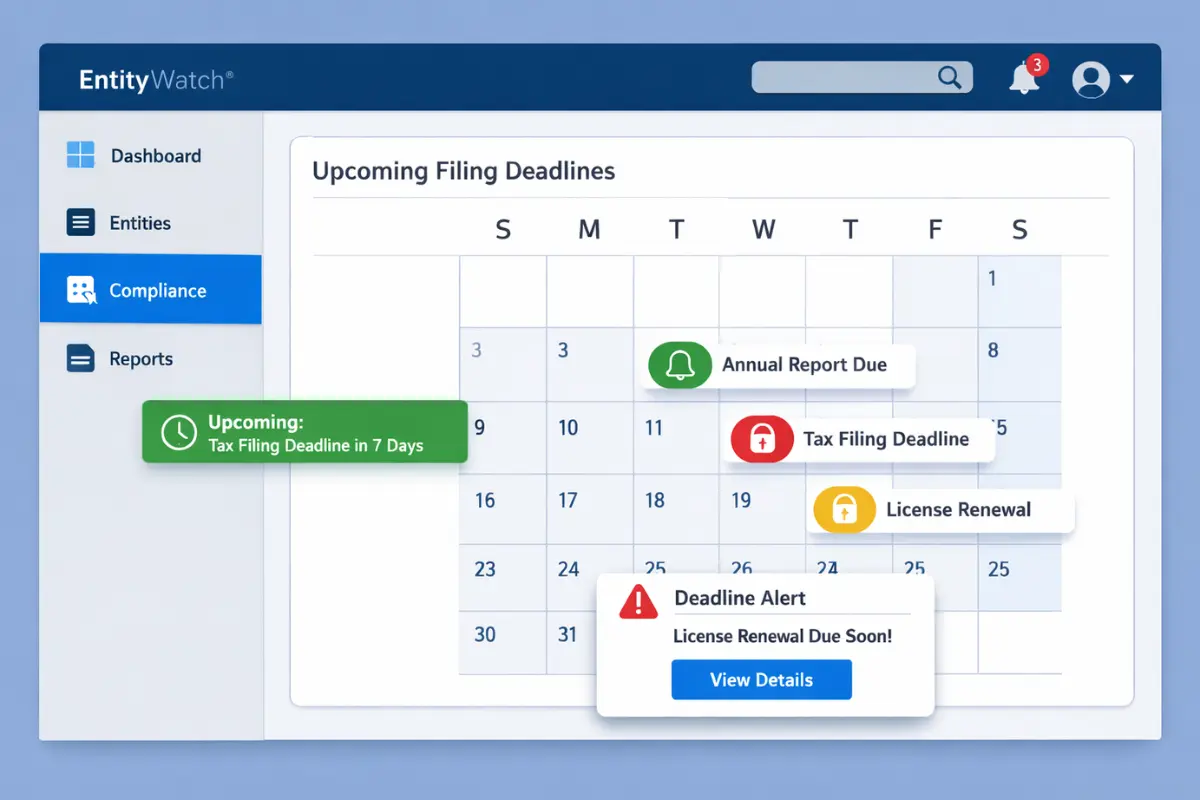
Systems like the EntityWatch compliance system provide automated alerts for upcoming annual report deadlines and other compliance dates. These tools help entities maintain good standing by reducing the likelihood of missed filings. Rather than manually tracking deadlines across multiple jurisdictions, entities receive proactive reminders ensuring timely submission.
Compliance tracking becomes particularly challenging for multi-state operations. Different states assess different fees, require different forms, and impose varying penalties for late submissions. Automated reminder systems help entities stay organized across all jurisdictions, supporting consistent compliance regardless of operational complexity. Registered agent resources explain how professional services support ongoing compliance.
Protection Against Administrative Dissolution
States may administratively dissolve entities failing to maintain required registered agents. When registered agents resign without replacement or entities fail to keep agent information current, states cannot deliver required notices. Administrative dissolution removes an entity's legal status and its right to conduct business in affected jurisdictions.
Consistent Commercial Registered Agent service helps prevent entities from losing legal status through administrative action. Professional agents maintain continuous service, update addresses promptly when relocating offices, and ensure state records remain current. This reliability protects against dissolution triggered by agent-related compliance failures.
Reinstating administratively dissolved entities requires filing applications, paying accumulated fees and penalties, and potentially addressing years of missed compliance obligations. These processes consume time and money while creating legal uncertainties. Understanding agent service changes helps entities avoid situations that could lead to administrative dissolution.
Expertise in State-Specific Requirements
State filing requirements vary significantly across jurisdictions. Forms differ, procedures change, and compliance obligations depend on entity type and business activities. Navigating these variations without guidance creates confusion and increases the risk of error. Mistakes on Articles of Incorporation, annual reports, or other filings can delay processing or trigger rejections.
Commercial Registered Agent services offer a deep understanding of the varying filing requirements across states. This expertise provides entities with reliable information regarding state-specific forms and procedures. Professional agents familiar with Secretary of State processes help entities complete filings correctly, avoiding common mistakes and processing delays.
The Model Registered Agents Act and similar statutes (such as provisions in the Revised Uniform LLC Act) established frameworks that some states adopted for registered agent registration and oversight, though not all states follow these uniformly. Understanding which states follow these provisions and how they implement requirements helps entities comply with jurisdiction-specific rules. Registered agent provider information offers insights into professional service capabilities.
Discover How InCorp Can Support Your Business Compliance
Understanding commercial registered agent benefits helps entities manage legal and administrative obligations more effectively. Professional services provide consistent availability, protect the owner's privacy, ensure documents are handled professionally, and support multi-state compliance. These benefits allow business owners to focus on operations while maintaining confidence in compliance management.
InCorp offers comprehensive registered agent services supported by the Entity Management system with EntityWatch. Our experience across all jurisdictions provides entities with reliable support for their registered agent needs. From initial business filing through ongoing compliance tracking, InCorp helps businesses maintain good standing efficiently.
Professional registered agent services represent practical solutions for businesses seeking reliable compliance support. Whether operating in a single state or managing a multi-state presence, entities benefit from professional expertise, systematic procedures, and dedicated infrastructure that support their legal obligations.
Explore InCorp's registered agent services and discover how professional support can help your entity manage compliance effectively. Contact InCorp to learn more about our services and how we support businesses across all jurisdictions.
FAQs
Can I change my registered agent after forming my company?
Yes. Most states allow businesses to change registered agents at any time by filing simple amendments or statements of change with the Secretary of State. The process typically requires submitting change forms and paying modest filing fees.
Do registered agents provide legal advice?
No. A registered agent's role is administrative. They receive and forward official documents but do not interpret the law or provide legal counsel. Businesses should consult attorneys for legal guidance regarding documents received through registered agents.
Is a registered agent required for nonprofits and foreign entities?
Yes. Nonprofits and out-of-state ("foreign") entities must also appoint a registered agent in each state where they are registered to do business. All business entities that maintain state registrations require designated agents, regardless of their profit status or formation location.
Can one company serve as the registered agent for multiple businesses?
Yes. A Commercial Registered Agent can represent many entities simultaneously, provided each business is properly listed with the state. Professional services routinely serve hundreds or thousands of entities across multiple jurisdictions.
Why do some business owners prefer a commercial registered agent instead of using their home or office address?
Business owners often prefer a professional registered agent service to keep their personal address off public filings, reduce junk mail, and avoid receiving legal papers in front of clients or employees. A commercial registered agent lists its own business address as the registered office address, serving as the public point of contact for legal notices and government correspondence.
Can a registered agent use a P.O. box as the official address?
No. States require registered agents to list a physical street address where someone can be physically present during regular business hours to accept legal documents and government notices. A P.O. box alone does not satisfy the statutory requirement for a designated registered agent's address.
What happens if my registered agent is not available when legal documents are delivered?
If the registered agent is not available during standard business hours or the address is incorrect, legal notices may be considered properly served anyway, and the business might miss critical deadlines. This can lead to default judgments, legal penalties, or loss of good standing, which is why a reliable professional registered agent helps maintain compliance.
How does changing to a new registered agent affect my business's compliance?
When you appoint a new registered agent, you must file the required change form with the state and update the registered agent's name and address on official records. As long as this is done correctly and promptly, the business remains compliant and continues to receive important documents, tax forms, and annual report notices at the new registered office address.
Disclaimer: This content is intended for general educational and informational purposes only and does not constitute legal, tax, or accounting advice. Every effort is made to keep the information current and accurate; however, laws, regulations, and guidance can change, and no representation or warranty is given that the content is complete, up to date, or suitable for any particular situation. You should not rely on this material as a substitute for advice from a qualified professional who can consider your specific facts and objectives before you make decisions or take action.