
How a Multi-Member LLC Supports Structured Business Growth


Two entrepreneurs launching a tech startup divided responsibilities informally. One handled product development while the other managed sales. When a client sued over a service issue, both founders discovered their personal assets were at risk because they operated as a general partnership without formal liability protection. They had never discussed ownership percentages, profit distribution, or decision-making authority. The lack of structure created potential personal liability exposure that threatened their personal finances before they formalized operations as a Multi-Member LLC.
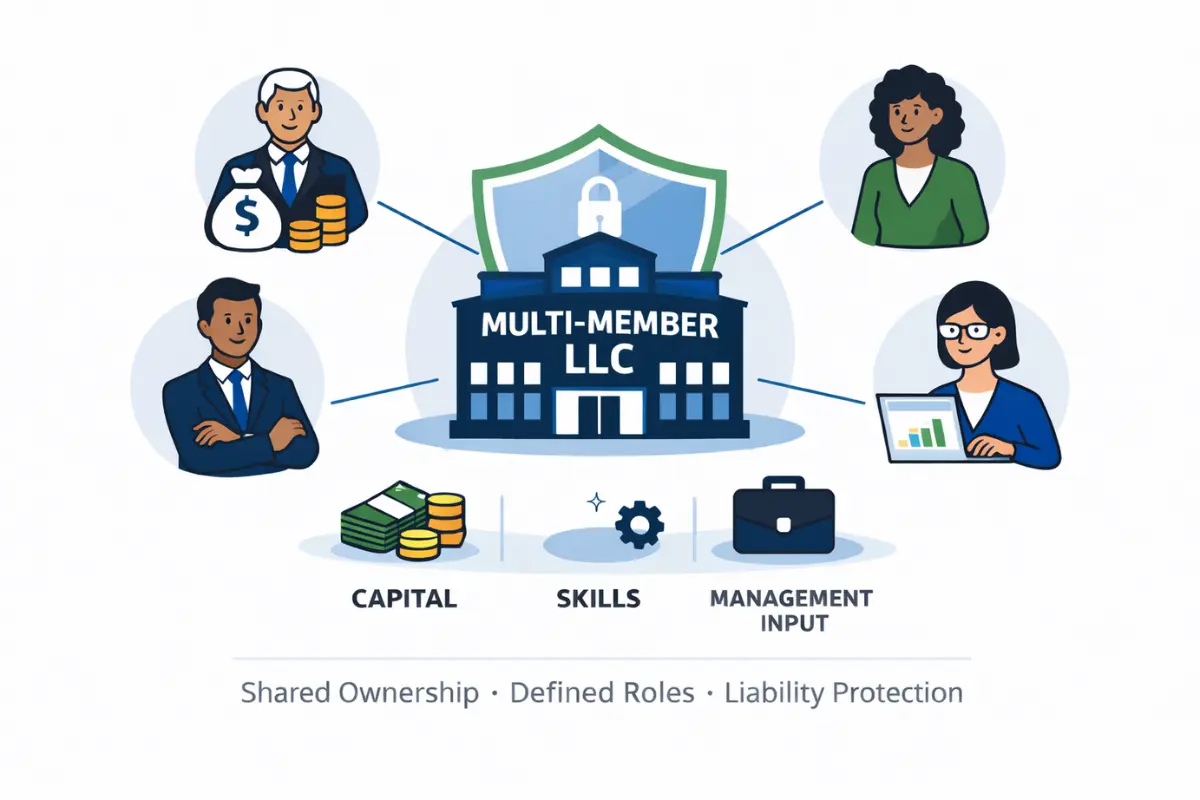
A Multi-Member LLC is a Limited Liability Company with two or more owners, known as members. This structure combines the flexible management style of a partnership with the liability protections of a corporation. For growing businesses, transitioning from single-member setups or general partnerships to MMLLCs facilitates expansion and formalizes internal operations.
Understanding how multi-member structures support growth helps business owners make informed decisions about entity selection. The right structure provides legal protection, operational flexibility, and scalability supporting long-term business objectives. Multiple ownership brings both opportunities and complexities requiring careful consideration.
Key Takeaways
-
A multi-member LLC combines partnership-style flexibility with corporate-style limited liability, helping co-owners move beyond risky informal partnerships toward a formal growth-ready structure.
-
Pooling capital and shared financial responsibility in a multi-member LLC gives businesses stronger funding capacity and can improve how lenders and investors view the venture.
-
Multiple members bring diversified skills, allowing clearer division of roles, shared management duties, and more resilient decision-making than a single owner can usually provide.
-
Multi-member LLCs provide personal asset protection by treating the company as a separate legal entity, shielding members’ personal finances from most business debts and lawsuits when formalities are maintained.
-
Pass-through taxation lets profits and losses flow to each member’s personal tax return by default, while the operating agreement customizes ownership, profit-sharing, voting, and succession rules to support long-term growth.
Aggregation of Capital and Financial Resources
Having multiple members allows entities to pool financial contributions, providing more working capital for growth. A larger capital base improves entities' abilities to fund new projects, purchase equipment, or expand into new markets. Rather than relying on a single owner's financial resources, a multi-member LLC benefits from access to combined capital from all members.
The collective financial strength of multiple members may help businesses secure more favorable terms when seeking traditional financing. Lenders often view multi-member entities as more stable than single-owner operations because multiple parties share financial responsibility and risk. This perception can translate into better interest rates, higher credit limits, or more flexible repayment terms.
Business assets contributed by members can include cash, property, equipment, or intellectual property. Each member's capital contribution determines their ownership stake and profit-sharing rights, unless the operating agreements specify otherwise. Clear documentation of all contributions prevents future disputes about ownership percentages and distribution entitlements.
Diversification of Skills and Expertise
Multiple members bring a variety of professional backgrounds, including marketing, operations, and technical expertise, to the entities. This internal diversity enables more specialized management, helping businesses scale more efficiently than a single owner could alone. Understanding business structures reveals how member diversity creates competitive advantages.
Shared decision-making often leads to more balanced and well-vetted business structures strategies. When members with different perspectives evaluate opportunities or challenges, they identify risks and solutions that single owners might miss. This collaborative approach reduces blind spots and improves the quality of strategic planning.
Members' expertise should complement rather than duplicate one another. Successful MMLLCs often have members whose skills span different business functions. For instance, one might excel in finance, while another excels in marketing or technology. This specialization allows each member to focus on their strengths while trusting others to handle areas outside their expertise.
Shared Management and Operational Responsibility
MMLLCs can distribute daily administrative and operational burdens among members. This structure helps prevent "founder burnout" by ensuring that responsibility for the entity's success does not rest on a single individual. Shared workload allows members to focus on high-level growth initiatives while maintaining steady operational oversight.
Members can divide responsibilities based on skills, interests, or time availability. Some may handle customer relations while others manage finances or product development. Working with business partners requires clear role definitionsto prevent overlap or gaps in important functions for LLCs with multiple ownership structures.
Operating agreement llc documents should specify each member's management responsibilities and decision-making authority. Without clear role definitions, members may duplicate efforts or assume others are handling important tasks. Well-defined responsibilities create accountability and efficient operations.
Asset Protection through Limited Liability
Entities are separate legal persons from their owners. Members' personal assets are generally protected from the debts and legal obligations of LLCs. The SBA explains that llc liability protection helps reduce personal financial risk, provided members maintain proper corporate formalities.
Personal liability protection distinguishes LLCs from general partnerships, sole proprietorships, and limited liability partnerships. In unincorporated businesses, owners face unlimited personal liability. Creditors can pursue their personal assets, such as homes, vehicles, and savings, to satisfy business debts. LLC structure creates legal barriers between business and personal assets.
Protection works both ways. Business creditors typically cannot reach members' personal assets, and members' personal creditors typically cannot reach LLC assets. This separation proves particularly valuable when multiple owners with different personal financial situations share business ownership. One member's personal financial problems do not automatically threaten the business or other members.

Flexibility in Profit and Loss Allocation
MMLLCs are not required to distribute profits according to ownership percentages. Members can decide on custom allocation methods within operating agreements to reward specific contributions or roles. This flexibility allows entities to incentivize members in line with evolving business needs.
Ownership percentages may differ from profit distribution percentages. A member contributing primarily expertise rather than capital might receive larger profit shares than their ownership stake suggests. Another member providing startup capital might receive preferential distributions until their investment is recovered, after which distributions equalize.
Tax implications of profit allocations require careful planning. Even if members do not receive cash distributions, they pay taxes on allocated profits. A tax professional should review allocation arrangements to ensure they comply with IRS regulations and do not create unexpected tax burdens for any members.
Enhanced Credibility with Vendors and Lenders
Multi-member structures often signal more formalized and stable business operations to external parties. Having multiple stakeholders reassures vendors, landlords, and institutional lenders during due diligence. This perceived stability helps entities establish stronger commercial relationships and credit lines.
Vendors may offer better payment terms to multi-member LLCs than to sole proprietorships because multiple owners suggest greater financial stability. Landlords considering commercial lease applications often prefer entities with multiple responsible parties over single-owner businesses. These preferences reflect risk assessments based on ownership structure.
Annual reports and other compliance filings demonstrate the company's ongoing legitimacy. Understanding what registered agents do helps businesses maintain good standing with states, which supports credibility with commercial partners and lenders evaluating creditworthiness.
Facilitating the Addition of New Investors
MMLLC structures are designed to easily admit new members as businesses require more investment. Operating agreements can outline procedures for adding members without dissolving existing entities. This scalability represents key advantages for businesses planning long-term growth and capital rounds.
Adding members to an LLC typically requires approval from existing members and amendments to the operating agreement. New members may purchase interests from existing members, or entities may issue new membership interests, diluting existing members' ownership percentages. Operating agreements should specify these processes clearly before they become necessary.
Investment rounds in LLCs differ from corporate stock issuances but serve similar purposes: raising capital for expansion. Unlike corporations, LLCs cannot issue publicly traded stock, but they can create different membership classes with varying rights and preferences. This flexibility allows for creative deal structures that accommodate investor requirements while protecting founding members' interests.
Continuity and Business Succession Planning
In most states, MMLLCs can continue to exist even if one member leaves, becomes incapacitated, or passes away, provided the operating agreement includes continuity provisions. Operating agreements help manage transitions of ownership interests, preventing forced dissolution of businesses. This continuity provides security for employees, clients, and remaining members during transitions.
LLC succession planning addresses what happens to membership interests when members exit, whether voluntarily or involuntarily. Without clear succession plans, member departures can trigger disputes among remaining members or heirs. Operating agreements should include buy-sell provisions establishing how departing members' interests are valued and purchased.
Continuity provisions benefit businesses with long-term contracts, ongoing client relationships, or significant intellectual property value. Clients and partners want assurance that businesses will continue operating despite ownership changes. Registered agent services help maintain continuity by ensuring businesses remain in good standing during ownership transitions.
Tax Flexibility and "Pass-Through" Advantages
By default, the IRS treats MMLLCs as partnerships for tax purposes, meaning profits "pass through" to members' individual tax returns. Multi-member LLCs file partnership tax returns (Form 1065), while the IRS notes that for comparison, an LLC with only one member is treated as an entity disregarded as separate from its owner, unless it files Form 8832 and elects to be treated as a corporation.
Pass-through taxation for LLCs avoids the double taxation typically associated with C corporations. Corporations pay corporate income tax on profits, then shareholders pay individual income tax on dividends, effectively taxing the same money twice. LLCs avoid this by passing profits directly to members who pay only individual income tax.
Entities can elect S-corp or C-corp tax status if those structures help businesses meet specific financial goals as they grow. S-corp elections can reduce self-employment tax burdens for active members by allowing reasonable salary plus distributions, though the IRS closely scrutinizes salary characterizations, while C-corp elections may benefit businesses retaining substantial profits for reinvestment. Federal income tax planning should involve professional advisors evaluating which tax treatment optimizes overall tax efficiency.

Professional Governance through an Operating Agreement
Comprehensive operating agreements define roles, voting rights, and dispute resolution processes. Having these rules in writing helps maintain internal order and reduces risk of conflict as businesses scale. Clear governance structures help entities remain focused on growth objectives rather than internal administrative disputes.
LLC management structure can be member-managed, where all members participate in daily operations, or manager-managed, where members designate specific individuals to handle management. Manager-managed structures work well when some members are passive investors preferring not to participate in daily decisions. Member-managed structures suit smaller groups where all members actively contribute.
Operating agreements should address meeting procedures, voting thresholds for different decisions, and member withdrawal or expulsion processes. These provisions prevent deadlock situations where members cannot agree on important decisions. Well-drafted agreements anticipate potential conflicts and provide resolution mechanisms, avoiding costly litigation.
Build a Strong Foundation for Growth With the Right LLC Structure
Multi-Member LLC structures provide the foundational support necessary for sustainable business growth and risk management. The combination of liability protection, tax flexibility, and operational scalability makes this structure attractive for businesses with multiple owners planning expansion. Understanding how a business is formed helps entrepreneurs select appropriate structures that support their objectives.
InCorp's registered agent services and EntityWatch® system help multi-member entities stay compliant across all jurisdictions. Professional support ensures businesses maintain good standing while focusing on growth rather than administrative compliance. Filing services help formalize business structures and efficiently manage state requirements.
Contact InCorp to learn how professional services support multi-member LLCs throughout formation and ongoing operations. Proper structure and compliance support protect business investments and position entities for long-term success.
FAQs
Can a Multi-Member LLC operate in more than one state?
Yes. Multi-member LLCs can operate in multiple states, but they usually must register as "foreign LLCs" in each additional state. Foreign qualification requires filing applications with each state's Secretary of State office and maintaining a registered agent presence in every jurisdiction.
Does every member need to be involved in daily operations?
No. Some members may be passive investors, while others handle management duties, depending on the operating agreements. Manager-managed structures specifically accommodate passive members who contribute capital without participating in daily operations.
Can a Multi-Member LLC issue membership certificates?
Some LLCs choose to issue certificates for internal records, but they are not required by law in most states. Certificates serve as evidence of membership interests but do not replace operating agreements or state filing documents establishing ownership.
Can a Multi-Member LLC change its tax classification later?
Yes. LLCs can request different federal tax elections if members decide that another structure better fits their future goals. Changing a classification requires filing the appropriate forms with the IRS and may trigger immediate tax consequences that require professional guidance.
How does a multi-member LLC protect my personal assets from business debts?
A multi-member LLC is treated as a separate legal entity, so business creditors usually can reach only the LLC's business assets, not the members' homes, savings, or other personal assets, as long as personal and business finances stay properly separated and formalities are followed.
How are taxes handled in a multi-member LLC compared with a single-member LLC?
By default, a multi-member LLC is taxed as a partnership: the LLC files Form 1065, and each member reports their share of profits and losses on their personal tax return via Schedule K-1, paying income tax—and often self-employment tax—on that share. In contrast, a single-member LLC is generally treated as a disregarded entity for federal tax purposes unless it elects corporate or S corporation status.
What is the difference between a member-managed and manager-managed multi-member LLC?
In a member-managed LLC, all members participate in day-to-day operations and can bind the company in contracts and decisions, with authority typically tied to the operating agreement and ownership percentages. In a manager-managed LLC, one or more designated managers (who may or may not be members) handle daily business decisions, while non-managing members remain owners but act more like passive investors.
Why is a written operating agreement so important for a multi-member LLC's growth?
A well-drafted operating agreement clarifies ownership percentages, profit distribution, voting rules, and management structure, reducing conflicts as the business grows and more decisions and capital are involved. It also supports limited liability protection by documenting how the LLC is governed, which helps demonstrate that the company is separate from the members' personal affairs.
Does forming a multi-member LLC eliminate the need to keep separate bank accounts and records?
No. Even with limited liability, members must maintain a separate business bank account, keep clean business records, and avoid using LLC funds for personal expenses (or vice versa) to preserve liability protection. Commingling personal and business finances can undermine the LLC's status and increase the risk that a court holds members personally liable for business obligations.
Disclaimer: This content is intended for general educational and informational purposes only and does not constitute legal, tax, or accounting advice. Every effort is made to keep the information current and accurate; however, laws, regulations, and guidance can change, and no representation or warranty is given that the content is complete, up to date, or suitable for any particular situation. You should not rely on this material as a substitute for advice from a qualified professional who can consider your specific facts and objectives before you make decisions or take action.
Share This Article:
Stay in the know!
Join our newsletter for special offers.