

You're finalizing a major contract or filing a critical corporate resolution, and an important question arises: "Should you affix your corporate seal?" For today's business owner, this decision represents more than mere tradition—it's about choosing the right tools to project authority, ensure acceptance of your documents, and protect your business interests. While the legal landscape has evolved, the corporate seal remains a powerful symbol of legitimacy that can open doors and prevent delays in crucial business moments.
This guide cuts through the confusion surrounding corporate seals in today's business environment. We will demystify its role, answer whether your LLC or corporation needs one, benefits from having one, why certain institutions and international partners still expect to see that distinctive mark, and how InCorp's corporate kits provide both the traditional tools and modern compliance solutions you need to operate confidently in any business situation. Because in business, being over-prepared is always better than missing an opportunity.

Key Takeaways
-
Corporate seals are generally optional under modern U.S. law for both corporations and LLCs; an authorized signature is almost always sufficient to execute contracts and resolutions.
-
Despite no broad legal requirement, some banks, government offices, and international partners still expect or prefer sealed documents, so having a seal can prevent delays or extra back‑and‑forth in specific transactions.
-
Seals now function more as a professional and strategic tool than a legal necessity, adding formality and credibility to stock certificates, board resolutions, and high‑value agreements when you choose to use them.
-
Electronic and digital signatures, backed by ESIGN and UETA, carry the same legal weight as handwritten signatures, and in many cases serve as the practical “stamp of authenticity” for modern business documents.
-
Your entity’s legal health depends on compliance and governance—filings, taxes, records, and operating documents—not on whether you own a corporate seal, which should be viewed as a useful supplement, not the foundation of your protection.
When a Corporate Seal Is Still Useful
Most states no longer mandate the use of a corporate seal. However, this traditional tool remains valuable for adding a layer of credibility and authenticity to formal documents. Certain institutions or international partners may still expect a seal as part of their verification process. As highlighted in a guide from Engineer Seal Stamps, using a seal is often a best practice for specific corporate records. While seals are generally optional under modern U.S. law, they can still be useful where a counterparty’s internal policy or the nature of the transaction expects one.
Signing Official Business Agreements
Some third parties, particularly financial institutions, government contracting offices, or international partners, may request a corporate seal on documents. This is not typically a legal requirement but an internal policy. Using a seal in these scenarios demonstrates professionalism and reinforces trust in the agreement.
Issuing Stock Certificates
While electronic records are now common, corporations that issue physical stock certificates often use a corporate seal to authenticate them. This practice signifies the official nature of the document that denotes ownership interests. While not legally mandatory, applying the seal adds an extra layer of formality and helps ensure the certificate's legitimacy in the company's records.
Corporate Resolutions and Board Actions
Applying a corporate seal to board resolutions or meeting minutes symbolizes formal corporate approval. This practice is common for both corporations and Limited Liability Companies (LLCs) when documenting major decisions. Maintaining this tradition can enhance organizational integrity, ensure consistency in your compliance records, clearly separate official entity actions from informal decisions, and reinforce the business's limited liability protection.
Why Institutions Still Value Corporate Seals
Understanding why certain organizations still request corporate seals helps you anticipate when you'll need one:
Banks and Financial Institutions
Traditional banks, especially regional and international institutions, often have legacy policies requiring seals on corporate account documents. Their reasoning: a seal is harder to forge than a signature alone, provides a clear chain of corporate authority, and satisfies their internal audit requirements that haven't been updated to reflect modern law. In reality, many modern U.S. banks rely solely on signatures and resolutions, but some still prefer or request seals for particular account-opening or lending packages.
Government Contracting Offices
Federal and state contracting offices may request seals because their procurement regulations were written when seals were mandatory. Updating these regulations is a slow process, and many agencies prefer to stick with what's familiar rather than risk invalidating contracts on technicalities.
International Partners
In many countries, particularly in Asia and parts of Europe, corporate seals remain legally required. Business partners in these jurisdictions expect seals because in their legal system, an unsealed document may be considered a draft or informal communication rather than a binding corporate commitment. They're not being difficult—they're protecting themselves under their local laws.
Is a Corporate Seal Legally Required?
For the vast majority of businesses in the United States, the answer is no. Modern state laws have clearly settled the corporate seal vs signature debate in favor of the signature. The signature of an authorized officer is now legally sufficient for executing contracts, resolutions, and other formal documents.
This principle holds true across most business structures, including Limited Liability Companies (LLCs), S Corporations, and C corporations. The legal standing of your entity depends on proper formation and adherence to formalities, such as having a robust operating agreement, not on possessing a physical stamp. Under the current Model Business Corporation Act, which many states follow, a document “may but need not” contain a corporate seal, meaning that seals are entirely discretionary and their absence does not affect a document’s validity. While specific company seal requirements can vary slightly by jurisdiction, the prevailing trend is that proper documentation and authorized signatures ensure compliance.
Modern Alternatives to a Corporate Seal
Modern technology and evolving business laws have transformed the corporate seal from a functional necessity to a largely symbolic artifact. Today, secure digital solutions provide greater efficiency and security while maintaining full legal validity. InCorp specializes in providing modern document management solutions that effectively replace the need for physical seals, offering enhanced security and convenience for your business.
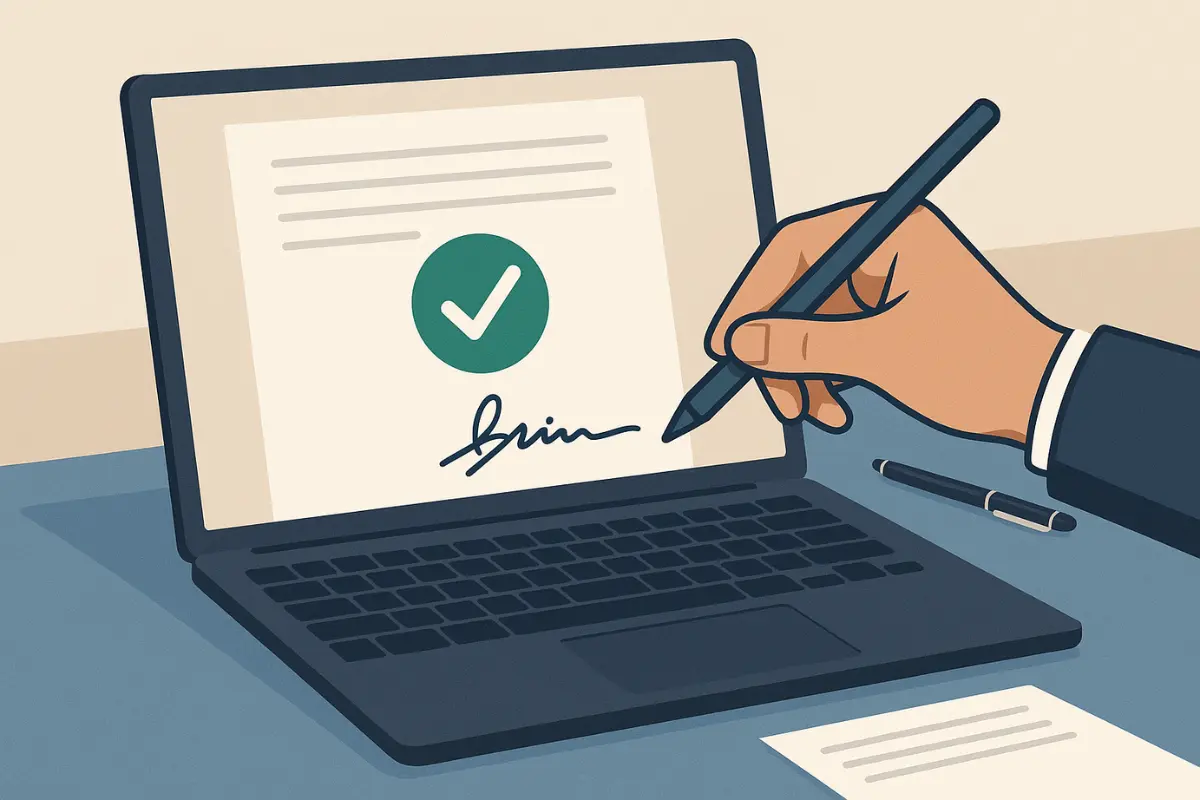
Digital Signatures and Online Filings
Electronic signatures have become a legally recognized method for approving corporate documents, carrying the same weight as traditional handwritten signatures. The Cybersecurity and Infrastructure Security Agency (CISA) confirms that digital signatures provide enhanced security through cryptographic validation, ensuring document integrity and signer authentication.
These tools, combined with state-mandated online filing systems, streamline operations and enable faster, paperless compliance across state lines, making them the new standard for electronic document authentication. In practical terms, these secure digital protocols serve a similar role to the traditional seal by evidencing identity and approval, even though statutes treat them as signatures rather than “corporate seals” in the technical sense.
Compliance Record-keeping and Verification Tools
Cloud-based platforms and compliance dashboards have revolutionized corporate record-keeping by maintaining accurate, timestamped business records that create an immutable audit trail. InCorp's entity management system serves as this centralized compliance dashboard, helping businesses track critical business licensing, filings, renewal deadlines, and document verifications securely and efficiently. This modern approach to business compliance tools provides far greater reliability and accessibility than traditional physical record books and seals, ensuring your business maintains proper corporate formality with digital precision.
Why Smart Businesses Still Choose Corporate Seals
While the legal landscape has evolved, savvy business owners recognize that corporate seals offer strategic advantages beyond mere compliance. Here's why many successful companies still maintain this traditional tool:
Professional Prestige and First Impressions
A corporate seal signals established business practices and attention to detail. When dealing with traditional industries, established financial institutions, or conservative partners, having and using a seal demonstrates your commitment to corporate formalities. It's comparable to maintaining professional business cards in our digital age—not strictly necessary, but a mark of thoroughness and professionalism.
International Business Advantages
Many international jurisdictions still expect or require sealed documents. If your business has international aspirations—whether opening foreign bank accounts, establishing overseas subsidiaries, or entering into cross-border contracts—having a corporate seal ready prevents delays and confusion. Countries throughout Asia, Europe, and Latin America often view unsealed corporate documents with skepticism.
The "Belt and Suspenders" Compliance Approach
For the modest investment, a corporate seal provides an extra layer of authentication that can prevent disputes about document validity. While a signature is legally sufficient, combining a signature with a seal creates multiple verification points—particularly valuable for high-stakes documents like major acquisitions, real estate transactions, or significant corporate restructuring.
Organizational Ceremony and Culture
Using a corporate seal for major milestones—executing your first major contract, issuing founder shares, or documenting pivotal board decisions—creates memorable moments that reinforce your company's legitimacy. This ceremonial aspect can be particularly meaningful for startups transitioning into established businesses.
How to Obtain a Corporate Seal
If you determine that a corporate seal is necessary for your specific circumstances, or if you want one for traditional purposes, obtaining one is straightforward. You can order a seal from various online vendors or legal stationery companies. The process usually involves providing your company’s legal name, state of formation, and date of incorporation. The vendor will then create a customized stamp, often showing the company name, formation state, and year. Many companies choose a two-part seal set: an embosser for paper documents and an ink stamp for faster impressions.
While a seal is optional, maintaining organized corporate records is not. InCorp can assist with corporate kits, record books, and comprehensive entity management to ensure your business remains compliant and organized, whether or not it has a physical seal. This ensures that even if you choose to maintain a seal for specific purposes, your overall compliance strategy is modern, efficient, and secure.
InCorp's Complete Corporate Kit Advantage
When you order through InCorp, you're not just getting a seal—you're getting a corporate organization system. Our professional corporate kit includes both embosser and ink stamp options, a leather-bound binder for organizing critical documents, pre-printed stock certificates with transfer ledger, and templates for corporate bylaws and operating agreements. This comprehensive kit ensures you're prepared for any situation where traditional corporate formalities might give you an advantage, while our digital entity management system handles your modern compliance needs.
Why Compliance Still Matters — With or Without a Seal
The central takeaway is that compliance, not the possession of a seal, determines your business's legal standing and health. A corporate seal does not keep your entity in good standing; diligent adherence to state requirements does. This includes filing annual reports, maintaining a registered agent, and paying franchise taxes on time. Failure to do so can result in penalties, loss of limited liability protection, and even administrative dissolution.
Proper governance is what protects your business from piercing the corporate veil, not an embossed stamp on a piece of paper. For an S corporation, this also means adhering to specific IRS rules to avoid potential double taxation and understanding the tax implications of your business decisions, such as how distributions might be treated compared to salary. Because tax consequences are highly fact-specific, complex events like selling appreciated assets or planning distributions should be reviewed with a qualified tax professional rather than relying on general rules. Similarly, for an LLC, having a robust operating agreement is far more important than a seal for defining member roles, profit-sharing, and procedures. Ultimately, your focus should be on maintaining a legally sound operation, built on timely actions and accurate records, not on symbolic artifacts. These formalities are what legally separate your company from its owners, a critical distinction that a sole proprietorship does not provide.
The Strategic Choice
Think of a corporate seal as business insurance—an investment you hope you'll rarely need but will appreciate having when the situation arises. For less than the cost of a business lunch, you eliminate any possibility of delayed transactions or questioned authority. Combined with InCorp's modern compliance tools, you get the best of both worlds: cutting-edge digital efficiency backed by traditional corporate formality when it matters most.
Stay compliant and confident — InCorp helps ensure your entity remains in good standing.
FAQs
What is a corporate seal used for?
A corporate seal is a traditional stamp or embossing tool used to authenticate formal company documents such as contracts, stock certificates, membership certificates, and board or member resolutions. It serves as an official mark showing that the document was approved as a corporate act by the business.
Is a corporate seal legally required today?
In most states, no. Corporate seals are generally optional, and an authorized officer's or member's signature is sufficient to execute official documents for both corporations and LLCs, so a seal is not usually legally required for document validity.
When might a corporate seal be beneficial for my business?
A corporate seal can be helpful when financial institutions, government offices, or international partners specifically request sealed documents, or when you want an extra layer of formality and authentication for key documents such as major contracts, stock or membership certificates, or high‑value corporate resolutions. It also supports your business's legitimacy with more traditional counterparties and can be used for ceremonial purposes around important milestones.
Can digital signatures replace a corporate seal?
Yes. Electronic signatures and certified online filings are widely accepted and often provide stronger security and audit trails than a physical seal, so in most jurisdictions they replace any historical need for seals on everyday legal documents.
Do you need a corporate seal for an LLC?
No. An LLC does not need a corporate seal, and in most jurisdictions an LLC's documents are fully effective when properly signed by authorized members or managers, making a seal an optional formality rather than a requirement.
Is a corporate seal required by state corporation laws like those in California?
Modern state corporation statutes, including California law, generally allow a corporation to adopt a seal but do not require one, and most state laws treat sealed and unsealed writings the same for legal effect. In practice, that means a properly signed contract or resolution will usually be valid whether or not a corporate seal is affixed.
What is the practical difference between sealed and unsealed documents today?
Historically, sealed instruments carried special weight and sometimes different limitation periods, especially when many people could not read or write. Today, in most U.S. jurisdictions, sealed and unsealed instruments or writings are treated similarly, so unsealed documents that are properly signed and approved can still be fully enforceable.
How does a corporate kit relate to a corporate seal?
A corporate kit typically includes the corporate seal or embossing tool, stock or membership certificates, a minute or record book, and templates for bylaws, operating agreements, and resolutions, giving you a ready system to authenticate important documents and organize key records. Even if the seal itself is largely optional, the kit helps support good governance, clear corporate authority, and clean documentation of corporate acts.
Can I order a corporate seal online, and what information is needed?
Yes. InCorp lets you order a corporate seal online as a standalone MarkMaker® legal embosser or as part of a complete corporate kit that includes the seal, stock certificates, and a professional record book to organize your key documents. You simply provide your company's name, state of formation, and formation year, then choose the format that fits your needs—such as a portable MarkMaker® embosser, a pocket or desk embosser inside an Attache, Prestige, or Legacy legal kit, and optional stock certificates for authenticating ownership records.
How should a business owner decide whether to get a corporate seal?
The decision comes down to how often you expect to handle international transactions, conservative financial institutions, or partners who may still expect sealed documents, and whether you want the extra layer of formality for key documents. For many corporations and LLCs, the seal is largely optional and more about risk management, ceremony, and readiness than about satisfying a strict legal requirement.