

Founders can spend decades building a company and still discover, much later, that the terms governing control were settled long before any boardroom fight began. And Chip Wilson has become a vivid example of that tension. He founded Lululemon in 1998 and built it into one of the most recognized athletic apparel brands on earth, yet recently, he had to fight a months-long proxy battle just to earn two seats on the board of the company he created.
The settlement granted Wilson two board seats in exchange for his agreement to refrain from public criticism of the company for approximately 18 months.
For business formation and governance specialists, including InCorp, disputes like this bring attention back to the early documents founders often sign with growth on their minds, because those papers often define authority before investors and directors reshape the balance of power.
The Lululemon case gives founders a rare public look at how those early decisions follow a company even after the founder's name becomes part of its identity.
"Many founders assume ownership automatically translates into control, but those are two very different things," said Clay Plowman, Executive Vice President at InCorp Services Inc. "The documents created during business formation often determine who ultimately holds decision-making authority years later. By the time a dispute arises, the outcome is frequently shaped more by governance structures than by ownership percentages."

Ownership Does Not Equal Control
Chip Wilson's fight with Lululemon was never really about whether he cared about the company. Few founders remain as publicly invested in a business after stepping away from leadership, and few still hold a stake as large as his. Yet ownership and authority are not the same thing, which is exactly why the dispute became so public in the first place.
Wilson holds roughly 8.7% of the company's outstanding shares, making him its largest individual shareholder, and to most people, that sounds like a lot of power. Yet that stake alone did not give him enough voting power to reshape the board or redirect the brand without a fight.
Lululemon's board called his views "outdated" and pushed shareholders to vote against his nominees, and because Wilson did not control enough votes to override them, he had no path to force changes on his own.
Shares give a founder a financial stake and a voice at annual meetings, but boards hold the authority to hire executives and set a company's direction. And because board seats are decided by votes, those votes are often governed by rules most founders never think to negotiate.
"One of the most common misconceptions we see is founders focusing heavily on equity ownership while paying less attention to governance rights," said Clay Plowman, Executive Vice President at InCorp Services Inc. "Voting structures, board appointment rights, and shareholder agreements can have just as much impact on future control as the percentage of ownership itself."
The Decisions That Outlive the Founder
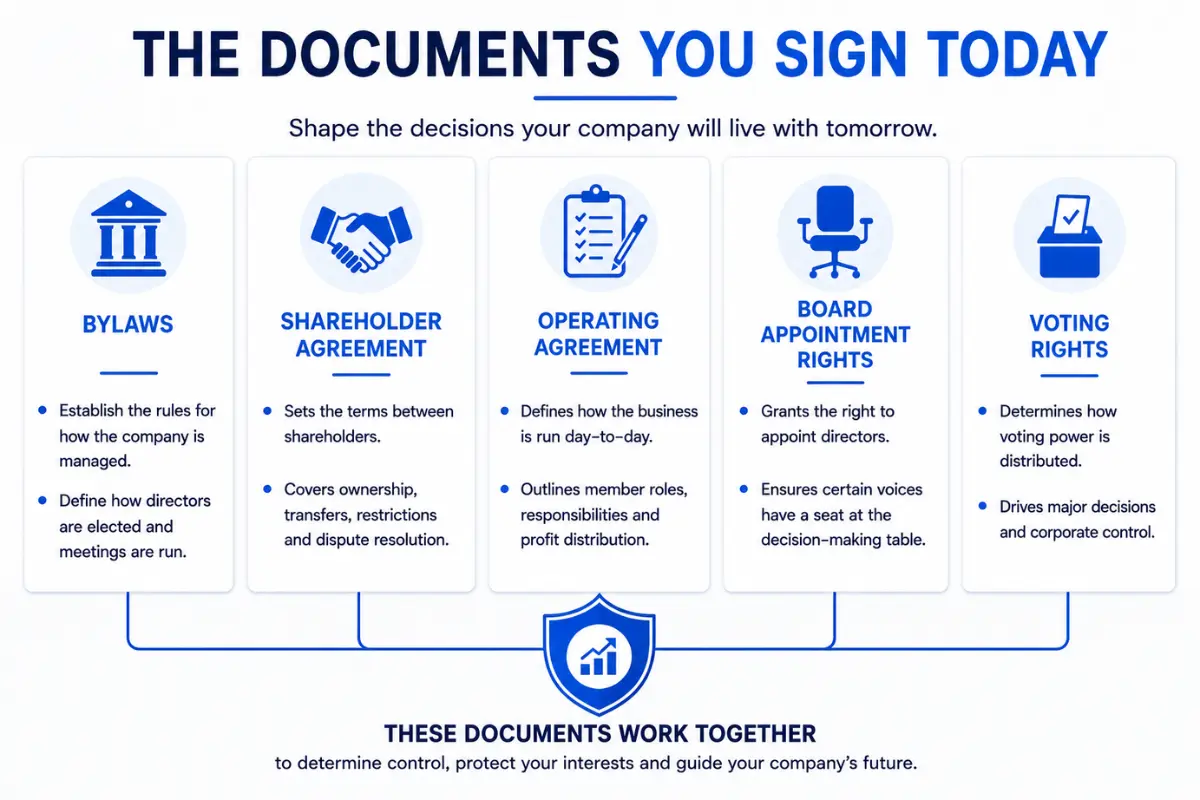
A new company is usually surrounded by paperwork before it has much else going on, and most of those documents get signed with far more attention on building the business than on future control. But those early documents are doing something founders often do not fully understand until much later.
Bylaws establish the ground rules for how a company handles director elections, while shareholder agreements set the terms for what happens when a partner wants out and who gets the first opportunity to buy their stake.
Board nomination rights extend that influence further, giving specific people a guaranteed seat at the decision-making table regardless of how ownership changes over time. Columbia Law School has noted that shareholder agreements are often used to contract over the composition of the board of directors, giving certain investors rights that go beyond ownership alone.
Each of these documents was drafted at a moment when everyone was working toward the same goal, and each one governs the company when interests no longer align. Wilson's recent fight suggests he did not have an automatic path back to Lululemon's board, since he had to run a proxy campaign and reach a settlement to secure representation.
By the time the conflict arrived, the rules were already set, and a public fight became his only realistic way to regain influence.
"Formation documents are often signed during periods of optimism when everyone assumes interests will remain aligned," Plowman explained. "The reality is that businesses evolve, ownership changes, and priorities shift. Strong governance planning helps ensure those future transitions don't become costly conflicts."
Why Tech Founders Often Keep More Control Than Retail Founders
Not every founder ends up where Wilson did, and the reason is not always tied to how successful the business became. Mark Zuckerberg holds roughly 13% of Meta's economic ownership, far less than most people would associate with control. But the shares he holds are not ordinary shares.
They carry 10 votes each, while the shares sold to most public investors carry one. Those voting rights give him roughly 61% of Meta's voting power, making it nearly impossible for outside shareholders to remove him against his will.
Alphabet follows a similar model, with its founder-held shares carrying 10 votes per share while ordinary public shares carry one. Snap went further at its initial public offering, selling public shares that carried no voting rights at all. Those companies built founder control directly into their share structures before public investors arrived.
However, Wilson's position at Lululemon was different. His 8.7% stake carried standard voting rights, the same as any other shareholder, leaving him without the built-in voting power to reshape the board on his own. And once the dispute reached the public stage, the voting structure had already defined the fight.
Most Founder Disputes Never Make Headlines
Most companies never face a proxy fight, and most founders never end up fighting publicly with their own board. But nearly every business eventually reaches a moment of internal conflict, and when it does, the outcome depends almost entirely on what was written down years earlier.
Co-founding partnerships break apart more often than business publications typically cover, and working out who keeps what and at what price gets complicated fast without a written agreement to anchor the process.
Outside investors who came in early often develop very different ideas about a company's direction once growth slows or priorities diverge. And families that inherit a business together rarely agree on who should run it or how profits should move.
"Most governance disputes never attract public attention, but they happen every day in privately held companies," said Clay Plowman, Executive Vice President at InCorp Services Inc. "Whether it's a disagreement between partners, a family-owned business navigating succession, or investors and founders pursuing different priorities, the underlying challenge is usually the same: expectations weren't clearly documented at the outset."
Even a minority partner who finds an outside buyer for their stake creates a different kind of problem entirely when their founding documents give the remaining owners no say over who ends up holding that equity.
Bloomberg Law has noted that disputes like these tend to escalate when founding documents fail to specify ownership percentages or how disagreements should be resolved.
Lululemon made headlines because it is a public company, but the same pressure shows up wherever ownership and control begin to separate. And most founders give these documents very little thought after the day they sign them, leaving many disputes far more complicated once a disagreement forces everyone back to the fine print.
"The best time to address questions about control is before they become problems," Plowman said. "Founders should periodically review their governance documents as the business grows, raises capital, adds partners, or expands into new markets. Decisions made early in a company's lifecycle often carry consequences far beyond the formation stage."
The Future of Corporate Control
Every founder signs their formation documents on a day when everything feels possible, and the partnership feels solid. Those same documents govern the company on the day when none of that is true anymore.
Founders pour enormous energy into building their products and hiring the people who will help them grow, and the early paperwork is seldom the priority. But the operating agreement or corporate bylaws a founder signs decides what happens when a co-founder wants out, and the shareholder agreement decides whether an outside investor gets a say over decisions the founder never intended to share. And those answers are already locked in, years before anyone thinks to ask.
By the time a conflict arrives, most founders have long since forgotten the pages they signed at the very beginning, and formation is the rare moment when founders still have the most say over what those terms will eventually decide.
Disclaimer: This content is intended for general educational and informational purposes only and does not constitute legal, tax, or accounting advice. Every effort is made to keep the information current and accurate; however, laws, regulations, and guidance can change, and no representation or warranty is given that the content is complete, up to date, or suitable for any particular situation. You should not rely on this material as a substitute for advice from a qualified professional who can consider your specific facts and objectives before you make decisions or take action.