

What if a single oversight in your compliance program could result in $16,000 in fines, hours of downtime, and your commercial vehicles sitting idle while your competitors keep moving freight?
Fleet managers face mounting pressure every day. Between managing drivers, maintaining vehicles, and meeting delivery schedules, DOT compliance often feels like a moving target—rules that constantly change, documentation requirements that multiply, and the threat of roadside inspections that can shut down operations without warning.
The truth is that non-compliance doesn't just risk penalties. It jeopardizes your reputation with clients, increases insurance costs, and exposes your business to liability that could threaten everything you've built.
But here's the encouraging news: trucking compliance doesn't have to be overwhelming. With the right systems, knowledge, and support, you can transform compliance from a constant worry into a competitive advantage that protects your business and keeps your fleet running smoothly.
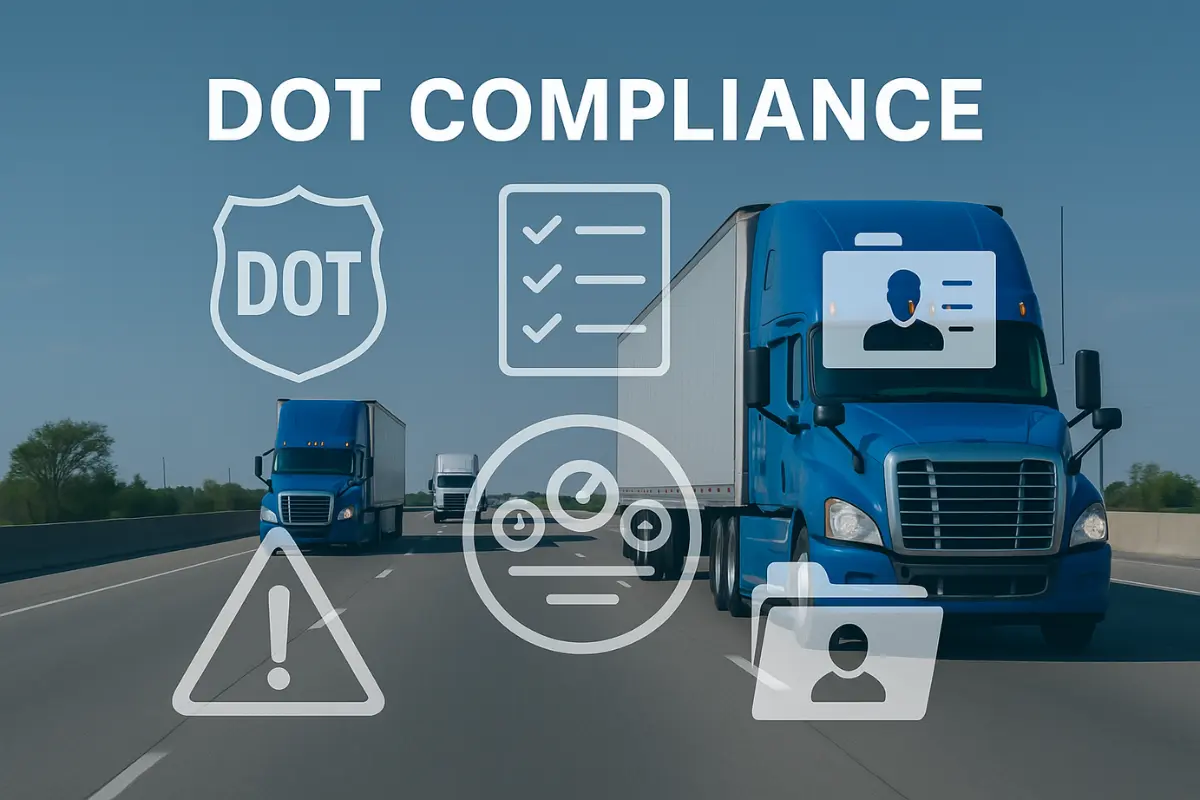
Key Takeaways
DOT compliance protects your business and bottom line: Proper compliance prevents costly fines, reduces accident liability, and keeps your fleet operational without unexpected shutdowns that drain revenue.
Federal and state regulations work together: Understanding both FMCSA federal requirements and your state-specific DOT regulations ensures complete compliance across all jurisdictions where you operate.
Vehicle and driver requirements are equally critical: Compliant vehicles without qualified drivers—or vice versa—still leaves your operation exposed to violations and potential out-of-service orders.
Systematic compliance programs prevent problems: Reactive compliance management leads to violations. Proactive programs with regular audits catch issues before roadside inspections do.
Understanding DOT Compliance
What is DOT Compliance?
DOT compliance represents the comprehensive set of federal and state regulations governing commercial motor vehicle operations. Think of it as the rulebook that keeps commercial trucking safe, accountable, and legally operational across state lines.
These regulations cover everything from vehicle maintenance standards and driver qualification files to hours-of-service logging and drug testing protocols. The Federal Motor Carrier Safety Administration (FMCSA), operating under the Department of Transportation, establishes these baseline requirements to protect drivers, cargo, and the traveling public.
According to the FMCSA, these regulations ensure that commercial motor carriers operate safely and that drivers are qualified and fit to operate commercial vehicles.
Importance of DOT Compliance in Trucking
DOT compliance directly impacts every aspect of your trucking operation, starting with your ability to legally operate commercial vehicles. Without proper USDOT compliance, your fleet can face immediate out-of-service orders that halt operations instantly.
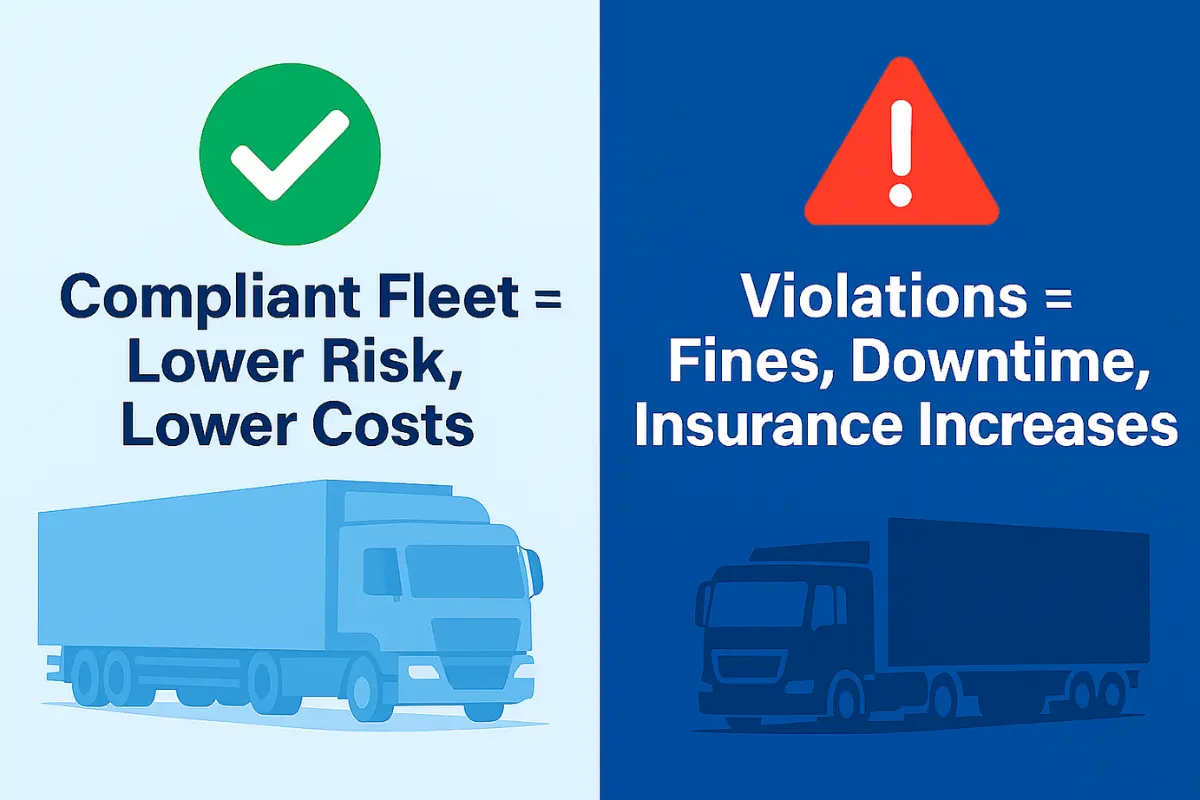
As The Larson Group fleet experts explain, "For fleet managers, maintaining compliance with Department of Transportation (DOT) regulations is more than just a legal obligation—it's a cornerstone of a safe, efficient, and reliable operation. Non-compliance can result in hefty fines, vehicle downtime, and reputational damage, making it essential to stay ahead of changing requirements."
Financial protection ranks among the most tangible benefits. A single serious violation during a roadside inspection can trigger fines ranging from hundreds to tens of thousands of dollars. Patterns of non-compliance lead to increased insurance premiums, lost contracts with major shippers, and potential civil penalties that compound over time.
Safety and liability concerns make compliance non-negotiable. Accidents involving non-compliant vehicles or unqualified drivers expose your company to devastating liability claims. Courts and insurance companies scrutinize compliance records heavily when determining fault and damages.
Your safety rating affects your ability to secure profitable contracts, maintain reasonable insurance rates, and avoid heightened inspection scrutiny that slows operations.
Key DOT Compliance Services
Overview of DOT Compliance Services
Motor carrier compliance services encompass the full spectrum of regulatory support that keeps your fleet legally operational. Professional trucking compliance services typically include DOT number registration and renewal, drug and alcohol testing program administration, driver qualification file management, electronic logging device (ELD) compliance support, vehicle inspection programs, hours-of-service monitoring, accident reporting assistance, and safety audit preparation.
These services transform complex regulatory requirements into manageable systems. Rather than dedicating internal resources to tracking constantly changing regulations, professional compliance support provides expertise that prevents violations before they occur.
The complexity increases significantly based on your specific operation. According to Mike Albert Fleet Solutions Compliance Team, "Requirements vary based on your vehicle and cargo weight, cargo content, number of passengers, and travel locations. If you don't comply thoroughly, correctly, and on time, you expose your business to hefty fines, potential downtime, and increased liability and risk."
Selecting the Right DOT Compliance Company
Choosing DOT compliance services requires evaluating several critical factors that directly impact your operational security.
Industry expertise matters tremendously. Look for providers who specialize in your specific segment—whether that's refrigerated transport, flatbed hauling, tanker operations, or general freight. Each sector faces unique compliance challenges, and specialized knowledge prevents costly mistakes.
Service comprehensiveness determines whether you need multiple vendors or can consolidate compliance support. Full-service providers offering drug testing coordination, driver file management, safety training, and audit support typically deliver better value than piecing together separate services.
Technology integration has become essential as ELDs, telematics, and digital record-keeping replace paper systems. Your compliance partner should seamlessly integrate with your existing fleet management technology.
Building a DOT Compliant Fleet
Vehicle Requirements for DOT Compliance
Your commercial vehicles must meet specific federal standards before legally operating in interstate commerce. These requirements ensure vehicle safety and prevent mechanical failures from causing accidents.
Annual inspections represent the foundation of vehicle compliance. Every commercial motor vehicle requires thorough inspection by qualified inspectors who verify that brakes, lights, tires, steering systems, and other components meet federal safety standards. The inspection generates documentation that must travel with the vehicle and be available during roadside checks.
Ongoing maintenance programs extend beyond annual inspections. Driver vehicle inspection reports (DVIRs) completed before each trip identify defects requiring attention. Your maintenance records must document repairs and demonstrate systematic preventive maintenance.
Vehicle marking requirements mandate that your USDOT number and motor carrier (MC) number appear prominently on both sides of power units. These identifiers allow enforcement officers to immediately access your safety record.
Driver Qualifications and Training
Qualified drivers form the other half of fleet compliance. No matter how compliant your vehicles, unqualified drivers create massive liability and regulatory exposure.
Driver qualification files must contain specific documents proving each driver meets federal standards: a completed driver application, motor vehicle record (MVR) from each state where the driver held licenses in the past three years, previous employer verification, road test certificate or equivalent commercial driver's license, medical examiner's certificate, and annual review of driving record.
Commercial driver's licenses (CDL) with proper endorsements match the vehicle class and cargo type each driver operates. Hazmat endorsements, tanker endorsements, and passenger endorsements each require specific testing and background checks.
Hours-of-service compliance prevents fatigued driving through federally mandated rest periods. Electronic logging devices now track driving time automatically, but fleet managers must monitor logs to prevent violations before they occur.
Drug and alcohol testing programs follow strict protocols including pre-employment testing, random testing, post-accident testing, reasonable suspicion testing, and return-to-duty testing.
Department of Transportation Compliance
Role of the Department of Transportation
The Department of Transportation oversees commercial vehicle safety through various agencies, with the Federal Motor Carrier Safety Administration handling most trucking compliance matters. These agencies develop regulations, conduct inspections and audits, investigate accidents, and maintain the public database tracking each carrier's safety performance.
The FMCSA Safety Measurement System (SMS) scores your performance across multiple categories: unsafe driving, crash indicator, hours-of-service compliance, vehicle maintenance, controlled substances and alcohol, and driver fitness.
Federal vs. State DOT Compliance Regulations
Trucking compliance requires satisfying both federal baseline standards and state-specific requirements that often exceed federal minimums.
Federal regulations apply nationwide to interstate commerce. If your trucks cross state lines, federal DOT compliance through FMCSA regulations is mandatory regardless of where you're based.
State DOT regulations add requirements beyond federal rules. California, New York, and several other states impose stricter environmental standards, additional insurance requirements, and unique permitting needs. The challenge intensifies when you operate across multiple states—you must understand which regulations apply in each jurisdiction.
Implementing a DOT Compliance Program
Steps to Create a DOT Compliance Program
Building a comprehensive compliance program transforms regulatory requirements from reactive headaches into proactive systems that protect your operation.
Start with a compliance assessment identifying gaps between your current practices and regulatory requirements. Review driver qualification files, vehicle maintenance records, drug testing protocols, and hours-of-service monitoring.
Develop written policies covering all major compliance areas. Your policy manual should address driver qualification procedures, vehicle inspection and maintenance programs, hours-of-service requirements, drug and alcohol testing protocols, and accident reporting procedures.
Assign compliance responsibility clearly within your organization. Whether that's a dedicated compliance manager or engaging professional compliance services, someone must own these responsibilities and have authority to enforce standards.
Implement technology solutions that automate compliance tracking. Electronic logging devices, fleet management software, and digital driver qualification file systems reduce administrative burden while improving accuracy.
Auditing and Monitoring Your DOT Compliance
Even well-designed compliance programs drift without systematic monitoring and regular audits that catch problems early.
Internal audits should occur quarterly at minimum. Review driver files, examine vehicle maintenance records, verify drug testing documentation, and analyze hours-of-service patterns. These audits identify problems while you can still correct them internally.
Continuous monitoring systems track real-time compliance metrics. Monitor electronic logging device data, track vehicle inspection due dates, verify driver medical certificate expirations, and review maintenance completion rates.
Conclusion
The Future of Trucking Compliance
Trucking compliance will continue evolving as technology advances and regulatory agencies refine safety programs. Electronic logging devices have already transformed hours-of-service monitoring. Telematics and advanced vehicle systems promise even more automated compliance tracking.
What remains constant is this fundamental truth: compliance protects your business, your drivers, and your future. The fleet managers who view compliance as investment rather than burden build operations that thrive through consistent profitability and manageable insurance costs.
Here's your action plan: Conduct a complete compliance assessment identifying gaps in your current program. Evaluate professional compliance services that can strengthen your weakest areas. Implement systematic monitoring that catches problems before roadside inspections do.
The structure you build today determines whether compliance becomes your operational foundation or your biggest liability.
FAQs
What happens if my fleet fails a DOT compliance audit?
Failing a DOT compliance audit triggers an investigation process where the FMCSA identifies specific violations and assigns a safety rating—often Conditional or Unsatisfactory. You'll face civil penalties and potential operational restrictions. An Unsatisfactory rating can force you to cease interstate operations until you demonstrate corrected compliance.
How often do I need to update driver qualification files?
Driver qualification files require continuous maintenance. You must obtain annual motor vehicle records, conduct annual reviews of each driver's safety performance, and verify medical certificate renewals every 12-24 months. Many fleet managers establish monthly file review schedules ensuring nothing expires unexpectedly.
What are the most common DOT compliance violations?
Hours-of-service violations top the list, including drivers exceeding maximum driving time and improperly logging duty status. Vehicle maintenance violations frequently appear during roadside inspections—brake system defects, tire issues, and expired annual inspections. Driver qualification deficiencies including missing files and expired medical certificates also rank among frequent violations.
Protect Your Business with the Right Foundation
While trucking compliance keeps your fleet moving, the foundation of your entire operation starts with how you structure your business. Many fleet owners and transportation companies operate without realizing that their business structure directly impacts liability protection, tax obligations, and long-term operational security.
Just as DOT compliance protects you on the road, proper business formation protects everything you've built off the road. The right business entity shields your personal assets from business liabilities, optimizes your tax strategy, and demonstrates the professionalism that clients and lenders expect.
Whether you're launching a new trucking operation or restructuring an existing fleet business, choosing the right business formation creates the legal foundation that supports sustainable growth. Contact InCorp today to discover how professional business formation and compliance services protect your assets while positioning your company for long-term success.