

What if a single online filing could unlock your business’s growth in a new state, giving you the legal authority to operate, sign contracts, and build new customer relationships—while overlooking it could result in costly compliance complications like fines, back taxes, or the inability to legally enforce agreements?
Expanding your LLC or corporation across state lines involves more than just entering new markets—it requires complying with a legal process known as foreign qualification.
While the foreign entity registration process may seem complex, learning how to file for foreign qualification online can significantly streamline it.
This guide outlines the steps to navigate the digital filing process, providing a roadmap for business expansion to another state that addresses key state regulations.
Understanding this online business compliance filing is crucial for any LLC or corporation looking to grow.
A key part of this process is appointing a registered agent, which is a different service from foreign qualification or the initial business formation. You can learn more about the distinction in our guide on registered agent vs incorporation service.
Key Takeaways
Foreign qualification is your legal gateway to doing business in states beyond where you originally formed your company—and skipping this step exposes you to fines, back taxes, and unenforceable contracts.
The filing process follows eight essential steps: Start by determining whether your business activities actually trigger registration requirements in the new state. Verify your business name is available, obtain a current Certificate of Good Standing from your home state, and appoint a registered agent in the foreign state. Then complete the online Application for Certificate of Authority, submit required documents with filing fees, and maintain ongoing compliance through annual reports and tax obligations.
Name conflicts can derail your expansion: If another business already uses your exact legal name in the target state, you'll need to file under a fictitious name or DBA to proceed with registration.
A registered agent is non-negotiable: Every foreign-qualified business must maintain a registered agent with a physical address in each state where it operates. Professional registered agent services provide reliability, privacy, and peace of mind that legal documents will be handled properly.
Online filing streamlines the process but isn't universal: While most states now offer digital submission for LLCs and corporations, some still require original signatures, notarizations, or paper filings. Understanding your target state's specific requirements before starting saves time and prevents rejection.
Compliance doesn't end with approval: Foreign qualification creates ongoing obligations including annual reports, franchise taxes, and registered agent maintenance. Missing these deadlines can result in penalties or revocation of your authority to operate in that state.
Professional guidance pays for itself: The complexity of managing different state requirements, forms, and deadlines makes foreign qualification an ideal situation for professional assistance that ensures accurate, timely filing across multiple jurisdictions.
Step 1: Determine Whether You Need to Foreign Qualify
Before filing for foreign qualification, first evaluate whether your business activities in another state actually require registration. Foreign qualification is not necessary for every out-of-state transaction—states generally require it when your business has a substantial and ongoing presence or is “transacting business” within their borders. The general rule is that “transacting business” repeatedly and substantially within the boarders requires it. This is a critical first step in the foreign entity registration process.
Common triggers include:
-
Having a physical office, warehouse, or employees in the state.
-
Accepting orders or conducting sales meetings within the state.
-
Holding significant assets, like real estate or bank accounts, in the state.
-
Maintaining a business bank account or other significant financial relationships in the state.
If activities are minimal, such as attending a trade show or having a website accessible nationwide, a business may not need to complete the process. However, the definition of "transacting business" varies, and when in doubt, Seeking clarification from a trusted professional or regulatory resource can help avoid unnecessary issues. As highlighted in Forbes, operating without proper registration can involve risks, such as paying back taxes for the time when you were doing business without being foreign qualified.
Step 2: Perform a Business Name Availability Check
The legal name of your company—exactly as registered in your home state—may already be taken by another business in the target state. A foreign registration can be rejected if the name is not available, halting your online foreign qualification filing.
Action: Use the target state’s Secretary of State business database online to check whether your exact company name is available. This database search is a primary and essential step handled by the state’s filing office.
-
If Available: A business can often proceed to register under its existing legal name.
-
If Unavailable: You may need to adopt a “fictitious name” or “Doing Business As” (DBA) for use in that state, helping to prevent immediate rejection and keep your filing on track.
This name availability check is an essential step in the foreign qualification registration process.
Step 3: Verify Good Standing in the Home State
The new state often requires proof that your business is legitimate and compliant with the laws where it was originally formed. This document is a Certificate of Existence (also known as a Certificate of Good Standing or Certificate of Status).
-
What it is: An official document from the home state’s filing office confirming the entity is active, has filed all required reports, and paid all necessary fees.
-
How to get it: It can typically be requested online from the home state’s Secretary of State website.
This certificate is often only valid for 30-90 days. Timing the application to ensure the certificate is current when submitted is a critical part of the planning process for a successful foreign qualification.
Important: Research whether your target state demands additional documents, such as original certified formation papers, special business licenses, regulatory approvals, or permits for your industry or profession. Requirements vary widely—omitting these can delay or block approval.
Step 4: Select and Appoint a Registered Agent in the Foreign State
This is a non-negotiable requirement for the foreign entity registration process. When a business operates in a state other than where it was originally formed (its “home” or “domestic” state), that new state is called a “foreign state” for registration purposes. A registered agent is a designated person or company in a foreign state authorized to receive service of process and other legal and state documents on behalf of the business during standard business hours.
-
Who can be one? An individual resident of the state or a commercial registered agent service authorized to do business there.
-
Why a professional service? A service provides a reliable, physical address, ensures documents are handled professionally, and helps maintain privacy. As compliance experts note, a dependable registered agent is a cornerstone of maintaining good standing. Understanding this role and how it differs from other services is a key part of the decision-making process, as detailed in our guide to choosing a registered agent or incorporation service.
Step 5: Complete the Application for a Certificate of Authority Online
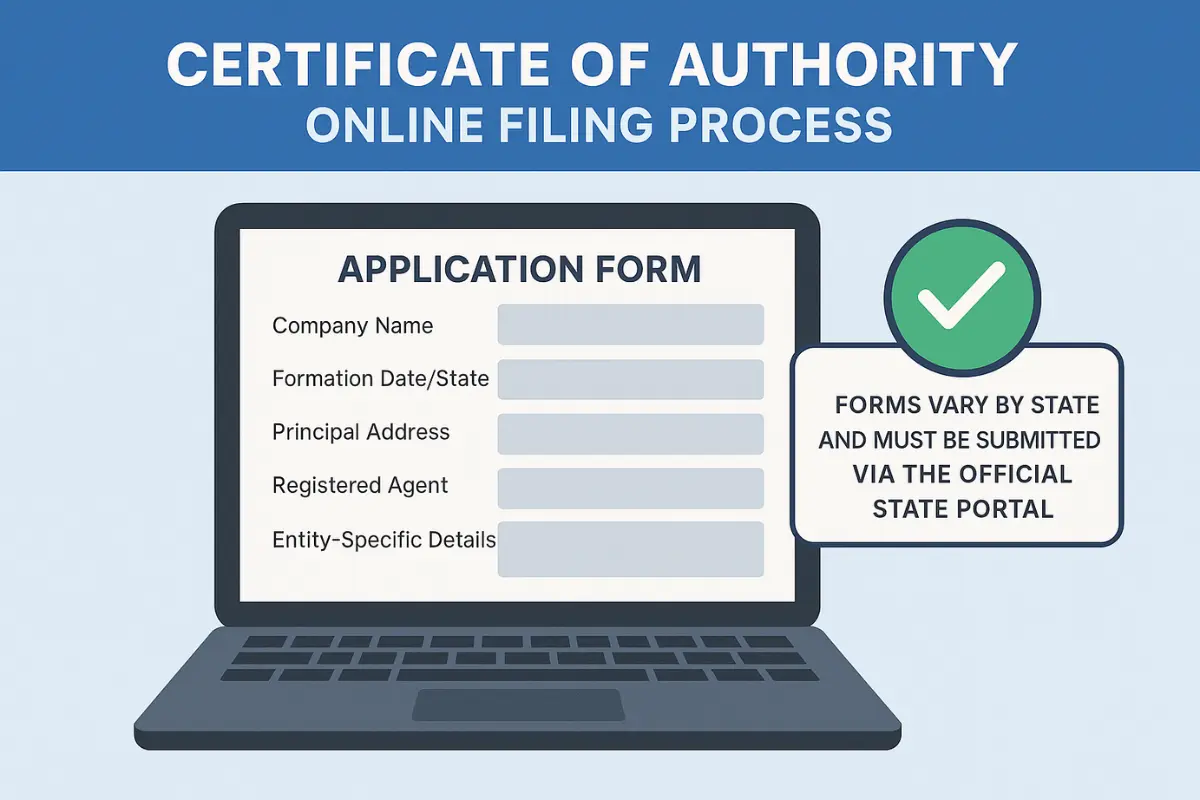
This is the core of the process for anyone looking to understand how to file for foreign qualifications online. Each state has its own specific form, typically called an "Application for Certificate of Authority" or a similar name, which is completed through the state’s official business portal.
Be prepared to provide accurate information, including:
-
The business’s exact legal name and home state.
-
The date of formation and the entity number from your home state.
-
The principal office address.
-
The name and address of your newly appointed registered agent in the foreign state.
-
The business type and purpose.
Accuracy is paramount. Any discrepancy between this form and your home state’s Articles of Organization (for an LLC) or Articles of Incorporation (for a corporation) can cause significant delays or outright rejection of your foreign corporation filing online.
Step 6: Submit Supporting Documents and Pay State Filing Fees
The online form is rarely submitted on its own. You will need to attach digital copies of your supporting documents and pay the required state filing fees to complete the online foreign qualification filing.
-
Required Attachments: This almost always includes your Certificate of Existence from Step 3. Some states may also require a certified copy of your formation documents (Articles of Organization/Incorporation). For other entity types, such as a Certificate of Limited Partnership, similar documentation is required.
-
Filing Fees: Filing fees vary by state and business type and must be paid in full for processing.
-
Expedited Service: If time is critical, many states offer expedited service for an additional fee, reducing processing times from weeks to just a few days.
Step 7: Confirm Approval and Retain Evidence
After submission, the state will process your application. Once approved, they will issue a Certificate of Authority, officially granting your business permission to operate in that state.
-
Timeline: Processing times range from a few days (with expedited service) to several weeks for standard processing.
-
Next Steps: Download and securely save the digital Certificate of Authority. This document is your legal proof of compliance and is essential for opening bank accounts, securing licenses, and other business activities in the new state. Proper document retention guidelines are crucial here.
Step 8: Post-Filing Compliance (Ongoing Requirements)
Filing for foreign qualification is just the beginning. To maintain your legal status, you must meet ongoing obligations. This is where robust entity management systems become valuable for tracking deadlines.
-
Annual Reports: Most states require an annual or biennial report updating your business information.
-
Franchise Taxes: You will likely be subject to annual franchise or privilege taxes in the foreign state. Understanding these tax requirements is essential for budgeting.
-
Registered Agent: You must maintain your registered agent service continuously.
Failure to meet these ongoing tax requirements and filing deadlines can result in penalties, fines, and eventually, the revocation of your authority to do business in that state.
FAQs
How long does it take to get foreign qualification approval?
Approval times vary by state, ranging from a few business days with expedited service to several weeks for standard processing. Online filings are typically processed faster than paper mail submissions.
Can I foreign qualify in multiple states at the same time?
Yes, you can file in multiple states simultaneously. However, each state maintains its own separate filing process, fees, and state regulations. You must complete the application and pay the required fees for each state individually, unless you use a commercial service like InCorp.
What happens if I operate in another state without a foreign qualification?
Operating without authorization can lead to consequences, including penalties, late fees, interest charges, and the inability to file a lawsuit in that state's courts until you come into compliance. It can also negatively impact your company's good standing.
Do all business entities need to file for foreign qualification?
Not always. Sole proprietorships and general partnerships may have different rules. However, LLCs and corporations almost always must file for a Certificate of Authority before conducting business in a new state. The requirements can depend on the business type and the nature of its activities in the state.
What does "foreign qualification" mean for a limited liability company or corporation?
Foreign qualification is the process of registering an LLC or corporation to conduct business in a state other than where it was originally formed. The term "foreign" simply refers to any location outside your home state, not an international jurisdiction.
How do I file for foreign qualification online?
Most states offer an online application process through the Secretary of State or relevant state agency. Requirements can vary; you may need to provide a certificate of good standing from your home state, formation documents, and details about your business activities. Some states still require original signed documents or physical mailings for approval.
If I conduct business in another state, do I automatically have to foreign qualify?
Not always. Each state defines "transact business" or "doing business" differently. Having employees, opening an office, or generating substantial revenue in another state generally requires registration, but limited or isolated activities may not. Consider reviewing local statutes or contacting the appropriate state agency for additional information.
Does registering for foreign qualification mean my company pays state or local sales taxes?
Registration may trigger tax obligations, including sales tax, depending on your business activities in the state. Requirements are determined by each state's tax agency; remote or online sellers should pay particular attention to economic nexus rules.
Is a certificate of good standing required to file for foreign qualification?
Most states request a certificate of good standing or certificate of existence from your home state, typically issued within the preceding 30–90 days. Always check with the state agency for valid document timing and format.
Can non-profit entities file for foreign qualification?
Yes, non-profit entities can register to operate in states outside their formation state. The process may differ from for-profit entities, and certain states require additional forms or approvals specific to non-profits.
What if my legal entity name is unavailable in a new state?
If your LLC, corporation, or non-profit's legal name is already taken, you may need to use a fictitious name or DBA in that state to complete registration and transact business. Name availability can be checked on the state's portal.
Are my corporate records and compliance obligations affected by foreign qualification?
Foreign qualified entities must maintain compliance with ongoing reporting requirements, retain records, and update the state agency about changes (such as office address, registered agent, or business activities) to stay in good standing.
What happens if my business does not properly foreign qualify before operating?
Operating without foreign qualification can result in fines, penalties, back taxes, loss of authority, and potential complications with contract enforcement until registration is complete. Requirements and enforcement procedures are specific to each state.
Do these guidelines apply to every LLC, corporation, or non-profit in all locations?
No. While the general process is similar nationwide, every state has unique requirements for forms, fees, supporting documents, and deadlines. Always review the official instructions provided by each state agency or consult qualified professionals for location-specific compliance.
Start Your Foreign Qualification Filing Online Today!
Navigating foreign qualification can be complex, especially since not every state offers a fully online process for every entity type. While most states now allow online filings for LLCs and corporations, some still require original signed documents, notarizations, or paper submissions—making multi-state business expansion anything but straightforward.
Expanding your business across state lines involves juggling unique requirements, different forms, and varying deadlines. What should be a straightforward process can easily become a paperwork marathon as you coordinate filings in jurisdictions with their own rules.
That’s where professional foreign qualification services can make a real difference. InCorp streamlines the entire process—whether your state supports online filing or still requires traditional paperwork. Our platform guides you from the initial name availability search through every required registration step, simplifying compliance regardless of specific state obstacles.
You’ll have experienced registered agents in all 50 states, helping ensure your business remains compliant.
Ready to expand without the administrative headache? InCorp’s makes foreign qualification filings straightforward and efficient, whether your target state supports online filing or not.