
A Complete Guide to Apostille Services for Corporations and LLCs


A technology company preparing to establish operations in Spain discovered its corporate documents wouldn't be accepted without proper authentication. Articles of incorporation, board resolutions, and good standing certificates all required Apostille Services before Spanish officials would recognize them.
Apostille Services authenticate documents for use in countries that are parties to the 1961 Hague Convention. Globally, more than 11 million electronic apostilles were issued between 2016 and 2020, with annual issuance projected to reach around 5.1 million by 2024, reflecting growing use worldwide.
Understanding when businesses need apostilles and how authentication works helps companies prepare for international transactions.
Key Takeaways
-
Apostille services authenticate U.S. business documents so corporations and LLCs can use them in Hague Convention countries like Spain without additional foreign legalization steps.
-
Companies typically need apostilles for international contracts, opening foreign bank accounts, registering or qualifying abroad, and certain intellectual property filings.
-
Common documents that may need an apostille include articles of incorporation, certificates of good standing, corporate resolutions, powers of attorney, and key contracts.
-
Only originals or certified copies go through the apostille process, and they must be submitted to the correct authority (usually a state Secretary of State or the U.S. Department of State for federal documents).
-
Professional filing providers like InCorp can organize required documents, handle state and federal submissions, and help reduce delays or rejections in the apostille process.
What Are Apostille Services?
An Apostille certificate is an international certification attached to documents destined for Hague Convention member countries. The apostille verifies the authenticity of signatures, the signer's capacity, and the document seals. This corporate document verification enables legal recognition in foreign countries.
Authentication for foreign governments works differently for non-member countries, requiring alternative legalization through consular certification. The destination country determines which authentication type applies.
Apostilles don't certify document contents. They authenticate that signatures and seals are genuine. Notarization vs apostille represents different verification levels.
What is the Purpose of an Apostille
Apostilles enable international document recognition without requiring recipient countries to verify authenticity through diplomatic channels. Business contract authentication streamlines cross-border transactions by providing standardized verification acceptable to Hague Convention members.
Certified document for international use status simplifies compliance with foreign requirements. Countries trust apostilled documents because the Hague Convention establishes uniform authentication standards.
Why Businesses Need Apostille Services
International business operations often require document authentication for acceptance abroad. Foreign business filings often mandate apostilled documentation as proof of corporate status or authorization.
Companies engaging in cross-border activities encounter various situations requiring apostille certification. These scenarios range from banking relationships to intellectual property protection.
International Contracts and Agreements
Many businesses engage in cross-border contracts requiring official recognition abroad. The U.S. Department of State explains that apostilling documents ensures foreign authorities accept them without additional verification.
The apostille process for companies begins with identifying which contracts require authentication based on the destination country's requirements.
Opening Foreign Bank Accounts
Some banks require apostilled documents for international account setup. Corporate resolutions, powers of attorney, and certificates of good standing frequently need authentication before foreign financial institutions accept them.
Financial institutions request apostilled documentation to verify corporate authority. Articles of incorporation and board resolutions may all require apostille certification.
Foreign Incorporation or Expansion
Documents submitted to overseas authorities often need apostille authentication. Foreign qualification processes frequently require apostilled proof of corporate existence and good standing.
Legalization of corporate records through apostilles enables businesses to register in foreign jurisdictions. Certificates of incorporation and good standing typically require apostille certification.
Intellectual Property Filings
Businesses filing patents, trademarks, or copyrights internationally may need apostilled documents. InCorp's trademark services help businesses protect intellectual property, and the U.S. Department of Commerce provides guidance on international IP protection.
LLC apostille requirements for IP filings vary by country. Assignment documents and ownership verification may require apostille certification.
Common Documents That May Require an Apostille
Typical business documents frequently require apostille certification for international use. Business documents that need apostille certification vary by transaction type and destination country.
Documents must be originals or certified copies with proper signatures and seals. Photocopies cannot be apostilled.
Corporate Resolutions and Board Approvals
Resolutions recording key corporate decisions may require apostille certification for foreign recognition. Apostille authentication process for corporate resolutions verifies that board members are properly authorized to take specific actions. Foreign banks and authorities frequently request these authenticated documents.
Board resolutions authorizing international contracts, opening foreign accounts, or overseas expansion typically require apostille certification. The authentication confirms that corporate officers held proper authority when making decisions affecting international operations.
Power of Attorney Documents
Bank of America explains that powers of attorney grant individuals authority to act on behalf of businesses. These documents, in particular, require apostille certification for international legal acceptance when authorizing cross-border activities.
Steps to obtain an apostille for international contracts include preparing properly executed powers of attorney. Foreign institutions rely on authenticated powers when verifying signature authority for international transactions.
Contracts and Agreements
Certain business contracts, such as international sales agreements, partnership agreements, or service contracts, may require apostilles to ensure legal recognition abroad. Contract enforceability in foreign jurisdictions often depends on proper authentication.
International service agreements, distribution contracts, and licensing arrangements benefit from apostille certification. Foreign courts and regulatory authorities examine authenticated contracts when resolving disputes or verifying compliance.
Certificates of Incorporation or Good Standing
Proof of formation or compliance with state law may be needed for foreign registration or transactions. Apostilling these certificates provides official authentication for overseas authorities.
Apostille requirements for foreign business transactions commonly include good-standing certificates. These documents prove businesses maintain an active status and comply with home jurisdiction requirements. Foreign authorities examine apostilled certificates before approving business operations.
How Apostille Services Work for Businesses
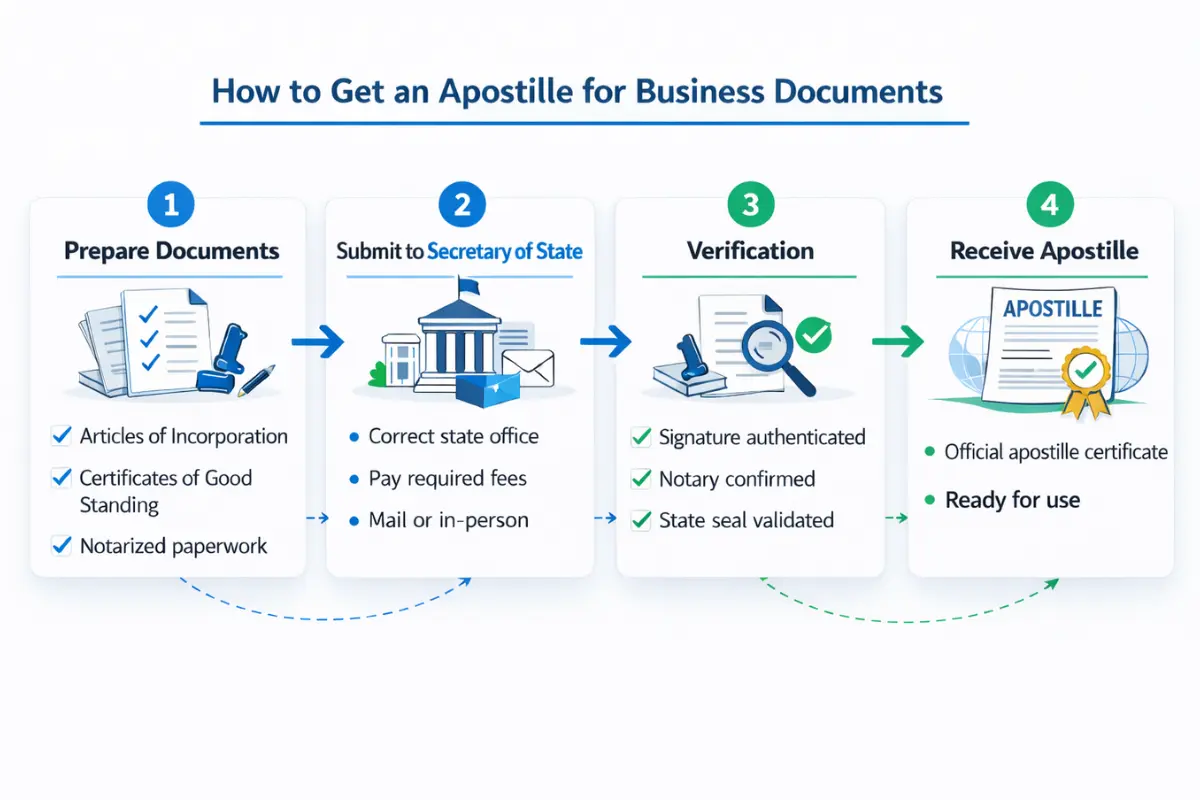
The procedural steps involve document preparation, submission, certification, and delivery. How to get an apostille for business documents requires understanding which authority issues apostilles for specific document types.
State documents receive apostilles from Secretaries of State. Federal documents require certification from the U.S. Department of State.
Document Preparation
Businesses gather all required documents, ensuring they are official, signed, and meet issuing authority standards. Proper preparation reduces processing delays and ensures apostille eligibility. Documents must be originals or certified copies with genuine signatures and seals.
Foreign language documents require certified English translations. Both the original language and English versions need to be notarized before apostille submission. Translation quality affects authentication acceptance.
Submission to Competent Authority
Documents are submitted to the state or federal authority authorized to issue apostilles. Secretary of State offices handle state-level documents while the U.S. Department of State processes federal documents. Submission methods vary by jurisdiction.
Processing times depend on the issuing authority's workload and the complexity of the document. State apostilles generally process faster than federal certifications. Expedited services may be available for urgent needs.
Certification and Authentication
The authority verifies document origin and authenticity, then attaches the apostille certificate. This confirms that documents are recognized under the Hague Convention for use in participating countries. Apostilles include standardized information identifying the signing official and seal.
Verification processes examine signatures against official records and confirm that seals match authorized versions. Proper verification ensures apostille validity in destination countries.
Delivery and Use Abroad
Once apostilled, documents can be submitted to foreign governments, banks, or organizations. They are legally recognized without additional verification in destination countries. Businesses should retain copies of apostilled documents for records.
Foreign authorities accept apostilled documents as authentic without requiring further legalization. This streamlines international transactions and reduces administrative burdens on businesses operating across borders.
How InCorp Helps With Apostille Services
InCorp provides business compliance and filing services, including document preparation support. Apostille services for LLCs and corporations benefit from professional assistance, ensuring accuracy and efficiency. InCorp helps businesses navigate authentication requirements.
Professional services reduce errors in document preparation and submission. Experienced providers understand state-specific and federal requirements, helping businesses avoid common mistakes that delay processing. Administrative support saves time while ensuring proper procedures.
InCorp's compliance expertise extends to document organization and submission coordination. Contact InCorp to explore how professional support streamlines apostille processes for your business documents.
Final Considerations for Businesses Using Apostille Services
Document authentication through apostilles enables international business operations by providing standardized verification. Understanding when apostilles are needed and how the process works helps businesses prepare for cross-border activities. Professional support simplifies authentication procedures.
Businesses should identify document authentication needs early in international planning processes. Advance preparation prevents delays when foreign authorities request apostilled documentation. Systematic approaches to document preparation and submission improve efficiency.
Professional filing services provide procedural benefits without guaranteeing legal outcomes. Businesses remain responsible for determining which documents require apostille certification based on the destination country's requirements and the transaction's purpose.
FAQ's
Which types of business documents commonly require an apostille?
Common documents include corporate resolutions, articles of incorporation, powers of attorney, contracts, and certificates of good standing. The need for an apostille depends on the receiving country's requirements and the specific transaction involved.
How long does the apostille process typically take?
Processing times vary depending on the issuing authority and type of document. State-level apostilles generally take several days to a few weeks, while federal documents can take longer. Using a professional service like InCorp can help streamline submission and tracking.
Can a business submit documents for an apostille on its own?
Yes, businesses can submit documents directly to the appropriate state or federal authority. However, professional services like InCorp can simplify the process, reduce errors, and save time by managing document preparation, submission, and tracking.
Does an apostille certify the contents of a document?
No, an apostille only certifies the authenticity of the signature, the capacity of the person signing, and, where applicable, the seal or stamp on the document. It does not verify the content or legality of the document itself.
Are apostille requirements the same for all countries?
No. Apostilles are recognized only by countries that are part of the Hague Convention. For non-Hague countries, documents may require a different form of legalization, such as consular certification through embassies or the U.S. Department of State.
Do I need separate apostilles for multiple corporate documents going to the same foreign country?
Yes. Each original document (for example, articles of incorporation, corporate bylaws, and certificates of good standing) generally needs its own separate apostille certificate for international use. The issuing authority reviews and authenticates each document individually, even if they are all part of the same transaction or being submitted together to a foreign government or foreign bank in a Hague Convention member country.
Who is the recognized authority that issues apostille certificates for business documents in the United States?
For most corporate documents and other state-issued documents, the recognized authority is the Secretary of State (or equivalent state agency) in the state where the document originated. For certain federal documents, such as FBI background checks or other U.S. federal records, the U.S. Department of State handles the apostille certification. Businesses must send apostille requests to the correct office based on the issuing authority named on the document.
What is the difference between apostille certification and consular legalization for international business use?
Apostille certification applies to public documents used between Hague Convention countries and provides a standardized official certificate that makes further legalization unnecessary. Consular legalization is used when documents will be submitted in a non-Hague Convention country; in those cases, documents may first pass through the appropriate state agency or Department of State and then through the foreign country's embassy or consulate before they are accepted. Companies expanding into non-Hague jurisdictions should plan for this longer authentication process.
Can personal and vital records be apostilled along with essential corporate documents for international business operations?
Yes. Public documents such as birth certificates, marriage certificates, death certificates, and certain court documents or divorce certificates can be apostilled, as long as they are original documents or certified copies issued by the proper government agency or county clerk. These authenticated documents may be needed alongside corporate records (for example, for opening an international bank account, immigration-related business moves, or establishing ownership or management in a foreign country).
When is it worth using professional apostille services for corporations and LLCs?
Professional apostille services are especially helpful when businesses are dealing with multiple documents, multiple destination countries, tight deadlines, or complex combinations of state documents, federal documents, and notarized documents. A professional service can help prepare the apostille request form or authentication request form, route documents to the correct state's office or Secretary of State's office, coordinate expedited processing or courier service, and reduce rejections caused by issues like missing notary's signature, incorrect document description, or submitting documents to the wrong agency.
Disclaimer: This content is intended for general educational and informational purposes only and does not constitute legal, tax, or accounting advice. Every effort is made to keep the information current and accurate; however, laws, regulations, and guidance can change, and no representation or warranty is given that the content is complete, up to date, or suitable for any particular situation. You should not rely on this material as a substitute for advice from a qualified professional who can consider your specific facts and objectives before you make decisions or take action.
Share This Article:
Stay in the know!
Join our newsletter for special offers.