
Certificate of Existence: A Detailed Overview of How To Obtain One


A business owner applying for a commercial loan discovered at the last minute that her lender required a current business good standing document (Certificate of Existence) from her home state. Her LLC had fallen behind on annual reports, making her ineligible to receive the certificate. The loan approval deadline passed while she scrambled to reinstate good standing, costing her the favorable interest rate she had negotiated. Understanding when this document is needed and how to maintain eligibility prevents such costly delays.
A Certificate of Existence (often referred to as a Certificate of Good Standing) is an official document issued by a Secretary of State certificate office to verify that an entity is authorized to do business in that jurisdiction. This document confirms the entity has met its statutory filing requirements, such as filing annual reports and paying required state fees. While the document's name varies by state, its primary purpose is to provide formal evidence of an entity's current status and compliance with state law.
Certificates of Status serve as official verification tools in numerous business scenarios. Understanding certificate documentation helps entities prepare for situations requiring proof of active status. The document typically remains valid for 30 to 90 days, so timing is important when requested.
InCorp is not a law firm and does not provide legal or financial advice. This information is educational. Readers should consult with qualified legal professionals.

Key Takeaways
-
A Certificate of Existence (also called a certificate of good standing) verifies that your business is officially registered, active, and authorized to operate in its home state.
-
Lenders, banks, government agencies, and new business partners often require a recent Certificate of Existence before approving loans, opening accounts, or finalizing major transactions.
-
You generally cannot obtain a Certificate of Existence if your entity is not in good standing, which usually means you must be current on annual reports, state fees, franchise taxes, and registered agent information.
-
Most states let you request a Certificate of Existence online through the state’s business portal, with options for standard or expedited processing and fees that vary widely by jurisdiction.
-
Many third parties only accept certificates issued within a specific recent time frame (often 30–90 days), so it is important to time your request to match transaction deadlines.
-
Professional registered agent and filing services can help businesses, especially those operating in multiple states, obtain certificates accurately and quickly, and avoid delays caused by administrative errors or lapsed good standing.
Identifying When a Certificate of Existence is Necessary
Common business scenarios involve third parties requiring proof of business status, demonstrating an entity's active status and good standing. This document is a standard requirement for many administrative and financial transactions that involve verifying entities' legal standing. Business documents of this type facilitate trust between parties entering commercial relationships.
Banks, lenders, government agencies, and business partners request these certificates to confirm entities remain legally authorized to conduct business. Without current certificates, transactions may stall or terminate entirely. Understanding typical request scenarios helps businesses anticipate needs and maintain readiness.
Timing proves important because most requesting parties require certificates dated within specific periods, typically 30, 60, or 90 days. Entities should request certificates shortly before anticipated needs rather than maintaining certificates continuously. This approach ensures certificates remain within acceptance windows when presented.
Requirements for Business Financing and Banking
Lenders and banks often require current Certificate of Existence documentation before approving loans, opening business accounts, or establishing lines of credit. Financial institutions use these certificates to verify that borrowers operate legally and comply with home-state requirements. This verification protects lenders from extending credit to entities that lack legal authority or are facing administrative dissolution.
Business Filings' history, reflected in its good-standing status, indicates management stability and organizational discipline. Banks interpret consistent compliance as a positive indicator of creditworthiness and business viability. Entities with lapsed filings or inactive status face loan denials or unfavorable terms regardless of financial strength.
Commercial credit applications typically include certificate requirements in initial documentation checklists. Entities preparing financing applications should obtain certificates early in the application process to ensure adequate validity periods remain when underwriting is complete. Understanding business licensing requirements helps businesses prepare comprehensive application packages.
Facilitating Foreign Qualifications in Other States
When LLCs or corporations seek to register to do business in new states (foreign qualification), the new jurisdictions typically require a Certificate of Existence from theirhome states. Forbes explains that foreign entity registration confirms businesses maintain good standing in formation states before authorizing operations in new jurisdictions.
Foreign qualification applications require certificates that meet specific age requirements, which vary by state. Some states accept certificates issued within six months, while others require certificates less than 30 days old. This variation requires research into the destination state's requirements before requesting home state certificates.
Certificate timing affects the processing speed of foreign qualifications. Submitting applications with expired or nearly expired certificates results in rejection and a requirement to resubmit. Strategic timing ensures certificates remain valid throughout the entire registration processes including any processing delays.
Verifying Entity Eligibility for Issuance
States will only issue Certificate of Existence documents if entities are currently in "Good Standing." Primary factors determining eligibility include being current on all state-mandated filings and having valid registered agents on file. Good standing versus compliance distinctions clarify specific requirements entities must meet.
Entities delinquent on franchise taxes, annual reports, or other required Business Filings face rejection when requesting certificates. States maintain public databases where businesses can verify current standing status before ordering certificates. This preliminary check prevents wasted fees on rejected applications.
If entities are delinquent or administratively dissolved, they must typically complete reinstatement processes before obtaining certificates. Reinstatement requires filing all overdue documents, paying accumulated fees and penalties, and updating registered agent information. Understanding legal business documents helps entities navigate reinstatement requirements.
Navigating the State-Level Application Process
The general procedure for requesting documents from Secretary of State offices or relevant equivalent agencies in entities' states of formation involves several steps. Most states allow online requests through official business portals, while some offer mail-in or in-person options. The U.S. Chamber explains that registered agent services often assist with certificate requests across multiple jurisdictions.
Entities must accurately provide legal business names and state-issued identification numbers to ensure correct records are accessed. Name variations or outdated information can lead to failed searches or certificates issued to the wrong entities. Entity name precision prevents processing errors and delays.
Online portals typically provide immediate certificate downloads or email delivery after payment processing. Mail requests require longer processing times, typically one to two weeks, depending on state workloads. Expedited services reduce timelines but increase costs, sometimes doubling standard fees for same-day or next-day processing.
Understanding Associated Filing Fees and Timelines
States charge non-refundable fees for issuing Certificate of Existence documentation, with costs varying significantly by jurisdiction. Fees range from free in states like Colorado and Wyoming to $175 for long-form certificates in Delaware. These fee variations reflect different state administrative structures and revenue models.
Typical processing times vary widely, with many states offering expedited services for additional fees if documents are needed urgently. Standard processing ranges from immediate online downloads to three-week mail delivery. Expedited options can reduce delivery timelines to same-day or next-day delivery at a premium cost.
Because certificates are often time-sensitive (valid for 30, 60, or 90 days), the timing of requests should align with the specific deadlines of the requesting parties. Ordering certificates too early risks expiration before use. Ordering too late risks missing transaction deadlines. Strategic timing requires coordinating with all parties involved in transactions.
Differentiating Between Official Certificates and Status Reports
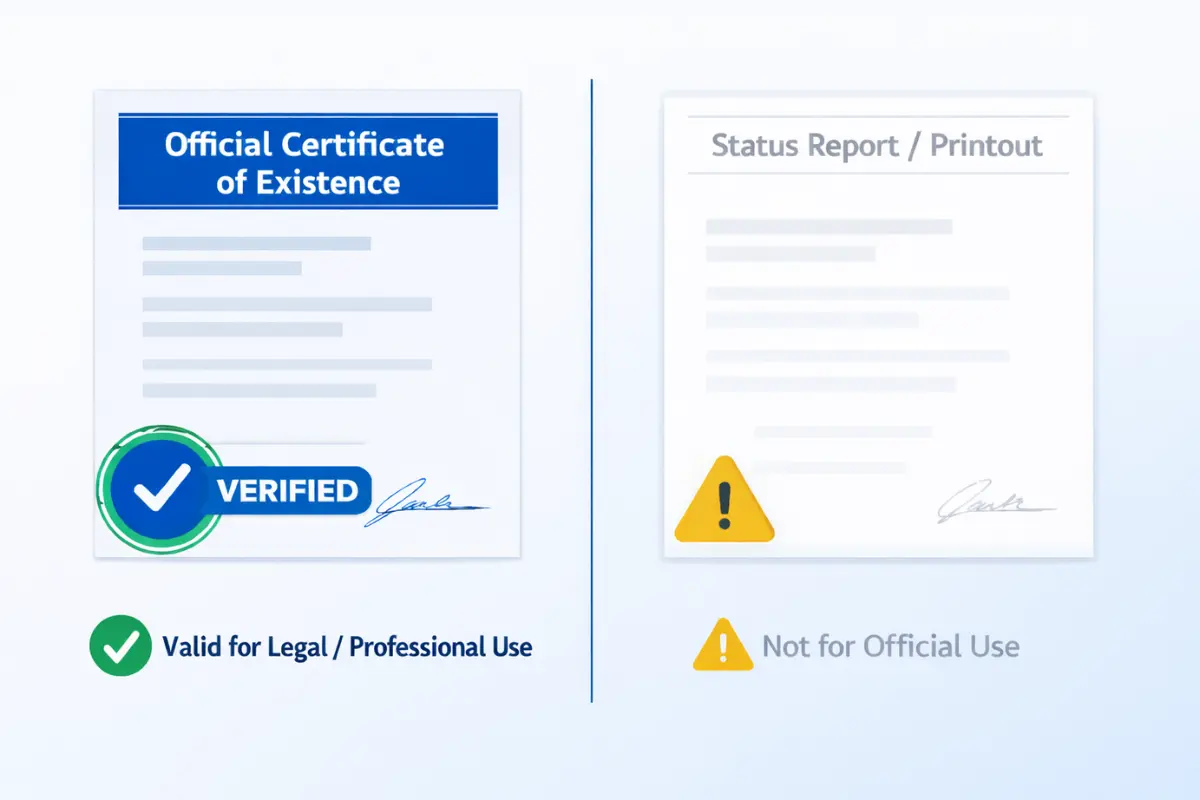
There is a distinction between formal, certified certificates of good standing and simple "status search" or printouts from state websites. Most professional or legal institutions require official, stamped, or digitally verified versions to accept them as valid proof. Business status verification standards vary among requesting parties.
Status searches prove helpful for internal monitoring but generally do not carry the same legal weight as formal certificates. Free online status checks allow businesses to verify standing before ordering paid certificates. This preliminary verification prevents ordering certificates when standing issues exist that must be resolved first.
Digital certificates with state seals and verification codes increasingly replace paper certificates. Most states now accept digitally certified documents, though some international transactions may require additional authentication, like apostilles. Digital delivery reduces processing times and shipping costs while maintaining legal validity.
Role of the Registered Agent in Maintaining Status
Registered agents serve as official points of contact for receiving state notices that could affect entities' standing. Timely receipt of these notices helps entities address potential compliance issues before they result in loss of good standing. While registered agents receive notices, entities remain responsible for taking necessary actions to remain compliant.
Missed notices due to invalid registered agent information represent a common cause of inadvertent compliance lapses. When entities move offices or change registered agents without proper state notification, subsequent compliance notices go undelivered. These missed notices result in administrative dissolution and ineligibility for a certificate.
Professional registered agent services maintain stable addresses and reliable notice acceptance regardless of entity location changes. This continuity ensures compliance notices reach appropriate parties promptly. Entity management systems often integrate registered agent services with compliance tracking.
Impact of Entity Type on Certificate Requirements
While processes are similar across most business structures, specific terminology or requirements may vary by entity type. LLC certificate of existence requests follow similar procedures to corporate good-standing certificate requests, though some states use different forms or fee structures.
Corporations and LLCs are the most common entities that require these certificates for commercial transactions. Partnerships and sole proprietorships typically face different documentation requirements depending on state registration rules. Statement of Information filings in some states serve similar verification purposes for different entity types.
Business owners often work with professional services to navigate specific nuances of their entity types' state requirements. Multi-state operations particularly benefit from professional assistance in managing certificate requests across various jurisdictions with different procedures and terminology.
Maintaining Compliance to Ensure Future Availability
The ability to obtain a Certificate of Existence depends on ongoing compliance with state-level administrative obligations. Consistent tracking of annual report deadlines and franchise tax payments helps ensure certificates are available whenever needed. Maintaining a state business compliance recordprevents eligibility issues.
Proactive management of routine tasks reduces the risk of operational delays during important business moments. Calendar systems, compliance software, and professional services help businesses track multiple jurisdiction requirements, preventing inadvertent lapses. Missing a single deadline can take months to remediate through reinstatement processes.
Business licenses and permits often have renewal requirements tied to good standing status. Entities without current certificates may face license suspension or denial of renewal, in addition to other transactional obstacles. Comprehensive compliance management addresses all interconnected requirements, maintaining operational authority.
Utilizing Professional Filing Services for Efficiency
Business owners can obtain these certificates directly from the states, though many prefer professional support to save time. Service providers like InCorp can help streamline request processes, especially for businesses operating in multiple jurisdictions. Professional assistance is particularly valuable when certificates are needed urgently or involve unfamiliar state procedures.
Utilizing professional support helps avoid administrative errors and ensures entities receive correct documentation promptly. Common errors include requesting certificates for the wrong entity names, using outdated identification numbers, or ordering from the wrong states for multi-state operations. Professional services familiar with state-specific requirements prevent such mistakes.
Bulk certificate requests for multi-state operations benefit significantly from professional coordination. Managing simultaneous requests across ten or more states requires specialized knowledge of each jurisdiction's procedures, fees, and timelines. Centralized professional services provide consistency and efficiency unavailable through direct state interactions.
Leveraging Technology for Compliance Monitoring
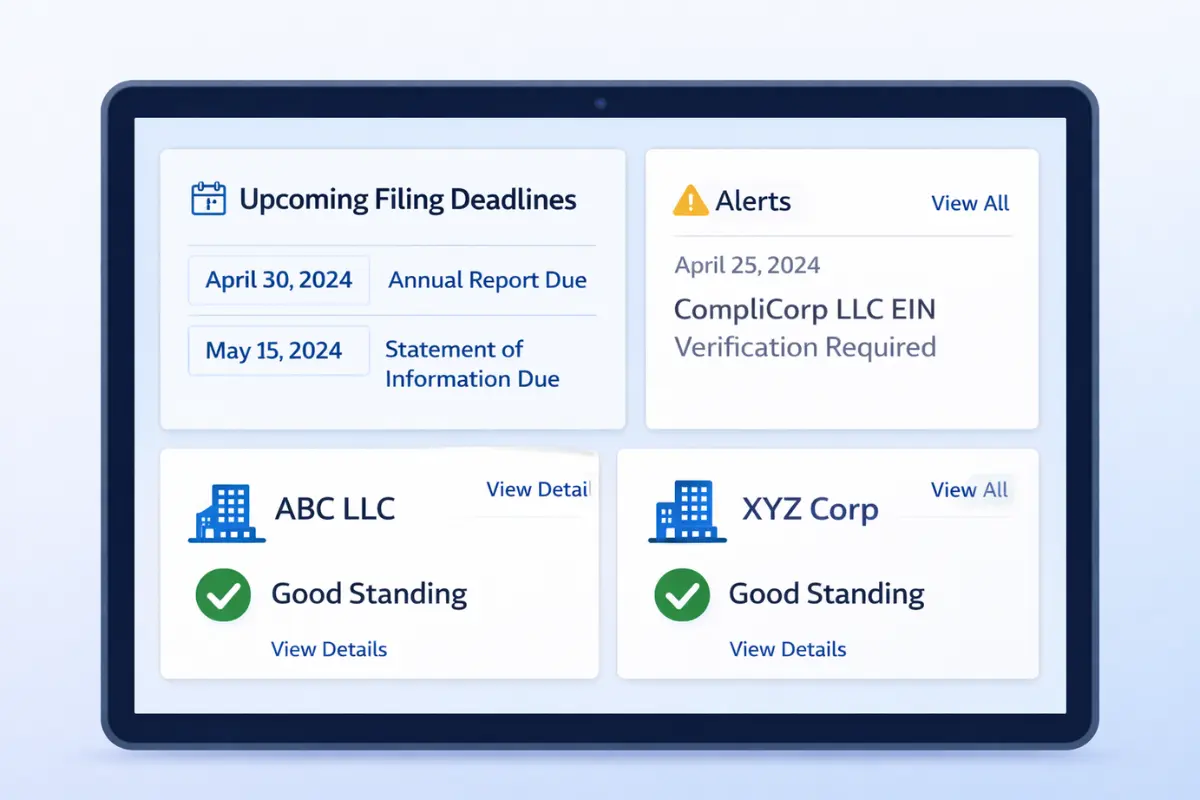
Digital tools help businesses monitor the current status of states in real-time. Systems like InCorp's EntityWatch® provide alerts for upcoming deadlines, helping entities maintain the status required for certificate issuance. Technology cannot replace entities' compliance responsibilities, but significantly enhances organizational capabilities.
Automated monitoring reduces human error in deadline tracking across multiple entities and jurisdictions. Manual calendar systems prove inadequate for businesses managing numerous entities in various states with different requirement schedules. Automated systems ensure no deadlines slip through organizational cracks.
Integration between monitoring tools and registered agent services creates comprehensive compliance ecosystems. When notices arrive at registered agent offices, automated systems log receipt dates and calculate response deadlines. These integrated approaches provide maximum protection against inadvertent compliance failures.
Get the Right Certificate When Your Business Needs It Most
A Certificate of Existence is necessary documentation that demonstrates an entity's professional standing and legal authority. Federal and state requirements mandate this verification in numerous business scenarios, from banking to expansion. Maintaining eligibility through consistent compliance ensures the certificate is available when opportunities arise.
InCorp's Certificate of Good Standing services help obtain documentation efficiently across any U.S. jurisdiction. Professional assistance navigates varying state procedures, terminology, and requirements, preventing delays and errors. Contact InCorp to explore how certificate services support business operations.
InCorp's Entity Management System with EntityWatch® helps monitor filing deadlines and maintain active status, ensuring business continuity. Automated compliance tracking combined with professional registered agent services provides comprehensive protection. This integrated approach helps ensure entities remain continuously eligible for certificate issuance, supporting operational flexibility.
FAQ's
How long is a Certificate of Existence usually valid?
Most third parties accept certificates issued within the last 30 to 90 days, depending on their internal requirements. Banks typically require certificates less than 60 days old, while foreign qualification applications may accept certificates up to six months old in some states.
Can a Certificate of Existence be ordered for inactive entities?
No. If the entity is inactive or dissolved, the state will not issue the certificate until the status is restored. Reinstatement requires filing all overdue documents and paying accumulated fees and penalties before certificate eligibility is restored.
Is a digital certificate legally acceptable?
In most states, yes. Digitally certified documents are commonly accepted by banks and agencies. Digital certificates include state verification codes and seals that establish authenticity, equivalent to paper certificates with raised seals.
Can a Certificate of Existence be used internationally?
Sometimes. Foreign institutions may require additional authentication, such as an apostille. Apostilles are official certifications from designated state authorities that confirm the authenticity of documents for international use under the Hague Convention.
Do I need a Certificate of Existence for every major financial transaction?
Not every financial transaction requires a Certificate of Existence, but many banks, lenders, and investors ask for one when you apply for financing, open new business accounts, or enter significant contracts. The certificate reassures them that your business entity is active, in good standing, and authorized to conduct business as of the date issued.
What is the difference between a short form and a long form certificate?
A short form certificate of existence (or certificate of good standing) typically confirms only the entity's name, type, and current status. A long form certificate may include additional information such as incorporation or formation date, amendments to the articles, and sometimes a summary of filings on record with the state's office.
Can I obtain a Certificate of Existence if my company is behind on annual reports or fees?
Generally, no. Most states will not issue a Certificate of Existence if the organization is not in good standing, which usually means all required annual reports are filed and fees, taxes, and other compliance requirements are up to date. Your first step is to address those compliance issues before requesting the document.
How do I request a Certificate of Existence from my state?
In most states, you can request a Certificate of Existence online through the Secretary of State's website or business filing portal, though mail and in‑person options are often available. You usually need your business name, entity ID number, and a valid payment method for the applicable fees, and then you select standard or expedited services depending on how quickly you need processing.
Is a Certificate of Existence required for foreign qualification?
Yes, foreign qualification applications commonly require a recent Certificate of Existence or certificate of good standing from your home state as proof that your LLC, corporation, or partnership is active and compliant. The receiving state may also specify how recent the certificate must be and whether a short form is sufficient or a long form certificate is required.
Disclaimer: This content is intended for general educational and informational purposes only and does not constitute legal, tax, or accounting advice. Every effort is made to keep the information current and accurate; however, laws, regulations, and guidance can change, and no representation or warranty is given that the content is complete, up to date, or suitable for any particular situation. You should not rely on this material as a substitute for advice from a qualified professional who can consider your specific facts and objectives before you make decisions or take action.
Share This Article:
Stay in the know!
Join our newsletter for special offers.